
THE AUTOBIOGRAPHY OF A SCHOOLBOY
A MEMOIR BY THOMAS TOMKINS, XV
Presented here with his kind permission is Chapter Fifteen of the hitherto unpublished memoir of his youth of a retired English publisher written under the pen name Thomas Tomkins and finished in 2026.
[Return to the beginning of this memoir]
Chapter Fifteen
And so in September I "came into residence" at my College in Cambridge. As a general rule, undergraduates resided in College for their first year, and in lodgings in their second and subsequent years. My "rooms" - actually a very modest and inconvenient bed-sitter - were on the first floor; I had access to a tiny kitchen, though I was expected to take at least most of my meals in Hall. Since the cost of these was covered by my Scholarship I made a habit of doing so.
To my delight, at least initially, my Tutor was to be a distinguished Classical scholar whose books I had read with great enjoyment. But he was a better writer than teacher. His lectures were spoiled by a habit of turning away from the hall and mumbling, and in tutorials - carried out normally with two or three students - he had a habit of rambling irrelevantly. However, if pinned down to a subject he was a mine of information and we did not fail to take advantage of it.
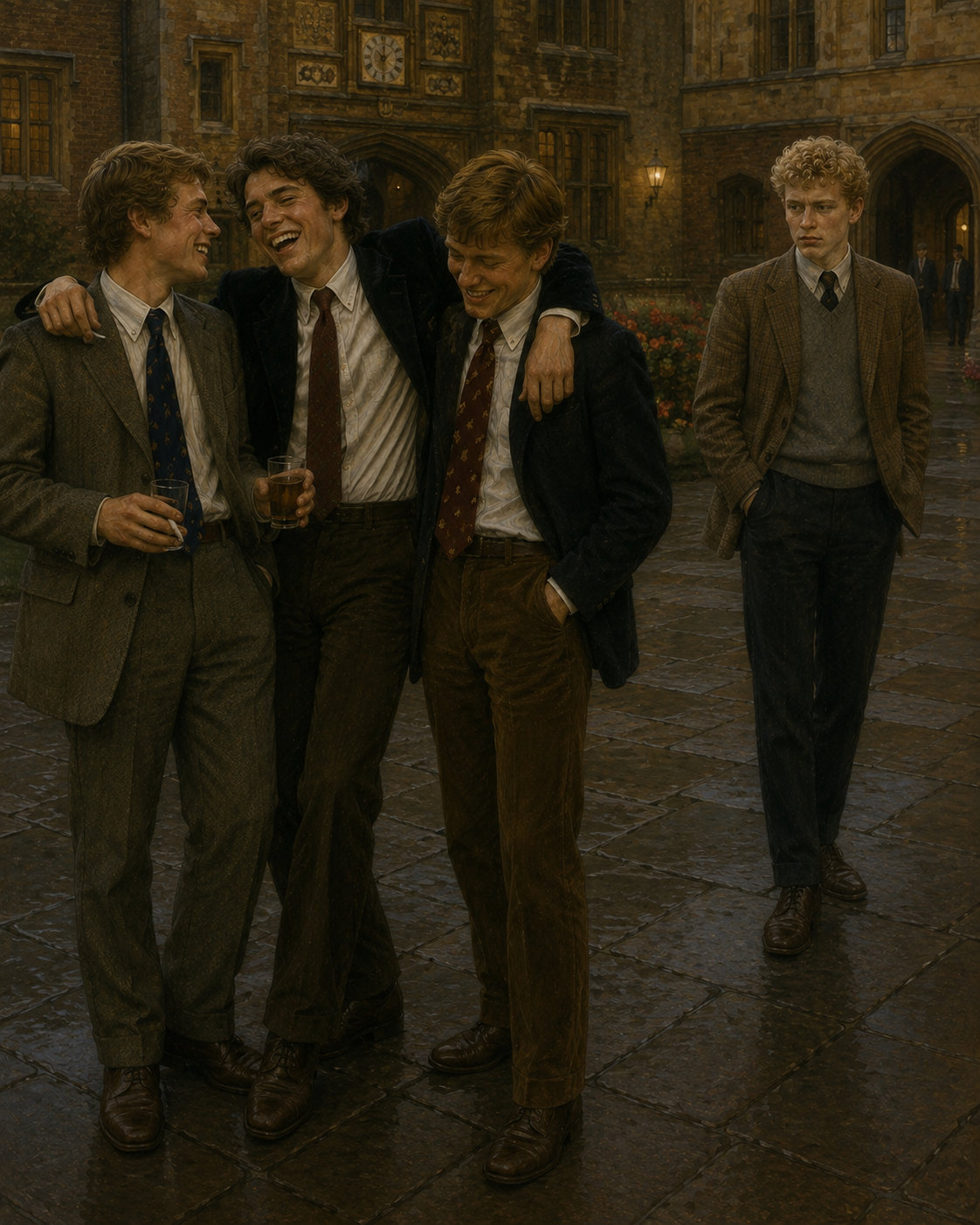
The worm in the academic apple of the University was the undergraduates, mostly from the upper or wealthy classes (the two categories are not the same, though they sometimes overlap) who were there for social reasons and had no intention of doing more than the bare minimum of work needed for a pass degree. They were rowdy, drank heavily and were apt to cause trouble out of all proportion to their numbers. On two occasions during that first year I returned to my modest room to find it in chaos, having been raided by a gang of these nuisances.
Homosexuality was there, if not widespread or immediately obvious. By now, sex in private between consenting men over the age of twenty-one was no longer illegal, and at least one of the dons was living openly with his male lover. I was young and good-looking enough to attract a certain amount of attention. My Public School experiences had made it easy for me to recognize the signs of someone finding me attractive, and I made the acquaintance of an undergraduate at another College who made no secret of his desire to sleep with me. I say I made his acquaintance, but in reality he claimed my attention on numerous occasions, until I eventually gave way to him. Blackridge, for that was his name, was keen that I should go to his rooms “to take tea”. I was fully aware that while tea, and even food, might be proffered, it would be only as a prelude to the main dish, and I was quite intrigued to know what that might be.
Accordingly, I made my way to his College and enquired at the Lodge where his rooms were. The porter gave me the necessary directions and, as he retreated into his inner sanctum, I overheard him say “... another one for Blackridge ... no stopping him...”
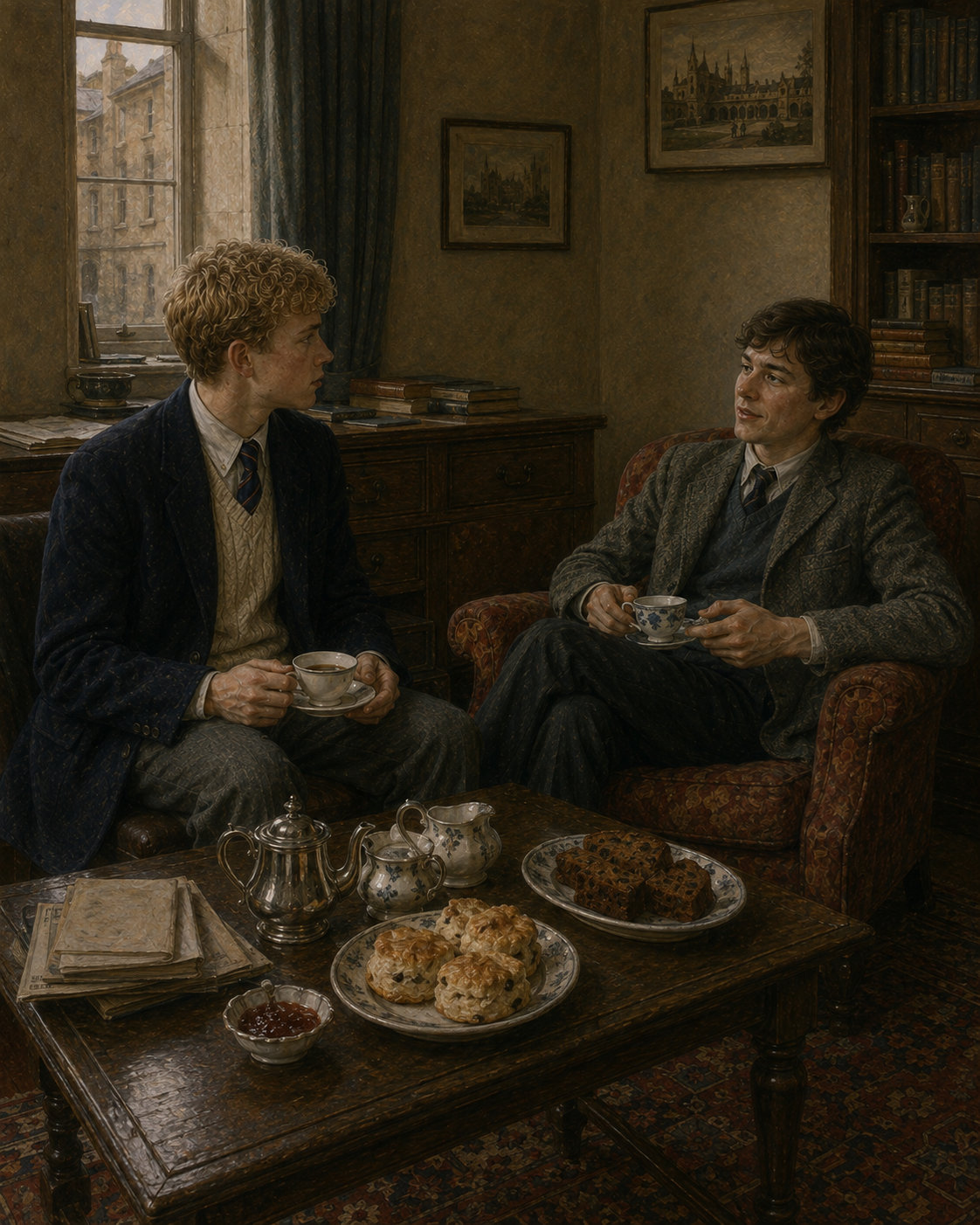
I will say for Blackridge that he did give me not only tea but scones and excellent plum cake before approaching his purpose. When he had shut the outer door to his rooms, we went through to his bedroom and removed our clothes. He was not a bad-looking young man, darker in colouring than I was, and not as tall, but neat and compact in appearance. He suggested that he should bugger me. This was one sexual act of which I had had, up to then, no experience, and his penis, already half erect, did not seem excessive in size, so I agreed. I knelt over a chair while he anointed me with Vaseline and then entered me. It was not positively painful but it was uncomfortable; I was slightly nervous which probably did not help. The main sensation I experienced was that of needing to defecate. My penis remained obstinately soft and I cannot claim that I had any sexual arousal at all from the passive act.
My companion, however, was becoming ever more excited and breathless, and with a few vigorous thrusts he brought himself to orgasm. I was intrigued to notice that I could quite clearly feel his ejaculation inside me. This, of course, was long before the AIDS epidemic began and it was not usual for men performing sex acts with other men to wear a condom; these were generally regarded as being for contraceptive purposes only.
His climax reached, Blackridge withdrew his now softening penis from my arse, leaving it feeling stretched and a little sore, but not otherwise damaged. I was probably lucky in Blackridge, in that he was both modestly proportioned and fairly gentle. I have heard of other young men needing medical aid after being buggered by larger, and rougher, men.
We agreed to meet at the same time next week, and parted. I was relieved to find that the next morning when I performed my daily bowel movement no difficulty or discomfort were experienced. But I was glad to notice that now he had, so to speak, got what he wanted, Blackridge ceased his importunities.
The following week I went to Blackridge’s rooms and suggested that this time I should bugger him. He agreed, with a little reluctance. I had taken the precaution of taking a little cold cream with me, obtained from the College Infirmarian on the pretence of a minor rash in an unmentionable place.
Recalling my experiences at school with dear old Tonks, I had no difficulty in achieving a creditable erection and operating upon Blackridge as he had upon me. I was interested to note that he, too, became erect and close to orgasm, though a little rubbing of his penis was necessary before he actually climaxed. While penetrating his arse I felt round for his penis and became aware that his foreskin was quite tight and did not retract fully as had those of other boys. I later discovered this to be a condition known as phimosis and to be not uncommon. However, most boys with the condition seem to be treated by the rather radical method of circumcision, which does seem to me to be taking a sledgehammer to crack a nut.
But to return to Blackridge, when he climaxed I saw that he ejaculated a huge volume of semen, far greater than anyone else I had observed, and at considerable pressure, such that the first two or three spurts flew across the room and hit the wall. A damp cloth was hastily procured to remove the evidence before it dried and remained there to shock his “bedder”.
(I should explain in parenthesis that the term “bedder”, short for “bedmaker” is the term used in Cambridge for a college servant; the equivalent term at Oxford is “Scout”.)
Blackridge and I continued for some weeks to meet in his room and more or less “take turns” in buggering one another. But after a few more meetings he found a more complaisant paramour and I was dismissed. I cannot say that this moved me greatly to either joy or sorrow. By the time I had arrived in Cambridge there were a good many women undergraduates at colleges such as Girton and Newnham.
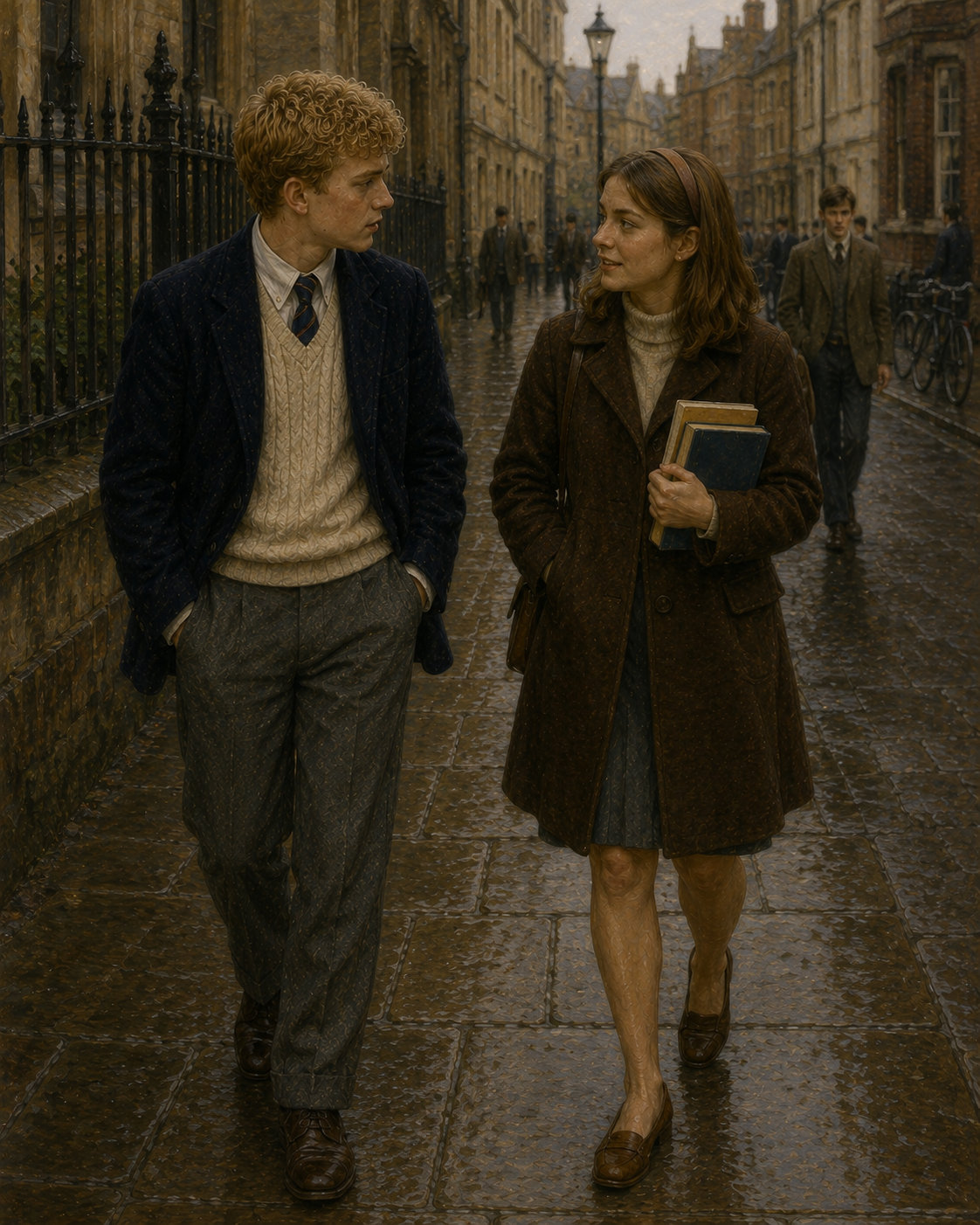
For a term or so I enjoyed a friendship with a girl named Heather Walton, an English student from Newnham College. She was from a similar background to mine; her father was a doctor and, like me, she was an avid reader. Also, like me, she held a Scholarship, though this was a minor award as her father was well able to pay the fees. Heather and I did not engage in any sexual activity beyond a friendly kiss on meeting and parting. She was happy to have an undemanding young man to take her about and to fend off other young men, but, again like me, her mind was on her work and she had no intention of falling in love and coming away with an inferior degree.
In the early 1970s the teaching at Cambridge was fairly haphazard. Some tutors were thoroughly conscientious, others regarded teaching as an annoying interruption to their research or other interests. Lecturers fell into one of three categories: those who enjoyed showing off, those who were undramatic but clear and reliable, and those who were dull, inaudible or both. There was also a considerable section of the University, both Juniors and Seniors, that was politically active, with politics ranging from just left of centre to outright communism.
It was fortunate for me that I had, through the years of my childhood and youth, learned to be self-reliant and, at Flamborough at any rate, acquired the habit of self-discipline. I continued to mind my book, insisting that my Tutor give useful correction to my essays and frequenting the lectures of those dons who could be relied upon to be both audible and relevant.
I still kept up correspondence with Allan, though with a little less frequency. On average, I think, I wrote once a fortnight. The Library of my College proved to be a useful place to work; my room was not really suitable as the noise made by rowdy undergraduates to either side of me inhibited concentration. I did on one occasion complain about this to the Master of the College, but received a bland and unsatisfactory response of the “boys will be boys” variety. I looked forward to my second year, when I should be permitted to reside in lodgings and would be free of these annoyances.
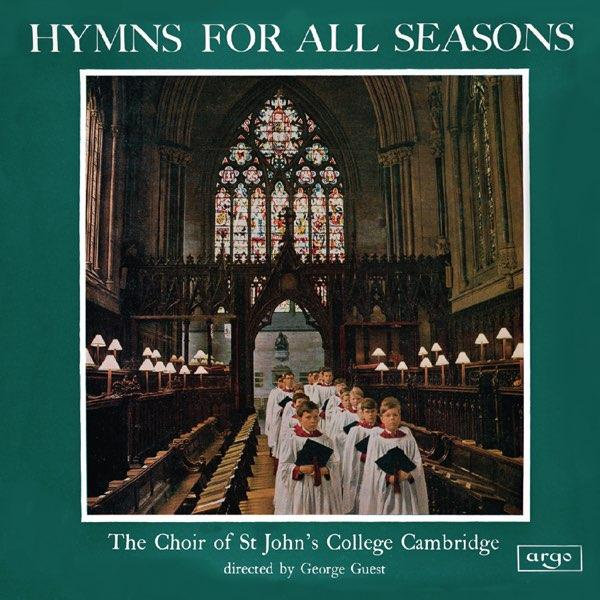
My College had a fine Chapel, and a small but competent Choir drawn from the student body. We did not, like King’s or St John’s, have daily choral services, but I always enjoyed going to hear Evensong on Wednesday and Sunday afternoons. I did from time to time also go to hear Evensong at St John’s, which had – and I believe still has – a choir of international reputation. Of still greater pleasure, though, was the College Concerts which took place weekly on Thursday evenings in the Chapel. These were usually of chamber music and introduced me to a whole new world of enjoyment. Heather was often my companion at these concerts. Though a forthright atheist she had a liking for choral singing, and her knowledge of chamber music was considerable.
Allan was delighted that I was enjoying music; he was himself no inconsiderable performer. We kept in touch as always by letter, never writing anything compromising for fear that a letter might go astray and be read by someone else, though we both delighted in putting in subtle hints such as 'quotations' from wholly imaginary authors and phrases which had personal significance to us both but would have an entirely commonplace meaning to anyone else.
I soon found that learning in the University setting was very different from anything I had experienced at school. During my final year at Flamborough one or two of the masters had given me some idea about this, and one in particular had realised that I did not require continual attention to produce good work, so I was not wholly unprepared, but nevertheless it was a new experience needing a new approach. I had, thank goodness, become accustomed to maintaining a reasonable level of work without supervision, and to seeking knowledge when necessary either from masters or from reference books, so it was, perhaps, less of a change for me than for many of my fellow-undergraduates. I tended to work in one of the Libraries – College or University – as they tended to be quieter than my room in College, since silence was generally enforced by the staff.
On the whole, I kept myself to myself. I probably gained something of a reputation for stand-offishness; if so, I was not unduly concerned. I disliked noise and confusion, drank very moderately and did not smoke. There was a small group of my fellow-students with whom I became moderately friendly, but my attitude to life at that time was curiously ambiguous. I liked the City of Cambridge, architecturally very varied (someone, I forget who, once averred that St John’s College had “a Queen Anne front and a Mary-Anne back”). I was very happy to explore its museums, churches and other places of interest. There were many opportunities to hear good music, though the “pop revolution” was by then in full swing and it could be difficult to avoid the stuff blaring from windows.
I had soon worked out which dons’ lectures were worth attending and who best to approach for instruction. But I found the condescending attitude of many members of the University to “the Town” quite repellent, the surly manners of many of the locals (though I had to admit that this could be due at least in part to the attitude of many members of the University to them) very tiresome and the rowdiness of the sillier, and larger, section of the undergraduates irritating in the extreme.They had been released from the firm discipline of their schools and responded by behaving in a thoroughly childish and undisciplined way. On the whole, the behaviour of boys from state schools was less unruly than those from Public Schools, though there were exceptions.
Some of my work was no more than going over old ground, though sometimes with a new slant on it. Some, of course, was just slog that had to be done. But there was enough of excitement in the new work to keep me enthusiastic. During the Easter holiday I had the opportunity to visit some archaeological excavations of the Roman site near Chichester; what I saw there fascinated me and, like so many museum visits, broadened my understanding of my subject.
Examinations came and went; I did well enough to be reassuring but not so well as to risk becoming complacent. The Summer showed Cambridge at its best, though the tourists crowding the City and even coming into College were a nuisance.
I spent some of the Summer vacation at home, though by now I was not expected to help with the business. I was surprised to see that, now that she had a reliable housekeeper to look after the paying guests, my mother had at last made a determined effort to keep the books straight. One of the oddities of my visits to the London house was that I seldom had the same room; I slept in whatever bedroom happened to be vacant. If no room was available there was a tiny room at the top of the house, but if this were the only option I preferred to stay with Allan at his cottage. On one of these occasions Allan was not there, but he had made it clear that I was nevertheless welcome to use the house.
I also returned to College for a week during the Long Vacation; I needed to catch up with some work and it was convenient to be able to use the College library. I slept in College, but for some reason was never charged.
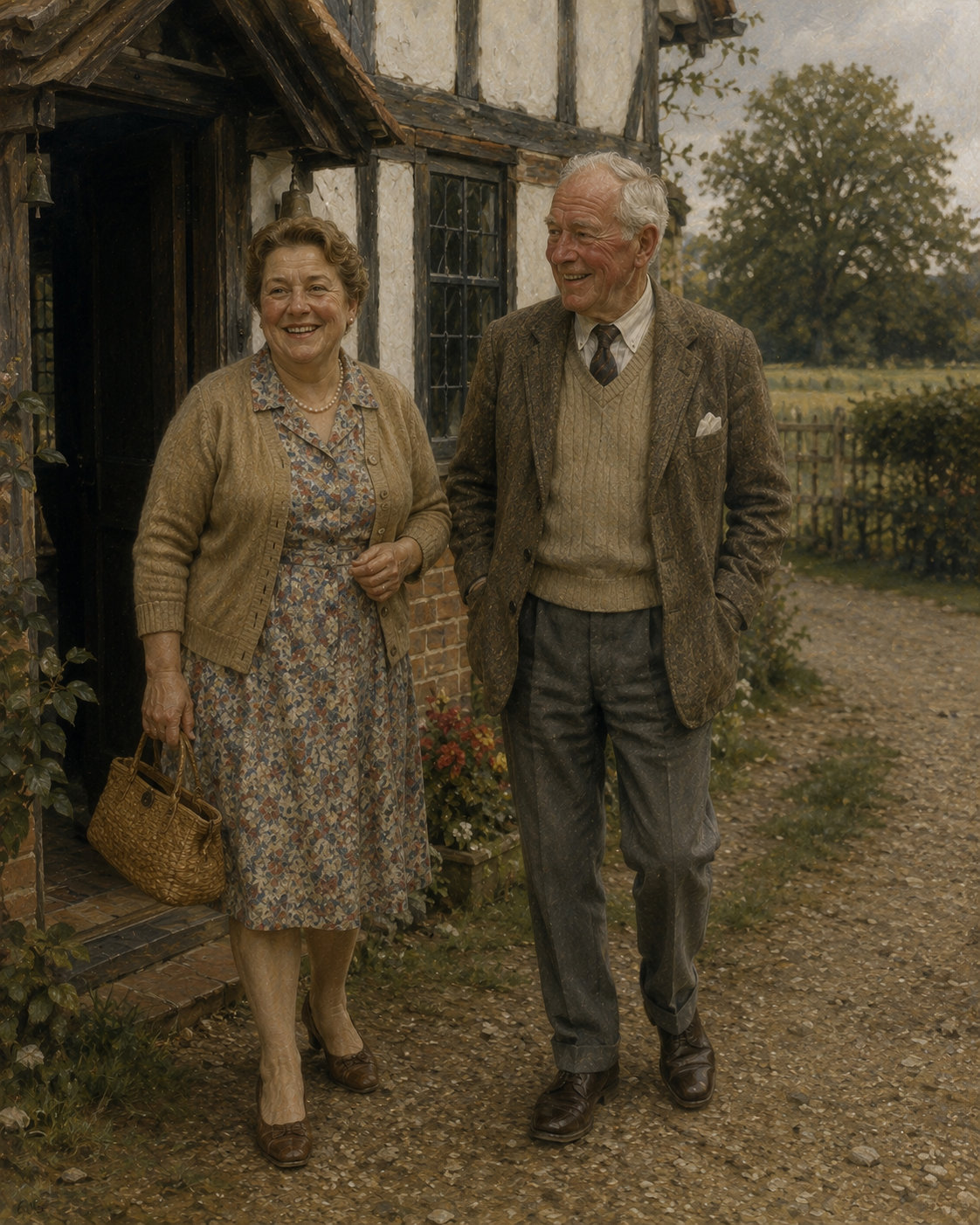
Returning after the Long Vacation, I was expected to find lodgings. I had used part of my week’s stay during the Vacation to scout around and find a place to stay. I ended up with a couple, Mr and Mrs Huckle, who had a delightful mock-Tudor villa out towards Trumpington. They were dear, kind people and looked after me devotedly. Mrs Huckle was plump and motherly and a superb cook. If I had allowed her to give me as much as she would have liked I would have become positively rotund. Mr Huckle was a good deal older; a little, wrinkled, white-haired, red-faced man in his sixties, speaking with a pure Cambridgeshire dialect. He had served for many years in the Merchant Navy and had an endless fund of seaman’s tales. I enjoyed his company immensely. My bedroom was on the first floor at the back of the house. It was large and comfortably furnished; the Huckles were used to having undergraduates as lodgers and my room was provided with a large table and chair at which to work. I spent many an hour there; it was always quiet and if I were there for any length of time during the day Mrs Huckle would keep me supplied with tea or home made lemonade, sandwiches and cake.
Though I did not smoke, Mr Huckle occasionally used to ask me to buy some tobacco for him at a particular tobacconist in order to save him having to go into the City. This was not far from College so it was no burden to me to do so. On one particular day I called at the shop and was served by a girl who I thought the most beautiful young lady I had ever seen. I think so still.
Prompted by goodness only knows what impulse, for I was quite a diffident youth, especially where girls were concerned, I invited her to come out with me. To my immense surprise and gratification, she accepted immediately, and that very evening we went together to the Green Man at Trumpington.
Debbie – her names were actually June Deborah, but she disliked her first name – was of medium height, slim with quite a boyish figure, dancing hazel eyes and the most beautiful complexion. She never wore make-up and generally dressed in jeans and an open-necked blouse, with a pullover in colder weather. Our friendship prospered and it was not long before I realised that I was deeply in love with her.
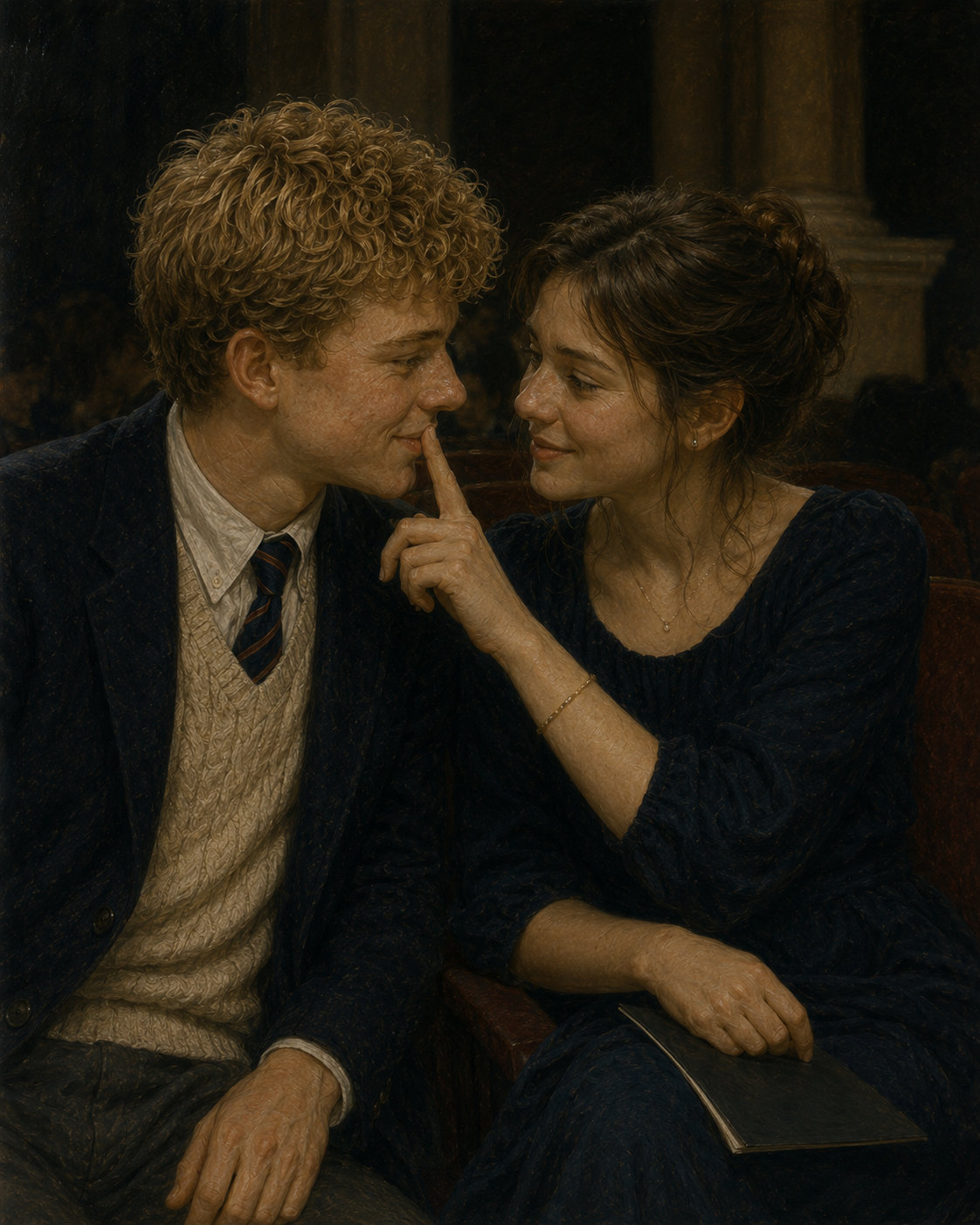
Dear Debbie! She was aware, long before I was, of my feelings for her, but although she was happy to spend time with me, she would not allow me to neglect my work. But we often found time to go out, and Debbie shared enough of my musical tastes for us to enjoy concerts together. But her musical passion was for the Savoy Operas. The D’Oyly Carte company used to come to Cambridge every year, and that Autumn they did a week’s season. We went to every performance. On the Saturday evening the final performance was H. M. S. Pinafore, and during the Act I finale I turned to Debbie and whispered “Will you marry me?” She turned to me and smiled, placing a finger on her lips. As the applause began, she replied, “When you have got your First”.
We were all very moral in those days. I bought Debbie an engagement ring, a modest affair as neither of us was well off. Today’s young people would not believe that we did not sleep together until we were married. But her encouragement sent me back to my studies with a resolute determination to earn a First Class Honours degree. Debbie continued to work in the tobacconist’s shop for some months, after which she took a post in, of all places, Marks and Spencer’s, in the ladies’ clothes department.
We met on four evenings each week: she insisted that I work on the other evenings. Occasionally we went to a concert, sometimes to the Green Man or another quiet pub, sometimes we would join the Huckles in their pleasant, comfortable sitting room. The Huckles took to Debbie immediately and made her as welcome as they had me. We planned to marry more or less as soon as I had graduated – undergraduates were sternly discouraged from matrimony – and then set up house together. What we were to do for money I don’t think we ever talked about; we just assumed that a young man with a good degree from Cambridge would have no difficulty in finding a well-paid job.
On the nights we went out, I would see Debbie home. She lived with her parents in a modest terraced house and if our 'goodnights' took a little time, no-one seemed to be concerned about it. I had, of course, to face the inevitable interview with her father. I regarded this with far greater trepidation than I had ever regarded any examination. At any rate, I passed muster. I found out later that her parents had visited the Huckles in order to find out what sort of chap I was. Fortunately they were able to give me a good chit.
It is difficult to write anything much about the two years during which Debbie and I were engaged. I worked hard, but with the vision of Debbie always encouraging me. One scene does come back to me: I took her to meet my mother. Fortunately I had arranged just a daytime visit; the housekeeper, Mrs Rogers, had provided a good afternoon tea and I introduced Debbie to my mother. She was as cold as ever, but unbent sufficiently to tell Debbie how proud she was of me, and dwelling upon my time at Public School.
The next time I saw my mother, she informed me flatly that “You are not going to marry that shop-girl”.
“That’s just where you are wrong, Mother”, I replied; “I am going to marry Debbie come what may”.
“In that case,” she replied, “You can give up any idea of inheriting anything from me.”
Well, of course that was that. Nothing in the world, certainly not my mother’s strictures, would have prevented me from marrying the woman of my dreams. I did not see my mother for quite some time after that. I sent her an invitation to the wedding – which she did not answer – and called on two occasions, on both of which she insisted that I was not to marry “that common child”. I had learned, early on, the futility of arguing with her and just insisted upon my right to marry whom I chose.
But of course I took Debbie to visit Allan. How not, when they were the two people I loved the most in the world? He was enchanted by her and congratulated me heartily. I introduced him to her as the schoolmaster who had given me a grounding in the Classics and had become as much a friend as a teacher. That Debbie saw through this facade I have no doubt; she was as astute a judge of character as ever lived. But she gave no sign of disapproval, even much later on when Allan became Godfather to our eldest son.
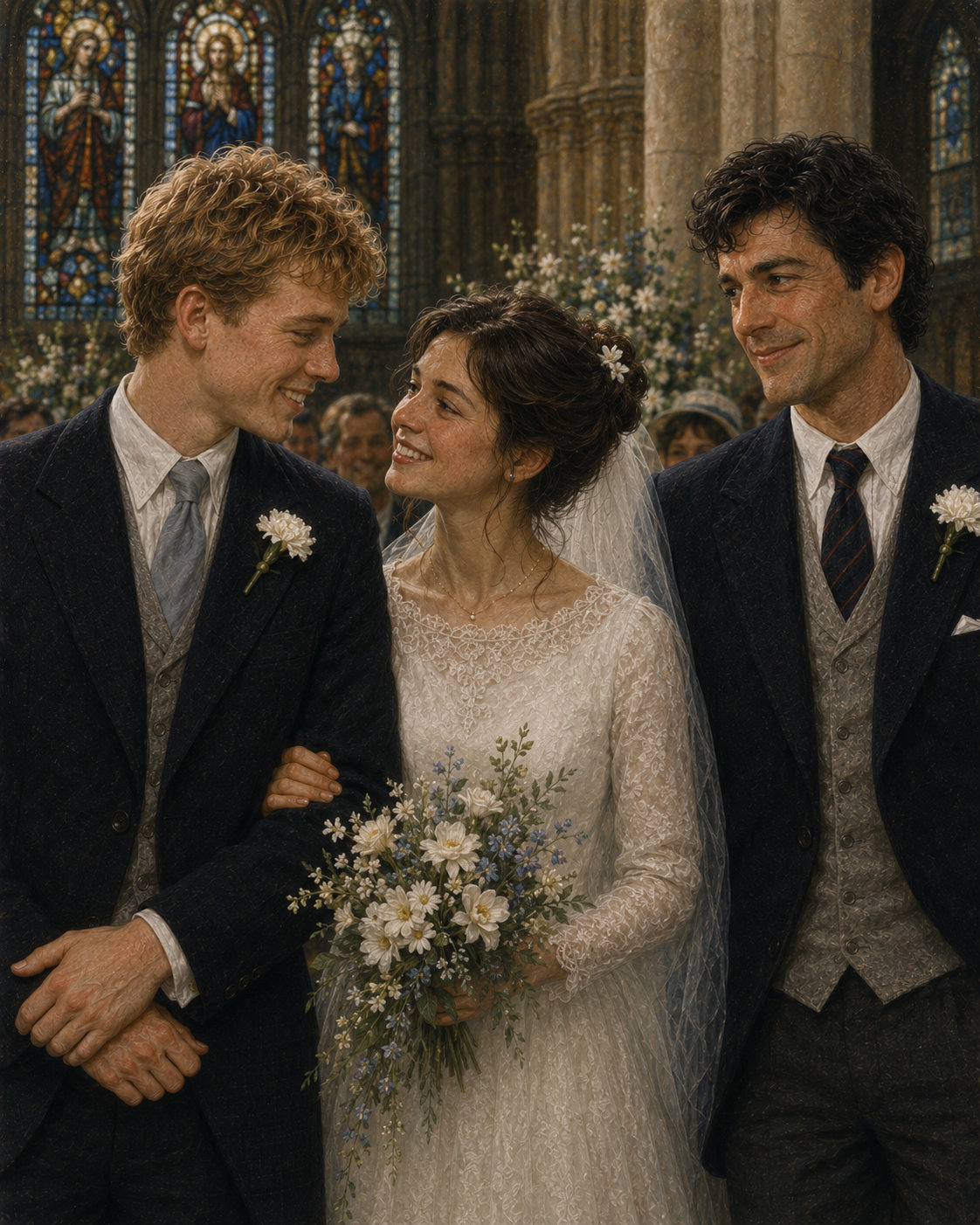
But my tale is soon told. With Debbie’s encouragement and support I did indeed gain a First Class Honours degree. Casting about me for a suitable career I entered the world of Publishing, first as a Reader for a publisher of academic works, then a Reader, later a Director, of a large London publishing house. Debbie and I married shortly after my graduation; Allan, of course, was my Best Man. I sent an invitation to my mother, together with a letter expressing my hope that she would come, but she did not even reply. I never saw or heard from her again.
When we first moved to London we rented a tiny mews flat. Very suddenly and unexpectedly, my mother died the following year. It was Mrs Rogers who told the authorities that my mother had a son; characteristically, she had not made a Will. The process of administration of her estate was, of course, prolonged and tedious, but in the end I inherited the house.
For some time Debbie and I hesitated about what to do with the house. In the end it was Debbie’s idea that we should move there, refurbish it and then see how we felt.
Allan visited from time to time and was of great help with getting the garden sorted out. Like everyone else, he fell under Debbie’s spell.
I could not have believed the difference that Debbie made to that tall, dingy house. Room by room it was brightened, modernized and made to feel loved. Mrs Rogers had nowhere else to go, so we let her have a bedroom and sitting room on the top floor in return for some help with the house.
Our two sons were born and brought up there. I was lucky enough to have landed a good post and earned a generous salary. In addition, after Mrs Rogers had left to go to another housekeeper's job, we converted the top floor of the house into a self-contained flat which we let. When the time came, the boys both went to St Mark’s with minor scholarships; by that time Allan had become Second Master. Both of them also gained Scholarships to Public Schools, though we chose schools nearer to home than Flamborough.
Allan frequently came to stay with us during the school holidays, though not when my sons were at St Mark’s; this would have undermined his discipline and neither he nor the boys wished to mix up Home and School.
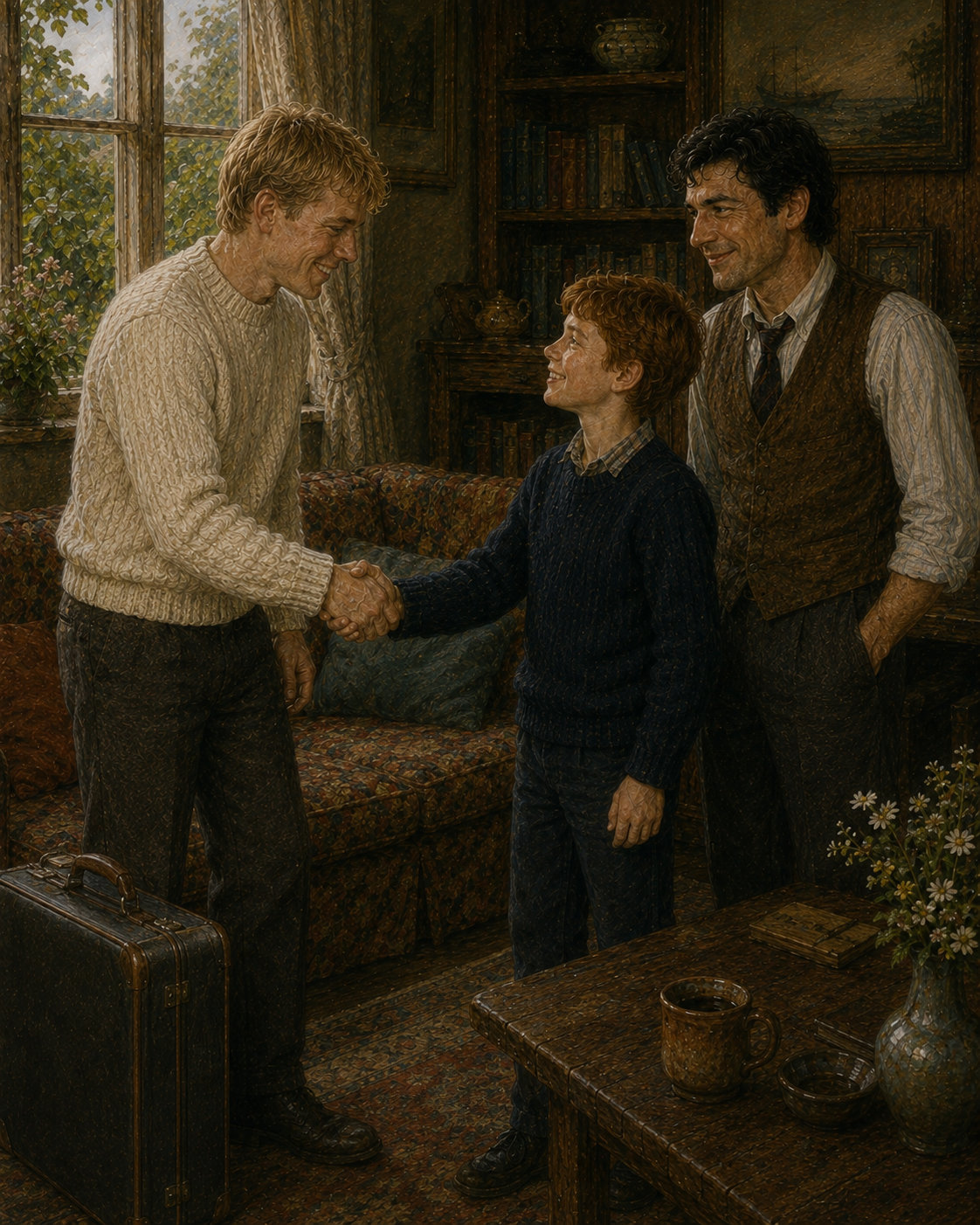
During this period I again visited Allan at his cottage; work had taken me back to Cambridge, where I stayed overnight with Debbie’s parents, and then on to a printing works in Norwich where much of our output was produced. Sorting out some problems there took several days. I stayed with Allan and his new (and I think last) 'young friend'. This was a red-haired Scottish boy called Kevin. He had a cheeky smile but a most affectionate nature. I was glad for Allan. He was attracted to young boys; but by its very nature this attraction can never last long and boy-lovers can become very lonely. I was glad, too, that I was in contact with Allan as although I would now never have contemplated any relationship with him other than a warm and generous friendship, at least he would always have me to turn to.
Then, when I was in my fifties, tragedy struck. Allan died, very suddenly, following a short illness. He had cancer, which had spread silently but unstoppably. I visited him in hospital and was horrified by his appearance. He had never been overweight but now he was gaunt, yellowish skin stretched tightly over bones. I had not shed a tear when my mother or father died, but at Allan’s death I was desolated. I remember still the night when Debbie held me in her arms as I wept with unbearable grief at the loss of my dearest friend and mentor. If Debbie had not realised before how much Allan meant to me, she realised it then. Had she surmised how close we had been when I was a boy? I had never told her, but she was shrewd enough to have guessed, and accepted that it had been a good and nourishing part of my growing up.
We hear so much nowadays about “child abuse”. No doubt there are relationships between adults and children that are abusive, but these are not about love or even lust, they are about power. The relationship between Allan and me in my boyhood was one of genuine love, freely given on both sides, and though the erotic element in our relationship faded as I grew towards manhood, the love which lay behind it matured and deepened with the years.
Two months after Allan’s death, I had a letter from a solicitor, Mr Cranborne of Bury St Edmunds. It informed me that “our late client, Mr Allan Charles Pascoe” had left his cottage to me, and invited me to come to their office to collect the necessary documentation and the keys. It also inquired whether I knew the whereabouts of “another beneficiary under Mr Pascoe’s Will, Mr Edwin Gulliver”. I suggested that they try Shrewsbury School; I remembered Allan having told me that Edwin had gone on to there.
I telephoned the solicitors and made an appointment for the following week. When I arrived they told me that they had managed to contact Edwin, who remembered me and sent his regards. I picked up the papers and the keys and made my way to the cottage. It felt lonely and forlorn without Allan, but I decided to keep it. Debbie and I and the boys used it as a holiday cottage and allowed friends to stay there also.

The boys grew up, left home, found partners and set up homes of their own. I retired, with a handsome pension. Then, two years ago, my beloved Debbie died. She, too, had cancer. I could not bear the house without her, and now that I was retired had no reason to stay in London. My younger son has the house now, and I stay there with him and his wife and family when I want to, but I now spend most of my time at what I still think of as Allan’s cottage, and therefore also my home. My health now is not good; I have suffered several heart attacks and know that I may suffer another, and possibly fatal, one at any time. I am content that it should be so. My sons are well settled in the world, with work that they enjoy and do well, with families and homes of their own. I have a few friends here that I meet when out walking, and one in particular, John Clarke, with whom I play chess once a week. But my work is done, and all those of my generation that I love have gone on ahead of me. Whenever my time comes, I will go without regret.
My life has had its ups and downs. But I have been lucky in three things. First that I developed early the habit of steady, consistent work. Secondly that I was guided through my school and university days by a kind, generous and loving man. Thirdly, that I lived most of my adult life with a wife who was beautiful, tender and supportive and who bore me two stalwart sons. I think I have been luckier than most.
Postscript
Two other people were left legacies in Allan's Will. One was Edwin, the other a man whom I never met as a boy, but who is now a doctor in practice near Cambridge. I have corresponded with both of them through the kindness of Mr Cranborne who forwarded my initial letters to them, and have subsequently met with Edwin and his male partner, who used Allan's legacy to start their own small business. Both of them had the fondest memories of Allan.
I have not been able, though I admit that I have not tried very hard, to contact Kevin, the red-haired Scots boy, but I have no doubt that he, too, remembers Allan with fondness.
Comments powered by CComment