
DESERT PATROL III: PAGSANJAN, I979
BY GUIDO FRANCO
Presented here is the third part of Desert Patrol (une aventure sous les tropiques), a travel memoir by French Swiss photographer Guido Franco published in 1980 and introduced here. It concerns what Franco saw of the pederastic scene involving local boys and foreigners when he visited Pagsanjan[1] in the Philippines in early 1979. The illustrations are all from the original book.
Pagsanjan
At every house, men make signs to us, trying to stop the car.
“They are the boatmen,” Lapu-Lapu explains. They take the tourists to the falls, in canoes. He knows one who gives him ten per cent when he brings customers.
“No question,” I tell him. “I’m not a tourist, and I don’t like canoes!”
“But you’re wrong,” he cries, unhappy at the loss of his ten per cent. “He’s a fine boatman! And besides, who do you want to go with?”
From all sides now we are surrounded, we are obliged to take care not to run them over.
“All tourists go the Falls,” he explains, “you are a tourist, so you have to go there. In the case of the Japanese it’s different. We have to take them to Roxas in the evening, to photograph the sunset.
* * *
Hardly had we arrived at the Lodge when the boys disappeared. At Pagsanjan they are at home. In front of the cabins, the customers of the place are chatting with a whole horde aged from eight to fourteen.
In the cabin next to ours a Swiss, looking a little high, and wearing thick-lensed specs, was holding two urchins on his knees, while a third was trying to remove the contents of his pockets, or to put a hat on his head, which the Swiss then let fall and the game restarted….
* * *
Everything happens at the Lodge,[2] around the pool. The adolescents splash about in the water, exhibit their muscles, and attract admiration for their dives. Emerging from their cabins, a little afflicted by the heat, speaking softly, with a towel around their hips, or in shorts, the amateurs from Zurich, Paris and Hamburg come out to form relationships, to sample the merchandise, and to watch out for new opportunities.
Actually two Frenchmen are eyeing up Lapu-Lapu and Noel.
“No, I’m sorry,” I explain, “they’re not free.”
“They are yours?” ask the Frenchmen.
“Not exactly mine,” I clarify, “they’re not mine, but they’re not free.”
They look put out.
“He would have suited me very well, that little one.”
Lapu-Lapu puts me in the picture. While my back was turned, the big fellow in shorts had invited him for some photography in his room.
“There are others,” I suggest, indicating the pool.
“I know . . . I know,” said the Frenchman. “But he’s cute…. What’s his name?”
“Lapu-Lapu.”
“And the other one, I think I’ve seen him somewhere already ...”
Just then Noel emerges from a bungalow with an old man.
“It was to get my red T-shirt back,” grumbles Noel. “Do you think I’m interested in that old fart?”
* * *
Yesterday evening they bickered until three in the morning. In fact Lapu-Lapu wanted to sleep in Noel’s room, but when Noel agreed, Lapu-Lapu changed his mind and accused him of God know what.
“Go in there now,” I told Lapu, “we want to sleep.”
“I see what’s happening,” he shouted. “You like that boy and you want to sleep with him.”
“No, it’s you who told me that you wanted to sleep next door.”
“Yes, but it suits you very well.”
* * *
It’s already one o’clock in the morning. That’s enough. Why do I listen to this boy?
“Do what you like,” I suggest, “sleep here or next door, but leave us in peace.”
“You see how you are, you like Noel more! He’s not a bad boy like me. I would rather go to Manila.”
He started to pack his things, and to put on his Chaplin pants. He won’t be going to Manila in the middle of the night.
“I can manage, don’t worry,” he told me.
Suddenly, though, he rushes at Noel and gives him a clout on the back.
“It’s all because of you!” he shouts. And that poltroon doesn’t even attempt to defend himself.
“What did he do to you, Noel?”
“He always says bad things about me.”
“He told me that you were fed up with seeing my face.”
“And now you like him more than me. Why am I going to stay here?”
“Eh?”
“Your little darling. You like him more than me. Why can he do what he likes and not me?”
* * *
This afternoon it started again. Lapu-Lapu is packing his things.
“I’m going back to Manila,” he says.
“Is Noel going with you?” I ask on the off chance.
“Er, yes.”
But Noel doesn’t seem to agree, and they start a slanging match in tagalog.[3] Lapu packs his bags.
I give him a little bag that I brought back from Mykonos.
He sits down on the bed.
“Give me my dough.”
“What dough?”
“The dough for having stayed with you.”
“You’ve often told me that you’re not coming with me for money.”
Boy isn’t happy, but he’s a good player.
“All right, I’m going,” he says with his belongings on his back.
I hug him, tell him that I will miss him for my whole life, but that it’s fate, etc.
“If you get rid of Noel,” he suggests, “perhaps I could stay.”
“Eh?”
“You know very well what I mean.” He looks directly into my eyes.
“Tell him to leave and I’ll stay.”
“But look, he’s your friend,” I protest. “It was you who wanted him to come.”
“Never. He’s not my friend. He said bad things about me and you believed them. Now you don’t like me any more and that’s why I’m leaving.”
He’s not joking, that kid.
“I’m not going to kick your pal out to please you.”
“He will never be my pal again. Kick him out to prove that you love me.”
I kiss him on the eyes, and on the lips.
“Since I’m not going to see you any more.”
Suddenly he changes his mind.
“Tell him to be nice to me, or else I leave to-morrow.”
* * *
Lapu-Lapu is thirteen and a half, I’ve just learned, and Noel a little over fourteen. They’ve gone to swim in the spring, and their quarrel, for the present, is no longer on the agenda.
At night we three sleep together in the Lodge, with the air-con, which is noisy. Otherwise we would suffocate.
Lapu-Lapu stretches and turns as he sleeps, and sometimes squeezes up against me. His body has become almost indispensable to me. My hand slides along his back, along his legs. Sometimes he moves away, and then I am sad….
* * *
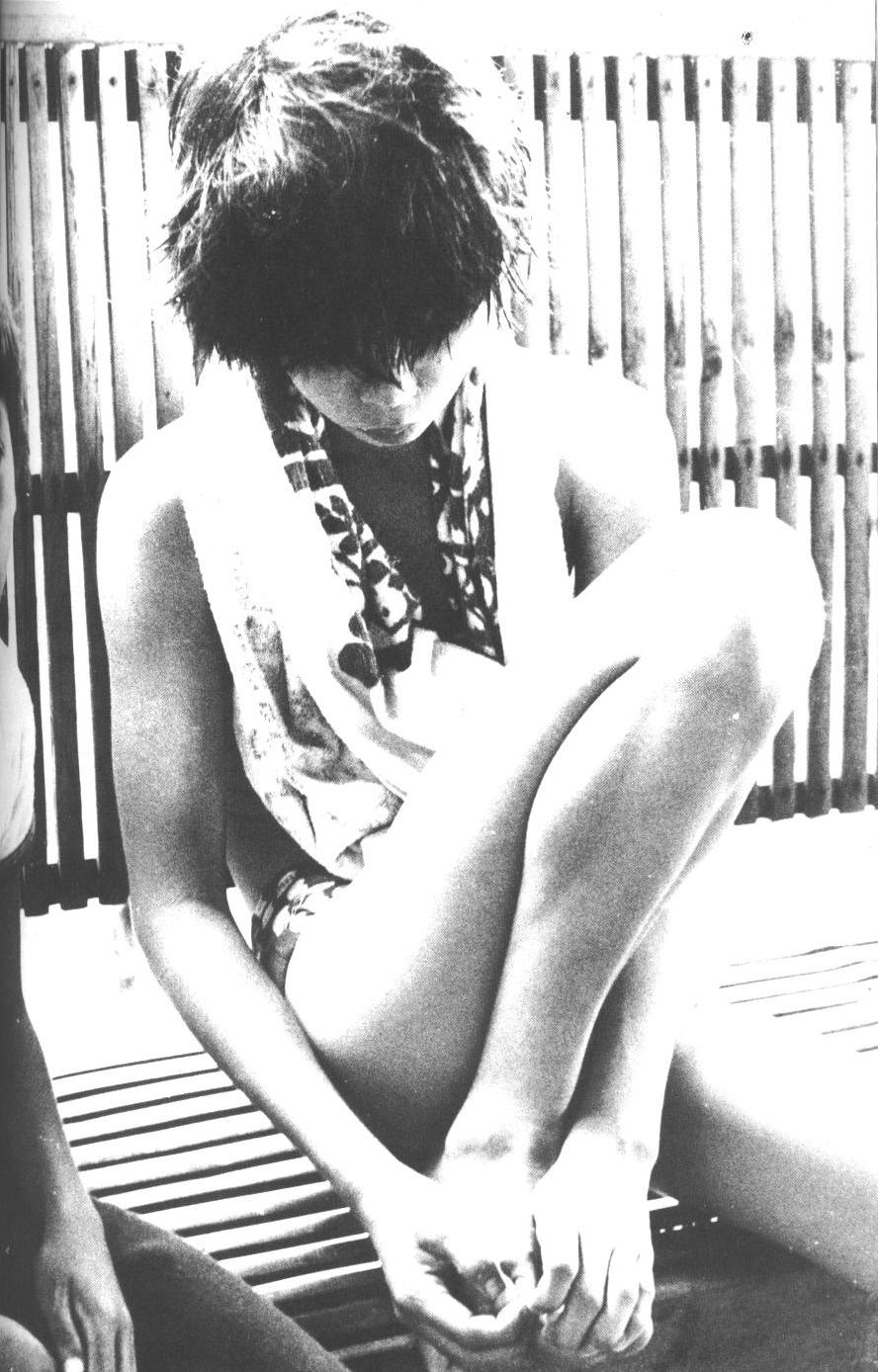
This evening, like yesterday, we took the car up into the mountain, a great perfection, when we came to the summit at the close of the day, the kids played with an ox, capered about, paradise rediscovered ...
Now I’ve become used to their continual quarrelling. The main thing is to get through the next quarter hour without incident, the next hour, the day ...
To-day we are leaving Pagsanjan Falls, and theoretically we are going on to Baguio, in the mountains, but I don’t know whether Noel will be able to come with us. They have still been fighting like dogs; Lapu-Lapu grabbed Noel by the hair and dragged him across the pool, head under the water. Noel is furious, all the more because, just before, Raphael[4] pushed him fully clothed into the water. He no longer wants to speak to any one, and is waiting for the return to Manila.
Continue to Desert Patrol IV: Manila II and Baguio
[1] Pagsanjan, a town in Luzon, 91 km. from Manila, which arose beside the famous Pagsanjan Falls, was at this time home to the most vibrant boysexual scene in the world. Much the fullest account of this was given by Richard Rawson in his Paggers Papers (Amsterdam: Acolyte Press, 1993), which takes its name from the American nickname for Pagsanjan and describes how literally all the pubescent boys there sought sexual liaisons with visiting foreign men for remuneration, generally with strong parental approval. [Website note]
[2] The Spartacus International Gay Guide, 1979 edition, the leading travel book of the time for homosexuals but which was very much designed for boysexuals as well as gays, said “There are 3 hotels in Pagsanjan but the absolute favourite of 99% of all our readers is the Pagsanjan Falls Lodge Hotel. The hotel consists of some bungalows, a houseboat, a restaurant, swimming pool, the Houseboat has 3 bedrooms and it is possible to rent the entire boat for a very reasonable price. The bungalows are in an area called Coco Grove and most of them have balconies overlooking the river.” (p. 385) [Website note]
[3] Tagalog: language of the Manila region. [Author’s note]
[4] Raphael was the author’s natural son, born in Rome in 1967 and so then aged 11 or 12. Franco was usually seen in his company and the boy was already seriously learning from his father the profession of photographer that he was to pursue for life. [Website note]
Comments powered by CComment