
DESERT PATROL I: MOUNT LAVINIA, CEYLON
BY GUIDO FRANCO
Presented here is the first part of Desert Patrol (une aventure sous les tropiques), a travel memoir by French Swiss photographer Guido Franco published in 1980 and introduced here. It concerns what Franco saw when he visited Mount Lavinia, a suburb famous for its beaches of Colombo, the capital of Sri Lanka (the new name for Ceylon), in January 1979. The illustrations are all from the original book.

I. Mount Lavinia, Ceylon
I’VE met an American. He wants to come and live here. (In absolute ecstasy at the number of “boys” everywhere.)
“I’m going to have a “culture shock” he tells me.
According to him, America is heading for disaster and he doesn’t want to be there when it happens. He will put his money in Switzerland. There was a tremendous storm in Trincomalee and all the homeless people have come here; they are being put up in schools, but also in the street.
He’s very excited. This morning he had breakfast with the President, and, on top of that, today is his birthday. He did not sleep at all last night, and now he has an invitation for lunch with friends. An invitation which he must reciprocate, they had to invite him in Chicago fifteen years ago, and also he met the Sri Lankan ambassador in London, in Baker Street, and he was the one who procured his “boy” for him, completely reliable, one would never say he was fifteen, but he was going to start at the University to study biology, a most intelligent boy.
* * *
It is now fifteen minutes that a beggar has been desperately waiting below the balustrade for a hypothetical rupee.
From time to time he extends his hand. I will give him nothing and I do not know why. Indifference, certainly. Just now there were three kids standing there on the beach. I said to myself: well, that would make a good photo. And then I saw that their little brother had a swollen stomach as in the droughts of Africa or the destitutions of Bangladesh. And earlier, there was that boy without one leg, walking on a pair of crutches, begging on the beach.
I went towards the sea, where the beggars never go, watching Raphael[1] skimming over the waves with his surf-board.
* * *

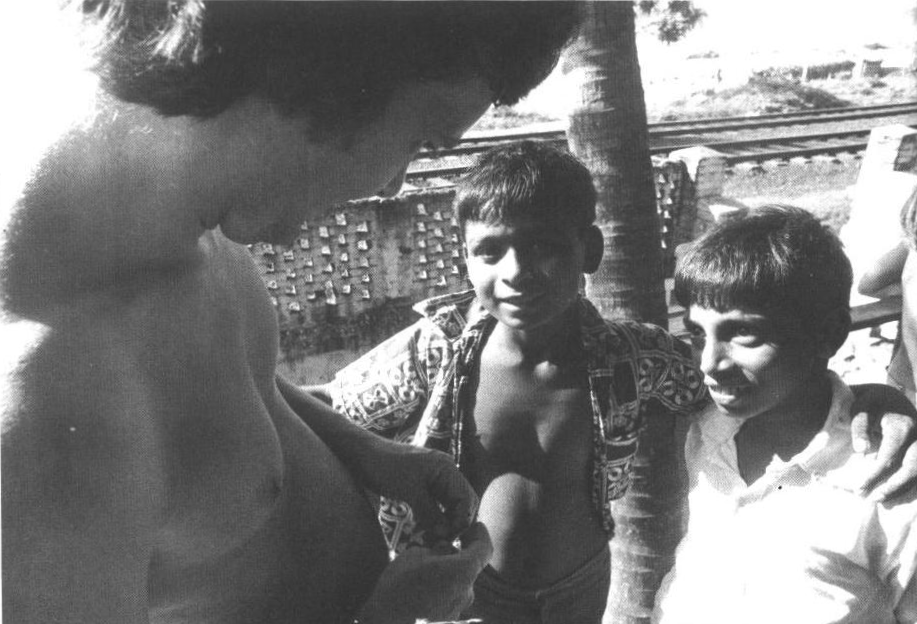
As I understand it, Mount Lavinia has become a paradise for homosexuals. There was Barry, and Fred who is travelling with Karel from Amsterdam, and they told me that the beach is full of them, and that the Bungalows Hotel is a real brothel where one can take eight boys at once if one wants; every night Fred and Karel had boys sleeping under their bed, and in the mornings, especially around midday, when St. Thomas College closes, boys pass along the railway line and wait in front of the Bungalows.[2] The clients are out on their balconies, and respond to the invitations (“do you want to fuck me”) with yes or no, or with the rendezvous time indicated by raising their fingers; at that time the boys are there, for ten rupees; it seems that there are so many that it’s becoming a problem, and they have to be chased away.
“It’s too easy,” Karel said, “it’s no fun any more.”
Even Kemal, Raphael’s pal for a long time, is part of the team. Yesterday evening he told me that he wanked off the old fellow who walks with a stick in the Mount Lavinia Hotel, and the old fool gave him fifty rupees. Kemal gave forty to his mother, and kept ten for himself, which he spent on toys and sweets for Raphael. This morning he was fucked by a tourist (but only half way, he tells me); it hurt him, and he wanted to show me his bum (nothing particularly apparent), and then he proposed wanking me off, no thanks, and suggested that when I leave I could leave the Sony cassette player for him or perhaps pay for some sheets for his mother.
“But the Sony,” I told him, “I need it.”
* * *
Barry is extremely jealous of his boys. Yesterday evening Paul had a cold and I suggested a tablet for him. That almost became a drama.
“What’s that? May I see it?”
Barry made out that he had reasons to be worried, and went as far as to analyse the composition of a nasal spray, “made in Switzerland.”
Raising his finger above his bald skull, he recommended to Paul and Gamini:
“My boys, you shouldn’t take medicine without consulting me; I love you as you are.”
As if I were interested in drugging his little pets!
“One never knows,” said Barry.
It seems that his previous boy took drugs and pinched a hundred rupees from him every day. But that was a boy contaminated by western civilization, he had come back from London or Chicago, while Paul and Gamini had been introduced to him personally by the Ministry of Culture, as he told me in confidence, and moreover it was Paul who carried his wallet and his credit cards. (In fact it appears that the two young rascals picked him up on Welawatta beach.)
Image 013h to side with caption ”The Bungalows Hotel is a real brothel”

Barry bluffed them when he used his American Express Gold card to pay for their air-con room at the Mount Lavinia, but now they are starting to get bored, and Barry is short of cash….
This evening Gamini came to my room, quite casually, and asked whether I had a Swiss watch, or something similar; it seems that Barry already gave his watch to his previous boy. Gamini whispered in my ear that after Barry leaves (in fact soon, on Monday ...), and if I didn’t have a watch, he knew about some cheap ones, 800 or even 500 rupees, Citizens. Barry had promised to bring him a watch next year, but “you see, next year”, it was out of the question that he should wait such a long time. On the way out, he reminded me to say nothing to Barry.
It’s crazy the interest that the boys here have in watches, in a country where time has little significance.
* * *
According to Barry, Fred comes from a very well-off New York family, but he lost two million dollars in some shady deal, and is now travelling with Karel to verify the addresses in a gay guide.
In fact it seems they spend most of their time sampling, one after the other, all the boys on the beach who are old enough to walk.
When I came to Bungalow no. 7, there were just two brats on the track, who appeared to be around ten or twelve years old:
“Yes, yes! I fuck! Me suck very good! ...”
Fred and Karel assured me that one of them was an expert, and as for the other, their advice was to sample him.

To-day Fred and Karel were kicked out of the Bungalows Hotel. As I understand it, the proprietress, a Belgian lady, had just come back from her travels, and the two of them took advantage of that to ask her whether she would like her establishment to appear in Romulus, the gay guide.[3] The lady must have made enquiries about the situation that had developed in Bungalow no. 7 while she was away; I don’t know very precisely what happened, but Fred and Karel were thrown out very abruptly. Now they are completely paranoiac at the idea that she might call the police; they have taken refuge at the Rosebud, a fourth-class boarding-house,[4] and only if they can stay out of trouble! But when I came back from the Kelanya temple, I found them with Barry, going out to look for their boys, whom they had apparently lost during the move. The boys, it seemed, had gone to the cinema, and arranged to meet them at the Pagoda, on the beach.
“They’re never going to understand if we’re not there,” moaned Frank.
We passed along the railway track in the dark, but at the Pagoda there was no trace of the boys. They must have heard that Fred and Karel had been kicked out, and so pushed off without further ado. We had a beer, just to pass the time, waiting for their eventual return ...
“Oh look, it’s her,” Barry suddenly said to me. The proprietress of the Bungalows.
She was sitting at the bar with her bodyguard. I felt it was unwise to have come here to pester her, but Fred and Karel were not budging an inch.
“At a pinch, the little one would be all right,” wails Fred, “but not Nissam!”
In the gloom, from the other side of the railway, the security guard of the Bungalows Hotel is watching the entrance. That’s where there is going to be trouble. A real idiot, this Fred. He stood up and went over to ask the guard if he had seen the two boys, Nissam and the other one, the little boy in short trousers. The fellow gave no answer, but now he has been discussing it with the proprietress, who is still at the bar with her heavy.
I feel it would be better for us to go back to the Mount Lavinia. After all, the beer is nothing special and we have nothing in particular to do here.
“Should we ask for the bill?”
“We should go,” said Barry. “Now.”
* * *
That is my idea exactly. We dump fifty rupees on the table without waiting for the bill, and off we go along the railway. What a fool, this Fred!
“I told you to go and offer him a cigarette to mollify him, not to ask him where the boys were,” moans Karel.
“Tough ... tough ...” says Fred, who is moving quickly in spite of his age.
“But how did they find out that we’re at the Rosebud,” he whines. I suggest that the “guard” could have sent them a message.
“And you, did you at least offer him a cigarette?” howls Karel.
“Do you think that was necessary?”
* * *
The problem with Fred is that he is really too stingy. We quickly took refuge on the Mount Lavinia terrace (in a hotel for charters there is never any risk, no Sinhalese cop would ever have the idea of disturbing a guest for peccadillos in a place like that) but for Fred it is too dear.
“Impossible, this Fred,” Barry told me as he collapsed into an armchair. You’ve seen it, in these circumstances I know when I need to get out. I didn’t even wait for my change. I said: let’s go immediately.
He is very pleased with himself, and in no time orders two beers. That Fred is an imbecile. He told me that the fellow had an island worth four million dollars, with a private airport, that his family were music lovers, people with everything good, when that idiot was caught with an adolescent, a short story, nothing exceptional, but in the United States he could go to Sing-Sing; in short he had to disappear quickly; he left a trunk containing two million dollars with his business manager, to cross the border. Obviously the man had never been seen again, and now Fred was there in Ceylon with Karel looking for addresses for Romulus, the gay guide.[5]
“On a cultural and voluntary basis!” Barry burst out laughing in his armchair. “You should ask him to show it to you, there are drawings in it, explicit, characters sucking each other, yes indeed it’s the guide they showed the Belgian proprietress, and she must have phoned the cops right away.”
Barry is on his seventh beer, and he tells me quite frankly:
“I have good protection in Ceylon, the President, and the President’s right arm, but I don’t want to squander them with nonsense like this, you will understand.
“Listen, I’m not talking rubbish; in their Guide, under the heading ‘Mexico’ you’ll find a fellow with a sombrero sucking a tourist, things like that.”
No wonder they’re paranoid, these fellows!
* * *
To-day the two Charlies have gone off with friends on a tour of the south. One of them is Fred’s lawyer, Barry tells me.
“I hope he’s going to warn them about the danger they are running by playing silly buggers,” I suggested.
“Not in the least. That Frenchman is even more cracked than they are. I wager that at the present moment they are touting their Guide at all the hotels on the coast.”
“And Karel, how does he fit in with that?” “What did he tell you?” Barry pulled a wry face.
“He said . . . he said that he was a photographer in Amsterdam, but that his business suffered from the fuel crisis.”
“The what crisis?” roared Barry. “They were banged up, yes indeed, because of their porno photos in a specialised magazine, photos with kids, you know the type. The magazine published his full name, and just stopped short of giving his address and phone number, he laments.
“It is astonishing that these two Charlies are still at liberty at the present moment,” he told me. “I swear to you that Fred still doesn’t understand why the Belgian lady kicked him out of the Bungalows Hotel, with his Guide, his boys, and everything….”
* * *

Yesterday, finally, Barry went back to New York. There had been several consecutive farewell parties, of which the last was definitive. His bottles of whisky were finished, and even the beer he had bought in anticipation of the full moon, when in this crazy country they don’t serve alcohol; I say that because for the rest of the month they get stinking drunk on their palm juice. He had to be photographed in the middle of his double bed in his airconditioned bedroom at the Mount Lavinia, surrounded by his favourite boys Paul and Gamini, as well as Kemal whom I was watching out of the corner of my eye, and Christopher, a little new one whom Lena brought us, making clear that he had known him since the age of twelve.
Lena specializes in the education of deserving young Sinhalese. (One of his protégés is now at the University of Miami, and when he comes back to Ceylon he will certainly be a Manager at the Intercontinental, he assures me.)
* * *
Barry suggests that I take over the care of his boys, something I accept, moved as the circumstances demand, but without too much conviction.
“I know that you will take care of them,” he repeats, embracing me like a brother.
“Hm . . . yes . . . certainly.”
Am I mistaken, or is Lena’s little protégé winking at me? I decide to be clear in my mind about it, and, leaving Barry to his effusions, I approach Christopher, with his velvety appearance and false jungle air.
“To-morrow, at five o’clock, in your room, 435,” he tells me “Don’t tell Lena.”
* * *
He can count on me. It’s difficult to see myself telling the German that his little darling has made an appointment with me. And moreover, what does he want? At any rate Fred and Karel are going to leave, for Kandy. They plan to open a little hotel in Ceylon; it’s an idea they had when they left Amsterdam. Fred dreams of retiring, and with his remaining cash, they could have a quiet life here, with their gay boarding-house; not something sordid like 707 Rosemead Place, no, almost chic, with classical music in every room, and boys, obviously. But Karel is starting to become tired of Fred and his phoney ideas.
“It will never work,” he tells me. “Sixty thousand dollars, what are you going to do with that, I saw it on a large scale! That does nothing for me, that pension for peds who listen to classical music. It’s Fred’s idea.”
They spent the evening trying to convince the American not to go and speak about his project at the Ministry of Tourism.
So, departure of Fred and Karel, for Kandy.
* * *
That morning, Kemal came with toys for Raphael, a kite, a rifle, and two popguns. Raphael had given him some rupees to buy the kite, but the rifle and the plastic popguns had been presented to him by a tourist, he said, as well as a pair of rubber sandals. (In exchange for what? best not to ask him.)
* * *
Following Barry’s departure, everything at Mount Lavinia became calmer. Paul came to see what was happening, he was looking for Gamini; Gamini dropped in the day after Barry left, weeping for his master (“very good man”) but nonetheless seeking to be offered that watch, the electronic Citizen for 800 rupees, without too much hope.
Lena decorated his boy like a Christmas tree, little gilded chains, rings with false diamonds, in the form of a heart, medals (“he likes that”), and in the end he understood that Christopher, in the afternoons, rather than going “to see his mother”, had his clients, his rendezvous.
“I don’t want to disrupt his work,” he told me to console himself. “I’m like a pimp. When he comes home I take his money and put it away for him. When I leave, he will buy himself a bicycle.”
* * *
Karel has come back from Kandy (no interest), leaving Fred down there, discussing music with an old friend.
“Utterly boring. If he wants to set up his boarding-house down there, he needn’t count on me.”
The moment he came back from Kandy, Karel hurled himself at all the boys on the beach. He went so far as to pick up a watercarrier whom he found well put together, and a little Sinhalese with a sweet little face to whom he offered a meal at the Intercontinental coffee-shop. But his expenses were all he got. The little rogue was in love with a thirteen-year-old girl tourist who, it seems, was staying at the Mount Lavinia with her parents.
“Do you know where is Martine?”—the whole evening he bored us stiff with that.
“Who does this little creature think he is,” complained Karel, “he cost me a meal at the Intercontinental and now he’s battering my ears with his Martine.”
Karel lives on a very strict budget. He has to share his cash between his meals and his boys. When all is said and done, after two days of this bachelor life, he told me that he missed Nissam, his house-boy, whom he left in a village on the way to Kandy ...
* * *
I had thought that Lena was used to the idea, but in fact he has not got over the fact that Christopher has become a little tart.
“Amusing himself a little,” he calls it.
“And you know, last year he was so sweet, wie eine Zuckerpuppe,[6] and now look at that hair, those rings, that watch, truly a professional, I made a mistake giving him all that, the best thing would have been if I could have taken him directly to Germany, but it’s winter and so on, and then he has acquired de luxe habits, he wants air-conditioned bedrooms, while at his home they sleep on the earth, a bathroom with hot water, shampoo from Paris, he spends hours in there playing with the foam, polishing himself, and as soon as I turn my back he’s making appointments with clients to wank them off, it can’t go on.
It’s hot, and when it’s hot, Lena only speaks German.
“Ich möchte sein Business nicht stören. Opas wichsen. Verstehst du?”[7]
(As for me, I pretend not to understand German, but he knows I understand it, so I’m buggered.)
“I’d really like to take him to Germany,” he wails. “He could cook for me, and clean. . . I’ve already had quite a few adventures with Neville, and with another one who is now in gaol ... Neville is studying in Miami, at the University, you wouldn’t believe it, but this one is so stupid, he doesn’t even know where Ceylon is, on the map he pointed to China….
“He looks like a Christmas tree with all that jewellery. And a hand on the package all night long.
“Playing, he calls that. But when he comes to Germany all that will be over, I can tell you….
“Look,” he goes on. “There’s a family with a kid. It’s really more suitable than all these queers.”
* * *
This morning Karel woke me up:
“Hurry, there’s a fire.”
I didn’t gather what was happening, he came into my room very excited.
“There’s a fire in the hotel, mate, you’d better get out of here, there’s a lot of smoke in the corridors.”
After a moment I smelled burning, I went to have a piss, and in the courtyard opposite there was a column of black smoke. It certainly looked serious.
I woke Raphael, or rather I tried:
“Get up, there’s a fire in the hotel.”
But there was no way to get that into his head.
“Let me sleep.”
“Karel came to warn us that there’s a fire in the hotel. Come on, it’s going to be fun.”
“Leave me alone.”
“It’s BURNING! there’s black smoke everywhere,” I shout.
Finally he opens one eye. He needs five minutes to stretch, then he goes to piss.
“Hey dad, we’re burning,” he tells me.
“That’s what I told you.”
“Let’s get out of here,” the brat bellows, and he dumps me there without worrying any more about his old dad.
“Wait for me,” I cry. And for my travellers cheques, my photos, my bottle of Gigondas.
“We’re getting out!” he has already disappeared into the black smoke. I try to run after him.
Through the window at the end of the corridor we can see the crowd that has gathered to watch the shipwreck. On the third floor, there is not another soul, they’re not fools those chaps, they’re all Germans who must have got up at eight so as not to miss breakfast.
The staircase is already black as a chimney, no question of venturing down there. This is where an intimate knowledge of the Hotel Mount Lavinia will show its extreme utility. Judge for yourself:
We cross to the left towards what was the central building, then to the right towards the Gordon Suite, we hurtle down the stairs with the gong, across the piano hall, and then, with gentle dignity, descend the staircase of the old reception.
* * *
Annoying as it may be for those waiting for the show, we have saved our skins. In the mean time, the Hotel Mount Lavinia, in all its splendour, is burning comfortably away.
“The good thing in cases like this,” I tell Louis, my driver, “is that they first let the hotel burn well before calling the fire brigade.”
“It’s not that, exactly,” he replies. “I have already twice been to Colombo and back. It seems that the firemen don’t want to come if they aren’t paid in advance, and that poses problems.”
From time to time there is a boy who, in peril of his life, goes to throw a bucket of water onto the boiler which has caught fire. On other floors, they are flinging underwear from the windows.
It’s great fun, the Germans film it in colour, for them it will make a holiday souvenir.
* * *
On the following day I looked at the newspapers. I was expecting to see large headlines, across the page, “BLAZE AT THE HOTEL MOUNT LAVINIA” or even “THE HOTEL MOUNT LAVINIA BURNS DOWN”, and photos. But not a word. It seems that in some paper a sub-paragraph was put in, but (I had a good look) it was nowhere to be found.
It’s striking the way the press neglects important events.
* * *
Several days have now passed. I had to move to the Hotel Palm Beach after the fire, it’s a pension for tourists, but with a lawn, and in one way life is more tranquil. Visitors are not admitted.
Kemal came to see me one evening with his older brother (he is frightened at night because of the demons), but he had to wait at the other end of the lawn while I was sent for. I explained to him, don’t come here, boys can’t come here, and he approved with a sad expression.
Yet Gamini managed to track me down, to tell me that his mother had a cardiac attack over Christmas, because of a firecracker, and that she was now in hospital, and that he had no money seeing that the banks were closed.
Clearly, if I could do something, seeing that he loved his mother very much, and that this story of the firecracker, especially at Christmas, was really bad luck. I advised him to write to Barry, who was told everything, his mother, the firecracker, the blow of the closed banks, and as he left I was obliged to slip him a hundred rupees for initial expenses.
He had tears in his eyes, but it is clearly one of their tricks, the sick mother, the school books, and the father’s birthday, three or four times a year.
Lena came this morning, saying that there was a very original German woman at the Mount Lavinia who threw herself fully clothed into the swimming pool, and that three or four of them intended to do her this evening for the New Year.
“Christopher is truly cracked,” he added. “Ganz verrückt. Yesterday evening he did it to me in the bum, with cream and everything. Very professional. Don’t tell anyone. And while he was doing that behind, he also wanked me in front. Ganz gut.
“So you see,” he said, “I’m tired and I don’t think I’ll be able to have that German woman this evening.”
* * *

To-day Lena came back with some problems.
Christopher had promised him to stop smoking in the New Year, but there he was, smoking sixty cigarettes yesterday evening while they were doing the German woman with the boy from the Hotel Duro bar.[8]
And she was ugly as sin, he told me. Her tits were not bad, but the rest . . . Too old. The bar boy, he was not bad, twenty and very skilful. They could do it to him between his legs.
“Ganz eng weisst du, wie eine Frau.”[9]
Clearly Lena had concerns, with that story of the cigarettes.
“I told him that if he went on smoking like that, he couldn’t come to Germany, und weisst du, das mein ich,[10] and then there was another thing,” he confessed after a moment.
“He got me to buy another ring. I didn’t want to show it to you.”
With reluctance he took the object out of his pocket.
“Very good value,” he suddenly told me, to excuse himself. “Thirty-five rupees.”
It was a ring with green stones and false brilliants all around.
“He swore to me that it was for his mother.”
But he no longer believes that, any more than I do. He’s in a bad mood.
“I know what you think of me,” he said. “That German, he buys rings for his boy and he will do better than . . . See what he looks like with all that jewellery. A Christmas tree, you could say!”
* * *
This morning Karel came, he was in a bad way. The previous day he had swallowed three Mandraxes[11] after Fred left. His mouth was coated, and I couldn’t understand what he was saying. According to him, Fred’s lawyer was waiting for us at Mount Lavinia. They had decided to go to Welawatta, where there are always boys on the beach. And afterwards they were going to invite them . . . you see we can tell them that we’re going to celebrate a birthday . . . and they were going to take them to 707 Rosemead Place.
“If you are interested, you can come with us, you can pay half for Rosemead Place, a hundred rupees,” he explained to me. “It’s not dear.”

While we were waiting, Karel suggested I go and find Napoleon. He assured me that I would have no trouble finding him.
The lawyer was in fact on the beach, in the process of picking up a fisher-boy.
“Just a moment, I’ll show you which one,” he whispered. “Over there, the tall one with the Tahitian shirt.”
“Eh? Does he know?”
“No, not yet,” grumbles the lawyer. “I’ve tried several advances on him, but for the moment he is resisting me. It’s intolerable. The imbecile is slaving away to earn a few rupees, when with me he could have what he wants. . . .”
“ ... ”
“You’re astonished at my interest in that fisher-boy. . . . Ah yes, I’m sure of it. . . . You, I suppose . . .”
I would for the moment prefer him to leave me out of the question. While he is waiting, still without much hope, I take a few photos for my archives, and then we set out for Welawatta.
I’m quite annoyed, because I’m with Raphael and his mother, and I suddenly realize that in this world one doesn’t wander around with wife and child. Very suspect!
It is Edmond, from the Ebert Silva Agency, who is driving us in his air-conditioned Statesman.
Stop at Welawatta Beach.
* * *
Hello, I spot on the beach the kid I saw at the Bungalow no. 7 the other day (“Me suck very well”) and I take him under my wing.
“Can I come to the party?” he exults. “Will you give me a few rupees?”
Sure. First of all I tell myself that I can give him something to eat. But that doesn’t please the lawyer at all.
“I never invite them to eat,” he explained to me. “In fact they are horrified at that. I give them a few rupees and they manage to eat something in the street.”
Clearly he is unenchanted by the fact that I’ve brought ‘Me suck very well’, Kemal, and all that tribe.
“I’ll be paying for them,” I explain at once, to clarify the situation.
We go on to other subjects, Paris, do you know the Philippines? . . . He gives me some addresses in Manila. Harrison Plaza, a shopping centre. A hotel. . . . San Carlos, I note. There are armed guards at the door, he tells me, but it is ‘supercool’, one can bring in a troop of white elephants.
“White elephants?”
“Boys,” Napoleon says, “don’t you know anything?”
Karel for his part is speaking more and more incoherently; he no longer appears to know much about where he is . . . apparently Fred went off yesterday evening to take a cultural trip into the back country (you can imagine, by train, in third class! laments Karel); they have divided their money—the money they still have—and now he has taken his three Mandrax.....
The kids are sitting tensely on their chairs; so far they have not had anything to eat.
“What about dropping it,” I ask Karel. “In any case you’re in no state to do anything. You would be better off going to bed.”
“Out of the question. It’s been five days since I did it with a boy,” he groans. “So to-day I need to do it with five.”
“What do you think of this little one,” he adds. “I’ve just met him, he’s the brother of the other one, the one who sucks. I’d like to have him as house-boy, to tidy me up. But first I’ll have to buy a shirt and shorts for him. I cannot take him to Rosebud like that.” We’ve been waiting for hours for a feed.
Suddenly Edmond interrupts, to tell me that he was ditching me, and all that. The Ebert Silva Agency did not keep airconditioned cars waiting at Welawatta Beach until the worst kind of peds had finished stuffing themselves. He was leaving me there, and there was no need for me to pay for the trip.
“Out of the question, we’re going to the French Embassy,” I explain.
“The What Embassy?” he asks me (he doesn’t believe a word).
“Rosemead Place,” I articulate.
He glances at ‘Me suck very well’, the little new one, and Kemal.
“With them?”
“So what?” I shrug my shoulders. “But first of all I must do some shopping at Cargills ... and Marks & Spencer.”
In a fury he conveys me to Colombo and waits in fifty degree heat in front of these establishments from the colonial epoch until I emerge from Cargills with two flasks of Beaujolais, which is no small matter considering the quantity of receipts, stamps, and formalities with which the locals here believe they are obliged to accompany the smallest purchase.
“To the Ambassador,” I fling at him, with my packages in my arms.
Edmond, now resigned, puts me down gently on the lawn of the French Embassy.
I settle the account with him, not without giving him some advice on how to treat high-class foreigners in all circumstances. Then I send him packing.
All we have to do now is to go on to number 707, right next door.
* * *
Because of our delay, the party is already in progress, and very badly it would seem. A concierge examines us, and then cautiously opens the door. Inside, it is difficult to see anything clearly. In one room, Napoleon is busy with seven or eight locals. Disastrous.
“I’ve just done it with that one,” he bawls, while the other is pulling up his trousers. Come on, make yourself comfortable. Ah, you’ve brought Kemal, and the little one ... Come over here, my darling.”
“Where is Karel?” I venture.
“He’s in the next room, he’s very busy. Karel! Karel! here are your friends!”
He goes on tiptoe to open the door.
Karel is alone, trying to screw a boy whose face I cannot see.
“Nothing doing,” he complains. “Open your bum-hole you silly blighter, why do you think I’m paying you?” he yells in Dutch.
He gropes another boy.
“They’re all worn out,” he says. “Sucked dry. How many tourists did you do this morning?”
He’s disgusted.
“All stark naked,” he bawls, “you are my slaves! But no, best to bugger off. What have you all got to look at?”
I would indeed like to bugger off, but I said to myself that there was no question of going back to the lawyer’s room. Rather die.
Karel has begun to roar, to make a scandal, as though it were the lawyer’s fault, or mine, that he didn’t get an erection.
“That’s never happened to me before,” he bawls.
I decide that it would be better to make a discreet retreat, and I feel my way back to the salon with broken armchairs, with which the management honours potential clients.
“What are you doing?” asks Karel, coming up with a cloth around his hips.
“I’m going to take some air, don’t you find it warm here?”
“You’re leaving? We’ve just got started!”
“I’m leaving because you’re a bit nervy.”
“What do you mean by ‘a bit nervy’,” he said in a nasty tone of voice. “I’m not nervy at all. I think we’re going to celebrate this birthday. We’re going to start everything again from the beginning. Ahoy, all hands on deck. Kemal, go and find us two bottles of Arak.”
But I am starting to have some reserves on the subject of this ‘party’. Local tradition or not, a dozen kids, in the greatest disorder, and now another two bottles of Arak.
“Without compliments,” I say, “I’m not thirsty . . . and then . . .”
“There’s no risk!” he bellows. “I tell you it’s COOL. SUPERCOOL.”
* * *
Left Rosemead Place. We were carted in a taxi that looked like it was going to lose its doors en route.
Halt at the mosque. It’s the hour of sunset. Finally something relaxing.
In the courtyard there are a hundred or so beggars waiting for a kind soul to throw them something edible on the way out. I give Raphael and Kemal a few rupees to buy for them a few of the pancakes made across the road.
The little one finds that very amusing. But suddenly I realize that Raphael is amusing himself by dangling the pancakes under the beggars’ noses and pulling them away when one of them tries to take one.
“You shouldn’t do that,” I tell him, covered in shame.
“Shouldn’t do what?” he asks, astonished.
“You know very well what I mean. Aren’t you ashamed at swinging the pancakes under the beggars’ noses, instead of handing them over right away?”
“It’s not my fault,” he groans. “They have had enough already. They were even sitting on them to hide them.”
Come on little angel. We’re leaving.
* * *
At nine o’clock, the boy from the Palm Beach comes to find me.
“Your friend is here. It seems to be urgent.”
Karel is waiting for me, in the midst of the tourist breakfast.
“I’ve lost my bag and everything in it,” he states. “My banknotes, my passport, the plane ticket; do you know where I left it? I have absolutely no memory of what I did yesterday. A hole in the head,” he told me.
At first glance, it seems serious. Here we go again, Goa, Katmandu, Benares. I tell him that it’s because he took those three Mandrax yesterday.
“What Mandrax? I haven’t got any Mandrax, do you think there’s any in this country?”
“You told me ...”
“What did I do yesterday? We were at ROSEMEAD PLACE!” he suddenly realizes with a smile.
“Shh, speak a little more quietly,” I recommend. “I don’t want to hear any more about that place.”
“But what did we do,” he asks me.
He wants me to tell him what he did yesterday; I cannot refuse him that.
“You came here,” I tell him; “you were in your normal condition.”
He looks astonished.
“There was that question of a birthday, at Rosemead Place. Do you remember?”
That seems to be the sole fixed point of his day. He tries to concentrate.
“Do you know what I’m going to do,” he suddenly says, with a flash of genius. “I’m going to go to the Tourist-Police, perhaps that bag was stolen.”
“No, no and NO,” I tell him.
I don’t explain why. I can already see him telling the Tourist-Police about his life, his boys, the Romulus guide, the Parisian lawyer and the Rosemead Place party. You talk about a local tradition. Karel is going to end up in the nick, and we with him.[12]
* * *
Karel came back in the afternoon. He has found his bag. It seems he left it in the kitchen at Welawatta Beach, and it was the lawyer who remembered that. And as well, Napoleon was also claiming a hundred rupees from him. It seems that yesterday evening he ordered a three hundred and fifty rupee meal at the Pagoda, with French wine and all, and didn’t have enough to pay for it.
“A bottle of wine? What an absurdity!” Karel protests. “And then you know, he wants you to go and pay for Rosemead Place; we left without leaving cash with the concierge. That’s going to make a bad impression.”
“Eh?” I say. “I gave you a hundred rupees yesterday, did I not, and then it was you who was screwing all those boys.”
“I know, I know,” said Karel, suddenly impartial. “You understand, I am between you two. You know how he is, the lawyer. Careful with his cash.”
He reflected.
“Listen, here’s what I propose,” he told me, in the manner of a man who has a good idea. “We restart the party, without the lawyer. That’ll be better,” he says, “more cool….”
* * *
The French are pissing off to Paris. I won’t miss them. Yet at the time of the last sunset, Napoleon invited me onto the balcony of Bungalow no. 7, to look at the railway line and drink the rest of the wine. I took a photo of him in a dressing-gown, in front of his bungalow.
“I have something more interesting to show you.” He asked me into his cabin.
“Look, Louis is busy screwing the cripple from the beach.”
Shit, it’s no joke. The cripple is sitting on their bed (he’s the same one who hops around on his crutches in front of the Pagoda, looking for a few rupees).
They make me sick, these people.
“He’s not exactly a cripple,” complains Napoleon, “because he still has one leg. Let’s see your bum for a moment . . .”
He turns the boy over, fondles his balls, and his stump.
“Both of us have screwed him,” he explains. “Did you enjoy it, my sweetheart?”
He sits him back up on his posterior, and slips him a cigarette. The boy stays there with a half-smile. His crutches are propped against the wall.
“The Mount Lavinia train,” the lawyer tells me. “Not a chance. He was hit by the train. In France he would have benefited from Social Security. But here . . . I’ve taken a few photos for my collection.”
“Ah! Louis, you’re finishing your holiday beautifully. Even so, it’s rare, you know, a cripple.”
The boy hides in the shade because he is scared of the Tourist-Police circulating on the road.
The Frenchman slips him a little cash and a green lighter.

Lena now declares that Sugar-doll is very intelligent because he has learned to count to thirty in German with a Cologne accent. But the general opinion is that Lena is behaving very badly with this boy by introducing him to de luxe customs, when at home he sleeps on the ground, and so on.
Karel has recovered his spirits, and has even invited us to the Rosebud to listen to some cassettes by the Floppies, his room was stifling, and full of mosquitos, no way to turn on the fan.
There was also a fellow whom they called Necker (apparently in Denmark he was in the nick for eight months) with a little kid I’d already seen somewhere stretched out on the bed and fondling his stomach.
“He looks nice,” I suggest, to say something.
“Doesn’t suck very well,” remarked the Dane. “He sucks three times, and then he needs to go to the bog to wash his mouth, ten times he’s played that trick, it’s no fun.”
He looks quite disgusted, this Dane. From what I hear, he’s come to spend six weeks at Rosemead Place. And he’s here, as might be said, ‘in retirement’, the cash he picked up in Denmark allows him to get by at the Rosebud, with meals and everything.
Amil (Karel’s new house-boy) is wandering around the room naked, he’s just taken a shower, they are going out.
“Amil’s cock is too long,” Necker reckons.
I don’t agree with him. I feel that I’m not going to get on with the Dane. Karel takes my side.
“There’s no need to listen to what he says. He’s not a person of your class.”
We go out to the Golden Gate, to eat without him. I don’t know why, but there is no way to enter this restaurant without being assailed by every beggar in Bambalapitiya. This time there is one, dressed in a bag, who follows us inside. The waiter throws the contents of a finger-bowl at his face. But it’s no use. The man is now behind the grille, shouting in his local language:
“I’m hungry! I’m hungry!”
Raphael takes a few rupees and disappears. Good little boy, a heart of gold, sensible and all.
When he comes back he explains to me:
“I gave them some chewing-gum. That will take the edge off their appetite.”
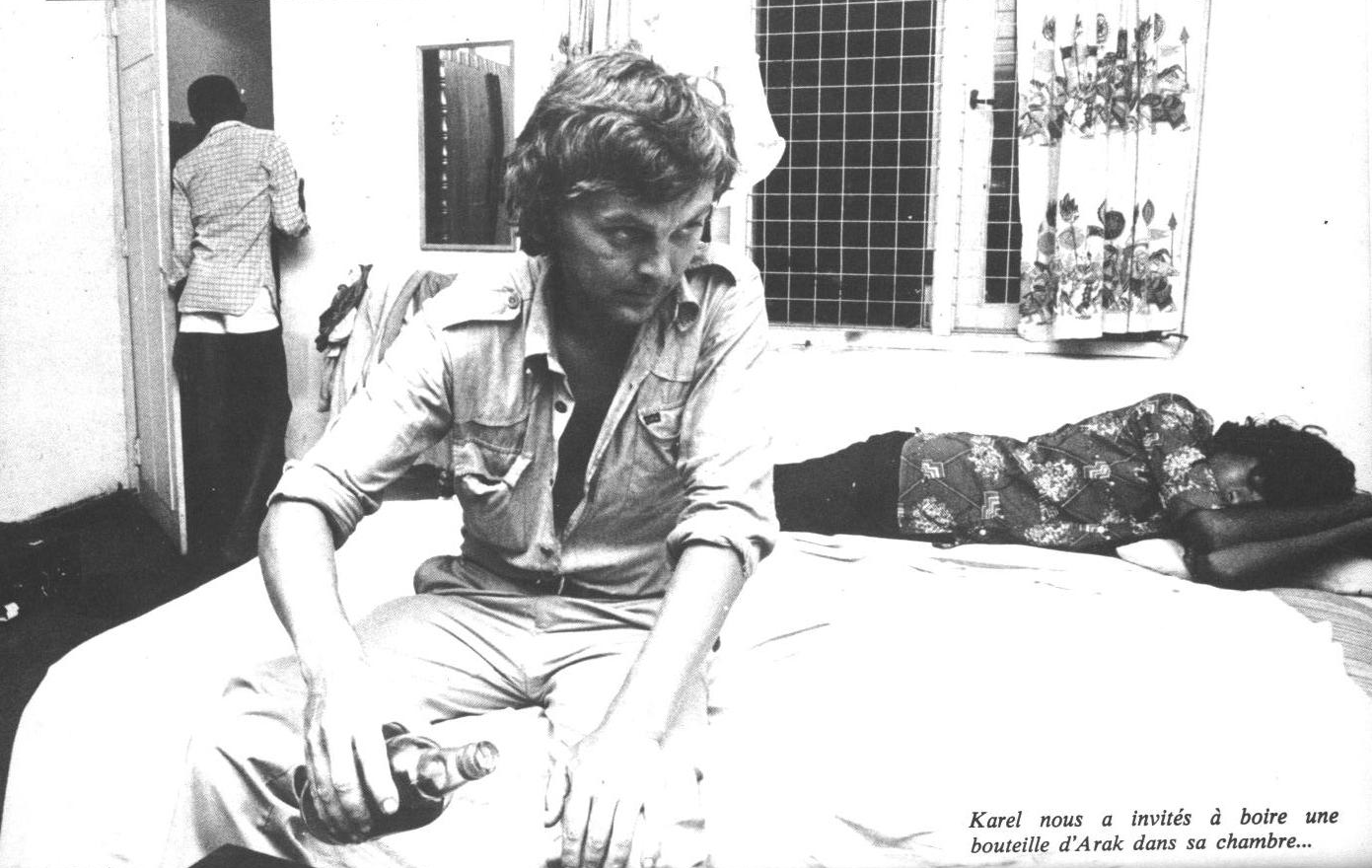
Karel invited us to drink a bottle of Arak in his room; seen close up it looks like cut-price Arak, of the type that gives you viral hepatitis, jaundice, or cholera.
“Not at all, he protests. It’s official Arak.”
He shows me the state stamp, twenty-two rupees. Even his boys grimace.
The fact is that Karel is going to be short of cash, I believe he has only three hundred rupees left for eight days, and with that he will need to pay for the Arak, his beer, his boys and their meals. I don’t know how he’s going to manage.
“I don’t need to eat,” he muses. “I will eat bananas.”
He’s found a new boy, Victor, but calls him Louis, confusing him with another one, who has gone to sleep during the little demonstration of 69 that Kemal and Amil have been offering us. Karel has closed the door that gives onto the hall, and of course we stifle. It’s impossible to ask him to open the windows, because of the mosquitos.
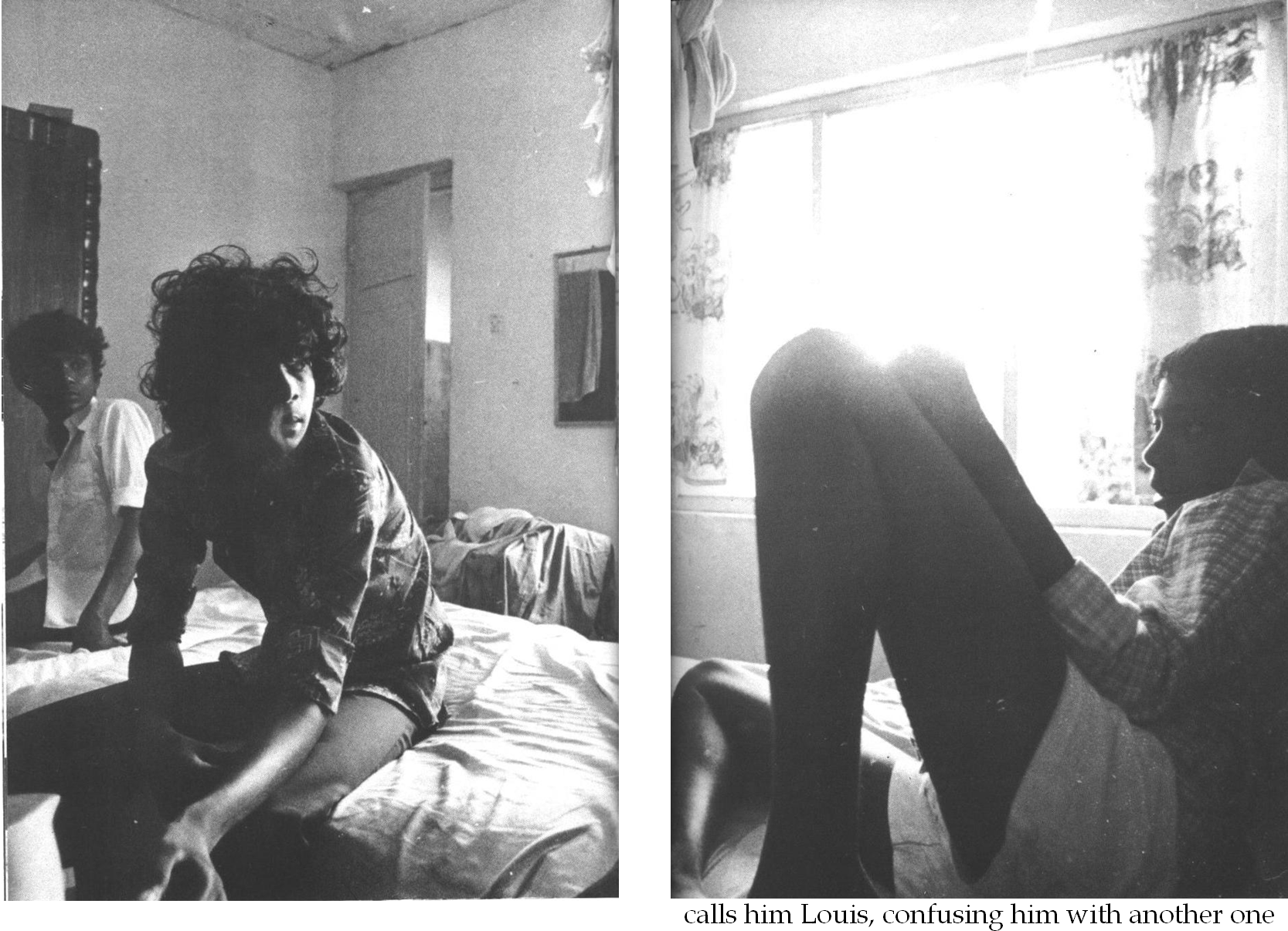
At the Rosebud, they have no illusions about the morality of their clients, and everything takes place in an atmosphere of good fellowship and healthy tolerance.
While we are busy with the boys, others are listening to Floppies cassettes, and a monk in an orange robe is transmitting insights from the Buddha’s teaching to some American boy-scouts.
“An unworthy monk,” Amil protests. “He’s smoking cigarettes.”
Amil has a big penis, of which he is proud. He is able to suck it himself, and shows it to everyone. As for Kemal, nothing. He has the willy of a twelve-year-old kid, and however much he wanks, nothing comes out. Every time, he calls out:
“Hey look! I think this is it.”
Nothing, obviously.
Following the 69 scene, Amil goes on wanking himself alone, but Karel doesn’t much care for that.
“It would be better for you to stop,” he advises from time to time. “Otherwise it’s going to be completely empty this evening.”
“You still have the other one,” I remind him, pointing to the sleeper.
“Ye-es….”
Karel truly needs to reduce his expenditure.

* * *
As for Lena, he is come to the beach less often.
“Christopher now has a Darling,” he explains to me. “The barboy from the Hotel Duro, it seems. Last night I couldn’t sleep. But the boy was quite disappointed. Christopher didn’t make love to him well.
“Why?” I ask in astonishment.
“He kept his briefs on, and all . . . just a little ziggy-ziggy between the legs, that’s what they like,” he told me in disgust. Such a performance they made . . . smoking, and the music till five o’clock, impossible to sleep. But Christopher is really in love with Darling. That’s his real name, he told me. Dar Ling, something like that.
“I took him to screw the German woman, but that didn’t work, she had her period.”

Karel is leaving to-morrow. He’s had enough of his room at the Rosebud. He’s had enough of the beach, of the Pagoda, of the constant sun, of the boys, of everything.
He’s given Amil his trainers, his shorts, and a shirt.
“I think ...” said Amil.
“Don’t think,” answered Karel. “You can’t think, you have no brains.”
After Karel has gone, Amil will probably go with the Master of Bungalow 12.
“Ye-es,” Karel warned him, “with the Kraut it will be ficky-ficky inside, and he has a big one.”
“He also has a big radio,” said Amil delightedly.
He cannot have Karel’s radio, because it is neither Karel’s nor even Fred’s, but belongs to Necker the old Dane in the next room.
In any case Karel wouldn’t have given him the radio, even if it had been his to give. Amil is well aware that Karel is not a Master who gives radios, but only trainers, shorts and a shirt. To-morrow he will to to see the Master of Bungalow 12. No, in fact he should wait until the day after to-morrow, because Karel’s plane doesn’t leave until the evening.
“He really has no brains,” Karel tells me. “Every time he turns on the fan, I sense that he’s going to put his fingers into it.”
“Will you think of me when you are in Amsterdam?” asks Amil. “Why should I think of him,” protests the Dutchman. “He has a big cock, nothing else.”
The boy wanted me to copy, on Fred’s typewriter, the address that Karel left him. In Amsterdam.
“But no, it’s fine like that,” I assure him.
“Turn the magic machine to the wall,” Karel told him. “And don’t just stand there . . .”
To-morrow I’m going off to Hikkaduwa with Kemal and his sister Tusi-Tha. If that doesn’t work, I shall send them back by train….

Kemal sees a rosy future for himself. Next year, I will bring two tickets for him and his sister. In France he will do fiki-fiki with the women (expensive he tells me) and his sister with the Masters over there.
Then he will come back to Ceylon with a big car. He will buy a four-roomed house in Mt. Lavinia, with telephone. When the telephone rings, he will answer:
“Fine, I’ll see you at nine o’clock.”
And he will hang up. And when the phone rings again, he will answer:
“Ah, hello, how are you; I’ll see you . . . at two o’clock.”
And without a doubt his sister will marry a rich Master over there.
Kemal imagines Europe as a gigantic brothel where he can wank people off the whole day long and earn a lot of money.
“And then,” he adds, “after two years in Europe, I will be white.”
* * *
Hikkaduwa is a God-forsaken hole occupied by hippies from the seventies, and it must be the despair of the touristic authorities.
Wedged between the lagoon and the highway, the skeletal hotels shake every time buses and lorries pass with their blaring horns.
From the other side of the highway, a shabby succession of merchants of sapphires, masks, local knick-knacks, tigers’ teeth, broken crockery and other tourist cons display their cheap rubbish, under neon lamps till late into the night, in the hope of catching a drunken German dealer falling out of a Neckermann bus.
In the daylight, they go off with masks to collect the few bits of coral that still remain at the bottom of the sea, around the rocks, but now that the Krauts have arrived with their bottles of compressed air and motor boats with glass bottoms, the last multicoloured fish have departed in disgust.
So the tourists will go hunting sharks, sawfish, and giant turtles, and will dance at night to Mamma. What they don’t know, is that the water of Hikkaduwa stagnating in the ponds among the guesthouses, the mask boutiques, and the railway line, contains fevers, miasmas, the runs, and tropical death.
* * *
The problem with Kemal is that he has a minuscule willy. To look at it, one would give him twelve years, but he says he is fifteen, almost sixteen…. It makes one wonder what he is going to do later on with a thing like that. Amil and even Christopher can hold their own, but however much he shakes it, nothing comes out, nothing at all.
It seems credible that he could be only twelve or thirteen years of age, but at school he is in form eight, to judge from his textbooks. He doesn’t know where America is on the map, nor anywhere else.
“Didn’t any one teach you anything, no geography?”
“Ye-es, they taught me where Wilpattu Park and Jaffna are.”
“Nothing else?”
“India,” he said, “as though that were more than enough.”
“And not America or Europe or places like that?”
“Not a thing,” he said. “But if you buy a plane ticket for me, I’ll go.”
“Do you know where in the world it’s warm, and where it’s cold?” I ask him.
“Here it’s warm,” he says. “In other places, according to what I’m told, it’s cold.”
“Do you know where the rich countries and poor countries are?”
“Here is a poor country. In other places they’re rich, right?”
“Hm . . .”
I look at the map. What might he know well?
“Do you know which are the communist countries?”
He takes a careful look at my Singapore Airlines map.
“The communist countries are red, for sure,” he says.
“And apart from that?” I ask him.
“Well, apart from that, the Bandaranaike party is blue, and the party of the present government is green. Sometimes the reds and the blues are together, sometimes they fight each other. The best brawls happen when the reds and the blues have a go at the greens, but there’s not so much of that these days, now that they’re fighting the Tamils. My dad shoved a bomb into a Tamil’s car, you should have seen it!”
Continue to II. Manila, 1979
[1] Raphael was the author’s son, then aged 11 or 12. The hostile account of the latter in issue 7 of Pan, a magazine about boy-love, published in Amsterdam in December 1980, said:
“Boy-lovers travelling the world should be on their guard against Franco. He is in his 40s, has black stringy hair and is usually in the company of a very nice looking 12-year-old whom he claims is his son (Franco isn’t married) but who doesn’t seem to go to school. Incredibly, there is a picture of this boy in the book, riding a horse.”
The photograph in question appeared on page 96, in the fourth section of Desert Patrol to be posted on this website. There appear to be no grounds for Pan’s insinuation that Raphael might not have been Guido’s real son. He was born to him in Rome in 1967 (around the time he was a filmmaker) by Erica Grüninger, who seems to have been with him for some time and indeed is mentioned as being present later in this text.
A professional photographer from boyhood, Raphael later lived and worked as one with his father in Thailand until the latter’s death and stayed on there until his death from cancer in 2024. [Website note]
[2] “Fred”, further identified in Prières pour des paradis meilleurs (the sequel to Desert Patrol), as Fred Shelltox, editor of PANPAN under the pen name of Dr. Sôren Kierkegaard, is a thinly disguised Francis “Frank” Duffield Shelden (1928-96) who, under the pen name of Frank Torey, was editor of Pan, a magazine about boy-love, published by Spartacus in Amsterdam. Almost certainly, therefore, Shelden was the “vacationing staff member of Spartacus [who] bumped into him in Ceylon a couple of years ago and a not especially amicable relationship ensued”, described in the already-mentioned hostile article in Pan issue 7, and the source of Pan’s animosity to Franco. [Website note]
[3] “Romulus” is Franco’s pseudonym for Spartacus. The Spartacus International Gay Guide, published annually from 1970 and edited by John D. Stamford, was at this time easily the leading travel publication for homosexuals. It was inclusive of and openly sympathetic to boysexuals, pointing out venues around the world where willing boys could easily be found. “Fred”, under the pen name of Frank Torey, was Stamford’s number two. Stamford himself frequently visited Ceylon, where he “sampled” boys for suitability to be introduced to clients of his travel literature. During the 1980s, his correspondence was written on paper with a naked Ceylonese boy of sixteen as background. [Website note]
[4] The Rosebud seems likely to be Franco’s nickname or pseudonym for the Rosewood Tourist Guest House, listed in the Spartacus International Gsy Guide, 1979 edition, p. 437 as one of the hotels in Mount Lavinia that would allow one to bring a Sri Lankan boy to one’s room: “Rather primitive by western standards, but completely sympathetic management.” [Website note]
[5] Francis Duffield Shelden (mentioned earlier as the real name of “Fred”) was a millionaire businessman and philanthropist who bought the 839-acre North Fox Island far from anywhere else in Lake Michigan in 1960. There he built an airstrip and accommodation and flew in boys, who went always nude, had sex with him and his friends and were filmed making love. This finally came to an end in July 1976 when a boy told his mother about it, leading to an arrest warrant being issued for Shelden for “sexual assault” of boys aged 8 to 14 and his fleeing the country early in 1977. The fraudulent business manager mentioned was Adam Starchild, whom Shelden, despite being a refugee, managed successfully to sue for recovery of his funds in 1983.
All of this can easily be gathered from a profusion of online reports relating to the scandal. Constrained as they are by a social and legal mythology which claims that sex with overtly enthusiastic boys is always “rape”, they inevitably depict Shelden as a monster. Fortunately, however, a boy who knew Shelden well for many years from 1965 onwards and witnessed what happened on North Fox Island, has written a memoir, The Life of Nicky, which sheds light on the reality. The other boys Nicky met were entirely willing and knew what to expect when they arrived. He found Shelden “always kind” and he “treated us very well.” It is hoped that this memoir will be published shortly.
As aforementioned “Romulus, the gay guide” was really Spartacus. The International Gay Guide, for which Shelden had been working as “Frank Torey” since taking refuge in Amsterdam. [Website note]
[6] Like a sugar doll. [Author’s note]
[7] I wouldn’t like to disrupt his business. Wanking grandpas off. You understand? [Author’s note]
[8] The Hotel Duro was the real name of a hotel listed in the Spartacus International Gay Guide, 1979 edition, p. 437 as one of those in the Colombo area that will “allow you bring a Sri Lankan boy to your room.” Its individual description said “Management allows double registration with Sri Lankan friend. Clean but somewhat run-down. Air conditioned.” [Website note]
[9] Very tight, you know, like a woman. [Author’s note]
[10] And you know, I meant it. [Author’s note]
[11] A Mandrax was a kind of sedative or sleeping pill which became a popular recreational drug and was later banned. [Website note]
[12] The Spartacus International Gay Guide, 1979 edition, p. 437 advises on Sri Lanka, “In the resort areas your contacts will all be made on the beaches. Here the tourist police are conspicuous, but the westerner has nothing to fear from them: they couldn’t be less interested in your sexual life; they are there to keep you from being robbed by the very active and clever, and sometimes equally charming, little thieves running about.” [Website note]
Comments powered by CComment