
THE AUTOBIOGRAPHY OF A SCHOOLBOY
A MEMOIR BY THOMAS TOMKINS, IV
Presented here with his kind permission is Chapter Four of the hitherto unpublished memoir of his youth of a retired English publisher written under the pen name Thomas Tomkins and finished in 2026.
[Return to the beginning of this memoir]
Chapter Four
The masters at St Mark’s were mainly unmarried men, who in term time lived either in the Masters’ Cottage in the school grounds or had rooms in the main school building. It was probably the case that on the modest salaries paid to junior masters at that time, marriage would not have been an option, and there were certainly one or two who were, shall we say, not of the marrying kind. During the time when I was at the school one young master had an affair with a girl who was on the domestic staff – I believe a kitchenmaid or someone of the kind – and when it became known, both were instantly dismissed.
One of the older masters, Mr Oldfield, who lived out of school and was married, was a notable hand with a gymshoe; defaulters would get “three on the plum” (three strokes on the naked backside) with this implement. In retrospect, the relish with which he carried out this punishment – and the relish with which other boys observed the proceedings – make me believe that he derived considerable pleasure from it. In theory any of the masters could “whack”; in practice this was generally confined to a slap on the legs from an open hand which was more alarming than painful. Certainly, it never occurred to any of us to complain; had we done so we would have been firmly told that it was our own fault and that we should behave better or work harder in future. But I discovered quite recently, in a conversation with a man who had been at St Mark's as a pupil not long after I left, that Mr Oldfield had been encouraged to retire as parents were beginning to express concern at his punishments; I believe Mr Swithinbank had also conveyed his anxieties to the Headmaster and to a friend on the Board of Governors.
So corporal punishment was fairly widespread, and I do not believe that it did any serious harm. Certainly, a boy offered the choice between two or three strokes of the cane or two or three hours’ detention would unhesitatingly have chosen the former. It was always understood that once the caning was done, the incident was closed. What is really destructive to a child’s personality is ongoing carping criticism or an atmosphere of constant petty fault-finding. A boy who has knowingly done something wrong and is punished accepts the chastisement and thereafter either does not do it again or is more careful not to be caught.

A curious feature of St Mark’s life was that any master might invite a group of boys to tea on Wednesday, Saturday or Sunday afternoons, and a small sitting-room, known as the Tea Room, was set aside for the purpose. It was not the done thing to invite the same boy or boys more than once in a term, but otherwise it was entirely at the discretion of individual members of staff.
But apart from this, and contact in lesson time, there was relatively little contact between masters and boys. Duty masters would patrol the buildings and grounds during our free time, but seldom intervened in our pastimes. Inevitably, some masters were better liked than others. Mr Oldfield, for example, was generally respected but not much liked while Mr Cubber was, conversely, much liked but not greatly respected. A master might put a friendly or comforting arm around a boy’s shoulders: this was never regarded as sexual and for the most part was welcomed or at least accepted by the boy concerned.
These were the days before “child abuse” became a bugbear and masters, particularly the younger men, were for the most part on friendly terms with their pupils. This was an entirely healthy state of affairs. Any boy might know that in any trouble or distress he would have one or more sympathetic adults to whom he could turn in confidence. Nowadays, as I understand, there is an elaborate system of “pastoral care” in every school, and detailed records must be kept of every incident, lest a parent should threaten litigation over some trifling misdemeanour.
Masters were not supposed to have “favourites” and there was, as I remember, very little unfairness in the distribution of rewards or the bestowing of indulgences. Boys, on the other hand, could and did have favourite masters. Inevitably, some were more popular than others; in any survey of popularity my votes would have gone first to Mr Swithinbank, and second to Mr Pascoe.
As a Scholar, I had privileged access to the Library. All of the school had set periods when they used the Library, but it was understood to be available to Scholars at any time other than during lessons or games. With my voracious appetite for reading material, I spent a good deal of my free time there, sitting in a chair or lying on my belly on the floor, legs waving in the air, engrossed in a book. For us, the Library could also provide a refuge from the hurly-burly of school life. On one occasion during my penultimate year, I had had the misfortune to do some damage to school property. In fairness, I have to admit that it was as much through carelessness as ill luck. However, I had been first lectured by Miss Miller, then caned by the Headmaster. I had retreated to the Library to indulge in boyish self-pity, when Mr Pascoe came in. I stood up, as convention decreed in the presence of a master.
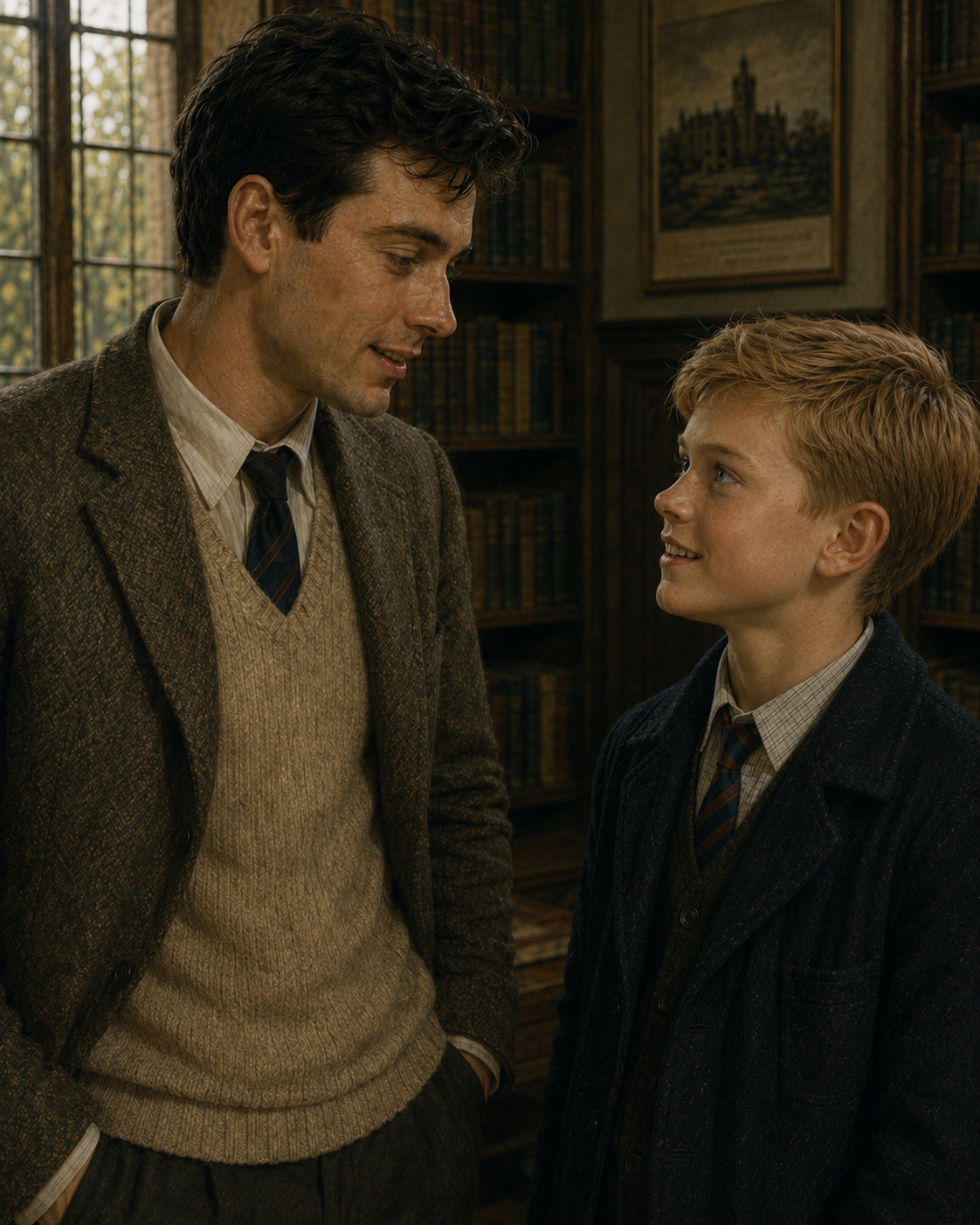
“Hello, Tomkins”, he said, “I heard what happened”. (Note: “I heard what happened”, not “I heard what you did”). “I bet you’ve got some decent bruises on your plum.”
“Yes, sir”, I replied, “but I suppose it was my own fault.”
He made no answer other than a non-committal murmur, but held out his arm and put his hand on my shoulder. I moved closer to him, and he put both arms around me and gave me a warm, comforting hug.
At that point he was apotheosed in my estimation from Quite Decent Master to Extra Special Master. He had not only refrained from concurring in my blame, but had shown sympathy with both my misfortune and its result. At this distance in time I can analyze my feelings with some accuracy; at the time I just felt that here was someone who Really Cared. It did not then occur to me to wonder about his feelings.
School life went on with its daily round. I was able to keep my end up pretty well in most academic subjects, though came top no more than my fair share of times. Holidays were spent either at home or, more enjoyably, with Granny T. My father avoided having to fetch and carry me from and to school; quite often I travelled with Richards, another boy who lived in the same town as us. Father’s excuse was, of course, his practice. My mother had never learned to drive.
At the end of each school year came the Gaudy Day, with a distinguished visiting speaker, prize giving and a concert given by the boys to the parents and other visitors. In my penultimate Gaudy, the visiting speaker was a distinguished classical scholar – I think the connection was that he had been a fellow-undergraduate with the Headmaster. I knew I had done reasonably well throughout the year and in the yearly examinations, though it was a tradition that the examination results were not given to us directly, but were included in our reports to our parents. I never saw any of mine, something which I still regret as I think they might have boosted my somewhat fragile self-confidence.
We listened to the Headmaster’s review of the school year, then to the address given by the visiting speaker. Then came the prize giving. The sports prizes always came first, for some reason. Then came the academic prizes.
“The Butler Prize for English”, said the Headmaster, “goes this year to Thomas Tomkins”. No doubt blushing, I proceeded to the platform to receive my prize and a handshake from the visitor.
Two or three more prizes for English and modern languages followed. Then came Latin.
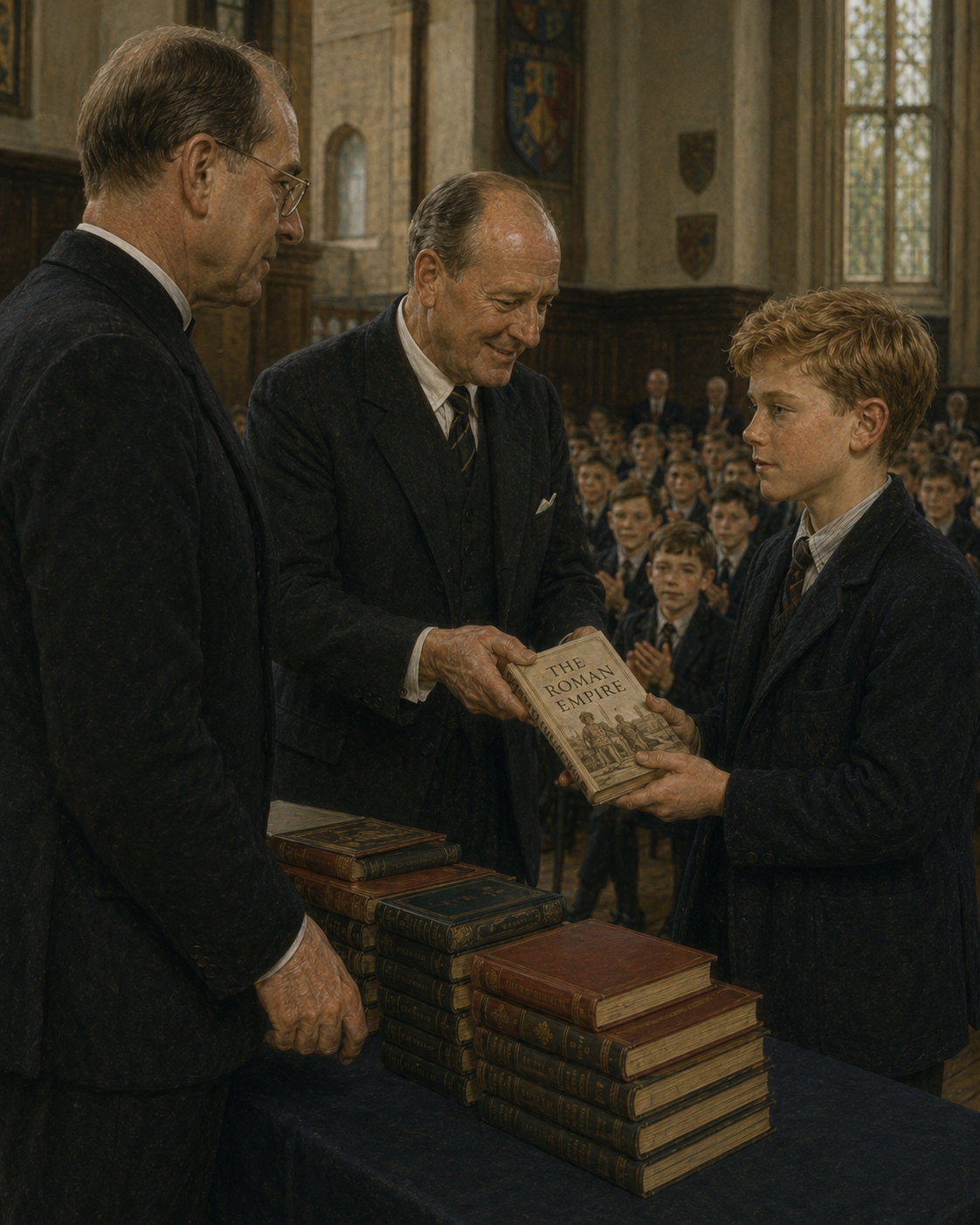
“The Arnold Prize for Latin goes to Thomas Tomkins”. I could scarcely believe my ears. I knew I had done reasonably well in Latin, but to win the prize... it was a moment of pure joy. I looked round at Mr Pascoe, who was beaming and clapping enthusiastically. He gave me a nod, and I climbed the steps once more to the platform. Another handshake from the distinguished visitor, and a book. I returned to my seat. When I looked at the book, not only was it a copy of a popular work on classical civilizations written by our distinguished visitor, but it had been inscribed in his own hand with a Latin motto praising my diligence. I have the book, which I have read many times, on my bookshelves to this day.
After the speeches and the concert were done, and parents were starting to round up their children preparatory to taking them home, I looked for Mr Pascoe to thank him. He was not in the Hall, nor in his classroom, nor in the Masters’ Common Room. Rather diffidently, as we were not encouraged to disturb masters in their off-duty hours, I knocked at the door of his room. He emerged into the corridor, beaming at me.
“I just came to thank you for getting me the Latin prize”, I said.
“You deserved it, “he replied, “and I am going to tell you, though I shouldn’t, that you came top in the exam with over ninety per cent”.
I must have looked at him open-mouthed. For the second time, he took me in his arms, and gave me a warm, elder-brotherly hug.
“You’re a good boy,” he said, “a very good boy, and you deserve every success. Now, have a good holiday, and come back next term ready to do even better.” Not knowing what I was doing, I returned his hug, and then with a conventional “goodbye, sir”, walked though the rapidly emptying building and joined the Richards family who were, as usual, to take me home.
When I reached home, I told my parents of my prizes. “Mph... well done” was my father’s sole comment. My mother said nothing. I didn’t bother to show them my prizes, but they stayed next to my bed for the whole holiday, where I could see them. I could not help but contrast my parents’ colourless response with Mr Pascoe’s obvious enjoyment of my success.
Comments powered by CComment