
HOW A MAN MAY BECOME AWARE OF HIS PROGRESS IN VIRTUE
BY PLUTARCH
How a Man May Become Aware of his Progress in Virtue Πῶς ἄν τις αἴσθοιτο ἑαυτοῦ προκόπτοντος ἐπ᾿ ἀρετῇ is one of the many essays that make up the Moralia of the Boiotian Greek historian and philosopher Plutarch Πλούταρχος of Chaironeia (ca. AD 46-120) who won Roman imperial favour and rose to become procurator of Achaia, written around AD 100. Presented here is the only passage in it of Greek love interest.
The translation is by Frank Cole Babbitt for Plutarch, Moralia, Volume I, the Loeb Classical Library Volume 197, published by William Heinemann in London in 1927.
80e-81a
|
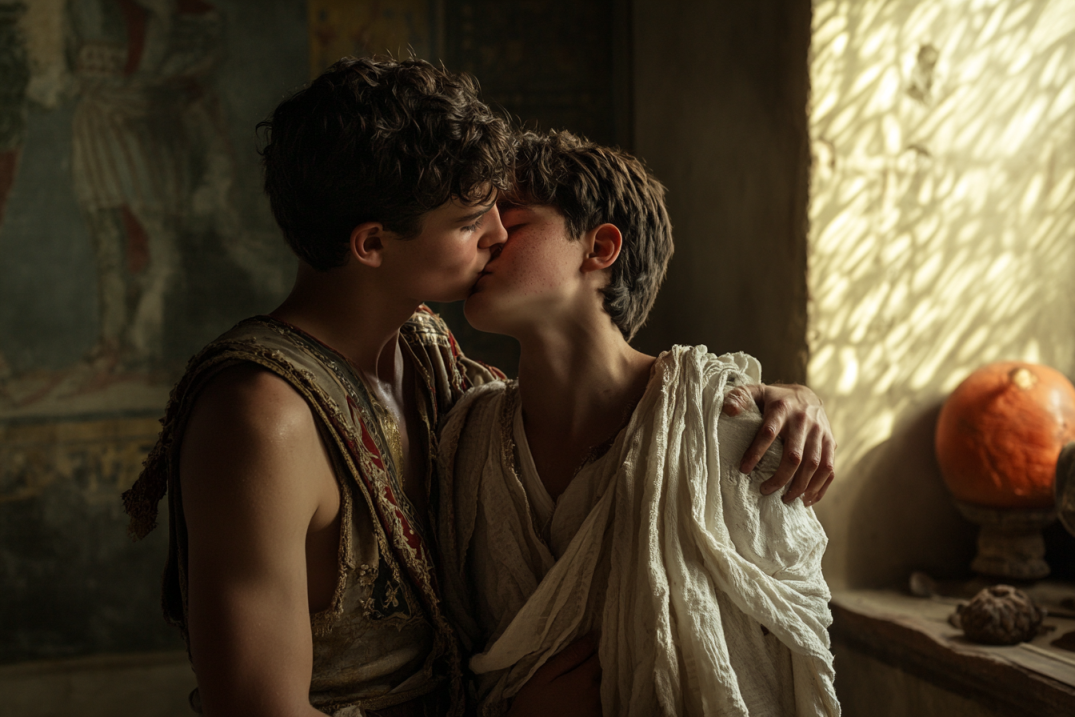
For if true love for a boy[1] or a woman does not seek witnesses, but enjoys the fruits of pleasure even if it consummate its desire in secret, it is even more to be expected that the lover of honour and wisdom, in the familiar intercourse with virtue which comes through his actions, should keep his pride in himself to himself and be silent, feeling no need of eulogists and auditors. […] It is therefore the mark of a man who is making progress, not only when he has given to a friend or done a kindness to an acquaintance to refrain from telling of it to others, but also when he has given an honest judgement amidst a numerous and dishonest majority, when he has peremptorily declined a discreditable conference with some rich man or some official, when he has scorned bribes, and even when he has felt a craving in the night for a drink and has not taken it, or when he has fought a good fight, like Agesilaos, against a kiss of a lovely girl or youth,[2] to keep all this to himself and put the seal of silence on it. |
[80e] εἰ γὰρ ἀληθινὸς ἔρως παιδὸς ἢ γυναικὸς οὐ ζητεῖ μάρτυρας, ἀλλὰ καρποῦται τὸ ἡδὺ κἂν κρύφα κατεργάσηται τὸν πόθον, ἔτι μᾶλλον εἰκός ἐστι τὸν φιλόκαλον καὶ φιλόσοφον συνόντα διὰ τῶν πράξεων τῇ ἀρετῇ καὶ χρώμενον αὐτὸν ἐν ἑαυτῷ σιωπῇ μέγα φρονεῖν, [f] ἐπαινετῶν καὶ Fἀκροατῶν μηδὲν δεόμενον. […] [81a] ἔστιν 81οὖν τοῦ προκόπτοντος οὐ μόνον δόντα τῷ φίλῳ καὶ γνώριμον εὐεργετήσαντα μὴ φράσαι πρὸς ἑτέρους, ἀλλὰ καὶ ψῆφον ἐν πολλαῖς θέμενον ἀδίκοις δικαίαν καὶ πρὸς ἔντευξιν αἰσχρὰν πλουσίου τινὸς ἢ ἄρχοντος ἀπισχυρισάμενον καὶ δωρεὰς ὑπεριδόντα καὶ νὴ Δία διψήσαντα νύκτωρ καὶ μὴ πιόντα ἢ πρὸς φίλημα καλῆς ἢ καλοῦ διαμαχεσάμενον, ὡς ὁ Ἀγησιλαος, ἐν ἑαυτῷ κατασχεῖν καὶ σιγῆσαι. |
[1] There can be no excuse for translating παιδὸς as “youth” instead of “boy”, as the translator did. It has accordingly been corrected.
[2] This alludes to an incident in 395 BC when Agesilaos II King of the Spartans refused to be kissed by Megabates, a beautiful Persian boy he had fallen in love with, a story most fully recounted by Xenophon in his Agesilaos V 4-5. Plutarch himself also recounted it in his Life of Agesilaos XI.
The translation of καλῆς ἢ καλοῦ as “beautiful maidens and youths” is very approximate, though perhaps fair enough; it really means “the beautiful [implicitly female] and the beautiful [implicitly male]”, ie. the beautiful of both sexes.
Comments powered by CComment