
AELIAN’S HISTORICAL MISCELLANY
Claudius Aelianus was a Roman writer of the early 3rd century AD, who nevertheless wrote in Greek. His Historical Miscellany is a series of anecdotes from older writers. Presented here is everything in it of Greek love interest.
The translation is by Nigel G. Wilson for the Loeb Classical Library volume 486 published by the Harvard University Press in Cambridge, Massachusetts in 1997. His Latinisation of Greek names has been undone. A few words have been amended with full explanations in footnotes.
I 30
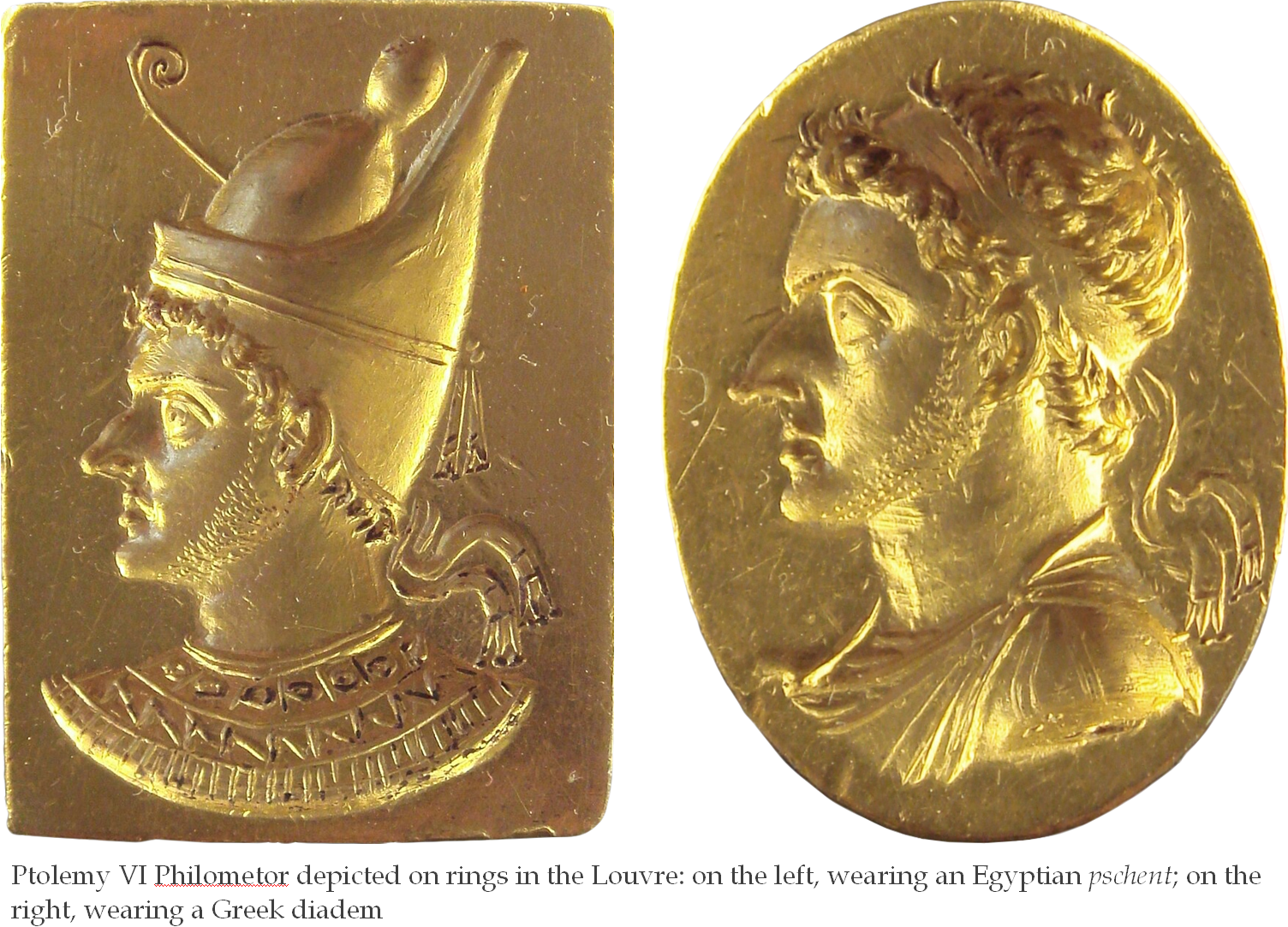
| King Ptolemy was in love with a boy called Galestes, of most handsome appearance.[1] But the lad’s judgement proved superior to his looks. Frequently Ptolemy recognised this and said to him, “Dear boy, you have never been the cause of misfortune to anyone, while you have brought many benefits to a lot of people.” The youth[2] was riding with the king, when he saw some men at a distance being led off to be executed. He watched with concern and said to Ptolemy, “Sire, since by a chance that is lucky for the condemned men we happen to be on horseback, if you are willing, let us increase our pace and make an effort to catch up with them, so as to be like Dioskoroi to the poor wretches, ‘saviours and benevolent guardians’, as those gods are commonly described.”[3] The king was greatly delighted by his noble thought and much appreciated his wish to show mercy; so he spared the men and increased his feeling of devotion for the boy. | Πτολεμαῖος ὁ βασιλεὺς ἐρώμενον εἶχε Γαλέστην ὄνομα, ἰδεῖν κάλλιστον. ἀμείνων δὲ ἦν ἄρα τούτῳ τῷ μειρακίῳ ἡ γνώμη τῆς μορφῆς. πολλάκις γοῦν αὐτῷ καὶ ὁ Πτολεμαῖος ἐμαρτύρει καὶ ἔλεγεν· “ὦ ἀγαθὴ κεφαλή, κακοῦ μὲν οὐδεπώποτε οὐδενὶ γέγονας αἴτιος, πολλοῖς δὲ καὶ πολλὰ ἀγαθὰ προὐξένησας.” ὁ μὲν ἵππευε σὺν τῷ βασιλεῖ τὸ μειράκιον· ἰδὼν δὲ πόρρωθεν ἀγομένους τινὰς ἐπὶ θανάτῳ, οὐ ῥᾳθύμως εἶδεν, ἀλλ᾿ ἔφη πρὸς τὸν Πτολεμαῖον· “ὦ βασιλεῦ, ἐπεὶ κατά τινα δαίμονα τῶν ἀγομένων ἀγαθὸν ἐπὶ ἵππων ἐτύχομεν ὄντες, φέρε, εἴ σοι δοκεῖ, τὴν ἔλασιν ἐπιτείναντες καὶ συντονώτερον ἐπιδιώξαντες Διόσκοροι τοῖς δειλαίοις γενώμεθα, σωτῆρες ἔνθα κἀγαθοὶ παραστάται, τοῦτο δὴ τὸ λεγόμενον ἐπὶ τῶν θεῶν τούτων.” ὁ δὲ ὑπερησθεὶς αὐτοῦ τῇ χρηστότητι καὶ τὸ φιλοίκτιρμον ὑπερφιλήσας, καὶ ἐκείνους ἔσωσε καὶ ἐπὶ πλέον προσέθηκε τῷ φίλτρῳ τοῦ κατ᾿ αὐτὸν ἔρωτος. |
II 4
|
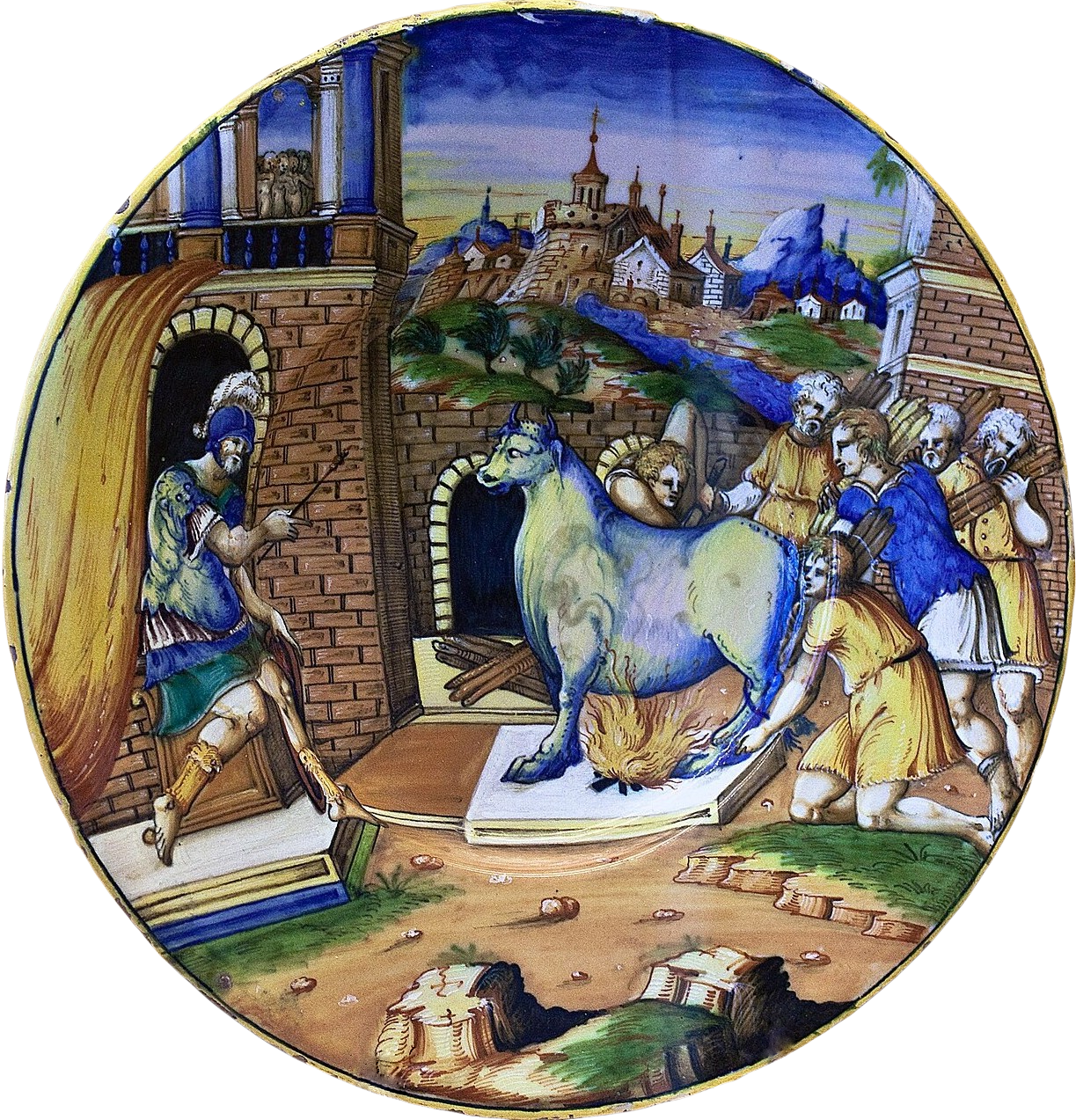
I want to mention to you an act of Phalaris which was not altogether like him.[4] The act indicates unsurpassed kindness and for this reason appears foreign to his nature. Chariton of Akragas, a lover of beauty, was specially susceptible to the charms of the young. He fell passionately in love with Melanippos, who was also from Akragas, a youth of noble character and exceptional beauty. Phalaris annoyed this Melanippos, because in a lawsuit the latter brought against one of the companions of the tyrant himself, Phalaris ordered him to stop his action. When he refused the tyrant threatened him with extremely severe punishment for disobedience. The defendant therefore won his case, unjustly, because Phalaris’ orders amounted to compulsion, and the magistrates annulled the case. The youth[5] was offended by this and complained of having been badly treated. He admitted to his lover his personal feelings of annoyance and asked him to join in a conspiracy against the tyrant. He also made efforts to enlist other youths[6] whom he knew to be very keen to take part in such an enterprise. Chariton saw he was beside himself and blazing with anger, but he knew that none of the other citizens would join them, for fear of the tyrant. He said he himself had longed to take this action for some time and was anxious at all costs to free their country from the servitude that had overtaken it. But it would not be safe to reveal such thoughts to many people. He asked Melanippos to let him investigate the matter more closely, and to leave to him the choice of the right moment for action. The youth[7] agreed. So Chariton took upon himself all the responsibility for the adventure, not wanting to engage his beloved as a partner, so that if he himself were caught and paid the penalty, at least he would not bring the same fate upon the boy. When the time seemed to be right he took a dagger and attacked the tyrant. But he did not escape detection, and was caught, as the bodyguards kept a very close watch against such attempts. He was put in prison by Phalaris and tortured in order that he should reveal who had conspired with him; but he held out and resisted the torture. When this had gone on for some time, Melanippos approached Phalaris and confessed not only to being an accomplice in Chariton’s plan, but to having suggested the idea of a conspiracy. When Phalaris asked the reason, he told the whole story, beginning with the annulment of the lawsuit, and admitted his great annoyance at this. Phalaris was struck with admiration and released them both without punishment, with an order to leave not merely Akragas, but Sicily, that very day. But he allowed them to enjoy their own rights of property. The Pythian priestess later celebrated them and their friendship in these verses: Setting mortals an example of divine affection |
Φαλάριδος ὑμῖν ἔργον οὐ μάλα ἐκείνῳ σύνηθες εἰπεῖν ἐθέλω· τὸ δὲ ἔργον φιλανθρωπίαν ἄμαχον ὁμολογεῖ καὶ διὰ τοῦτο ἀλλότριον ἐκείνου δοκεῖ. Χαρίτων ἦν Ἀκραγαντῖνος φιλόκαλος ἄνθρωπος καὶ περὶ τὴν ὥραν τὴν τῶν νέων ἐσπουδακὼς δαιμονίως· διαπύρως δὲ ἠράσθη μάλιστα Μελανίππου, Ἀκραγαντίνου καὶ ἐκείνου, καὶ τὴν ψυχὴν ἀγαθοῦ καὶ τὸ κάλλος διαφέροντος. τοῦτον ἐλύπησέ τι Φάλαρις τὸν Μελάνιππον· δικαζομένῳ γὰρ αὐτῷ πρός τινα τῶν ἑταίρων αὐτοῦ τοῦ Φαλάριδος προσέταξεν ὁ τύραννος τὴν γραφὴν καταθέσθαι. τοῦ δὲ μὴ πειθομένου ὁ δὲ ἠπείλησε τὰ ἔσχατα δράσειν αὐτὸν μὴ ὑπακούσαντα. καὶ ἐκεῖνος μὲν παρὰ τὴν δίκην ἐκράτησεν τῇ ἀνάγκῃ προστάξαντος τοῦ Φαλάριδος, οἱ δὲ ἄρχοντες τὴν γραφὴν τοῦ ἀγῶνος ἠφάνισαν. βαρέως δ᾿ ἐπὶ τούτοις ὁ νεανίσκος ἤνεγκεν ὑβρίσθαι λέγων, καὶ ὡμολόγει τὴν ὀργὴν τὴν ἑαυτοῦ πρὸς τὸν ἐραστὴν ὁ Μελάνιππος καὶ ἠξίου κοινωνὸν αὐτὸν γενέσθαι τῆς ἐπιθέσεως τῆς κατὰ τοῦ τυράννου καὶ ἄλλους δὲ ἔσπευδε προσλαβεῖν τῶν νεανίσκων, οὓς μάλιστα ᾔδει περὶ τὴν τοιαύτην πρᾶξιν θερμοτάτους. ὁρῶν δὲ αὐτὸν ὁ Χαρίτων ἐνθουσιῶντα καὶ ὑπὸ τῆς ὀργῆς ἀναφλεγόμενον καὶ γινώσκων ὅτι τῶν πολιτῶν οὐδεὶς αὐτοῖς συλλήψεται δέει τῷ ἐκ τοῦ τυράννου, καὶ αὐτὸς ἔφη πάλαι τοῦτο ἐπιθυμεῖν καὶ σπεύδειν ἐκ παντὸς τὴν πατρίδα ῥύσασθαι τῆς δουλείας τῆς καταλαβούσης· ἀσφαλὲς δὲ μὴ εἶναι πρὸς πολλοὺς τὰ τοιαῦτα ἐκφέρειν. ἠξίου δὴ τὸν Μελάνιππόν οἱ συγχωρῆσαι ἀκριβέστερον ὑπὲρ τούτων διασκέψασθαι καὶ ἐᾶσαι παραφυλάξαι τὸν χρόνον τὸν ἐπιτήδειον εἰς τὴν πρᾶξιν. συνεχώρησε τὸ μειράκιον. ἐφ᾿ ἑαυτοῦ τοίνυν ὁ Χαρίτων βαλόμενος τὸ πᾶν τόλμημα καὶ κοινωνὸν αὐτοῦ μὴ θελήσας παραλαβεῖν τὸν ἐρώμενον, ἵν᾿, εἰ καταφωραθείη, αὐτὸς ὑπέχοι τὴν δίκην, ἀλλὰ μὴ καὶ ἐκεῖνον εἰς ταὐτὰ ἐμβάλοι, ἡνίκα οἱ ἐδόκει καλῶς ἔχειν, ἐγχειρίδιον λαβὼν ὡρμᾶτο ἐπὶ τὸν τύραννον. οὐ μὴν ἔλαθε, κατεφωράθη δέ, πάνυ σφόδρα ἀκριβῶς τῶν δορυφόρων τὰ τοιαῦτα φυλαττόντων. ἐμβληθεὶς δὲ ὑπὸ τοῦ Φαλάριδος εἰς τὸ δεσμωτήριον καὶ στρεβλούμενος ἵν᾿ εἴπῃ τοὺς συνεγνωκότας, ὁ δὲ ἐνεκαρτέρει καὶ ἐνήθλει ταῖς βασάνοις. ἐπεὶ δὲ μακρὸν τοῦτο ἦν, ὁ Μελάνιππος ἧκεν ἐπὶ τὸν Φάλαριν καὶ ὡμολόγησεν οὐ μόνον κοινωνὸς εἶναι τῷ Χαρίτωνι τῆς βουλῆς ἀλλὰ καὶ αὐτὸς ἄρξαι τῆς ἐπιβουλῆς. τοῦ δὲ πυνθανομένου τὴν αἰτίαν, εἶπε τὸν ἐξ ἀρχῆς λόγον καὶ τὴν τῆς γραφῆς ἄρσιν, καὶ ἐπὶ τούτοις ὡμολόγει περιαλγῆσαι. θαυμάσας οὖν ὁ Φάλαρις ἀμφοτέρους ἀφῆκε τῆς τιμωρίας, προστάξας αὐθημερὸν ἀπελθεῖν μὴ μόνον τῆς Ἀκραγαντίνων πόλεως ἀλλὰ καὶ τῆς Σικελίας· συνεχώρησε δὲ αὐτοῖς τὰ ἴδια δίκαια καρποῦσθαι. τούτους ὕστερον ἡ Πυθία καὶ τὴν φιλίαν αὐτῶν ὕμνησε διὰ τούτων τῶν ἐπῶν· θείας ἡγητῆρες ἐφημερίοις φιλότητος |
III 10 & 12
For this, see the article Pederasty in ancient Sparta.
| Note that Sokrates’ loved boy[9] was Alkibiades, and Plato’s was Dion. But Dion did derive some benefit from his lover.[10] | Ὅτι παιδικὰ ἐγένετο Σωκράτους μὲν Ἀλκιβιάδης, Πλάτωνος δὲ Δίων. ὁ μέντοι Δίων καὶ ἀπώνητό τι τοῦ ἐραστοῦ. |
VIII 9
For this episode, see the article The Death of Archelaos of Macedon, 399 BC.
After describing how the Athenian lawgiver Solon [ca. 639-559 BC] had tried in vain to obstruct Peisistratos from becoming tyrant:
| However, Peisistratos did Solon no harm, whether out of respect for the man and his wisdom, or because of recollections of youth—he is said to have been Solon’s loved boy.[11] | ὅμως οὖν Πεισίστρατος, εἴτε αἰδοῖ τῇ πρὸς τὸν ἄνδρα καὶ τὴν σοφίαν αὐτοῦ, εἴτε καὶ μνήμῃ τῶν ἐφ᾿ ἡλικίας (λέγεται γὰρ αὐτοῦ παιδικὰ γενέσθαι), οὐδέν γε ἔδρασε κακὸν Σόλωνα. |
IX 4
| Polykrates of Samos was devoted to the Muses. He honoured Anakreon of Teos, and took him seriously, enjoying both his company and his poems. But I cannot applaud the tyrant’s extravagant habits. Anakreon was warm in his praises for Smerdies, Polykrates’ loved boy.[12] The youth was delighted by the compliments and greeted Anacreon, who was in love with his soul but not his body, in very formal style. Let no one, by the gods, utter in our hearing accusations against the poet from Teos or say that he was guilty of indecency. But Polykrates was jealous of his regard for Smerdies and because he could see the poet’s friendship returned by the boy. Polykrates had the boy’s hair cut off, which humiliated him and was intended to pain Anakreon. The latter displayed moderation and self-control by pretending not to criticise Polykrates; instead he blamed the youth and accused him of arrogance and bad behaviour, and of taking the shears to his own hair.[13] Let Anakreon sing his poem about the fate of the hair—he will sing it better than I can. | Πολυκράτης ὁ Σάμιος ἐν Μούσαις ἦν καὶ Ἀνακρέοντα ἐτίμα τὸν Τήιον καὶ διὰ σπουδῆς ἦγε καὶ ἔχαιρεν αὐτῷ καὶ τοῖς ἐκείνου μέλεσιν. οὐκ ἐπαινῶ δὲ αὐτοῦ τὴν τρυφήν. Ἀνακρέων ἐπῄνεσε Σμερδίην θερμότερον τὰ παιδικὰ Πολυκράτους, εἶτα ἥσθη τὸ μειράκιον τῷ ἐπαίνῳ, καὶ τὸν Ἀνακρέοντα ἠσπάζετο σεμνῶς εὖ μάλα, ἐρῶντα τῆς ψυχῆς, ἀλλ᾿ οὐ τοῦ σώματος· μὴ γάρ τις ἡμῖν διαβαλλέτω πρὸς θεῶν τὸν ποιητὴν τὸν Τήιον, μηδ᾿ἀκόλαστον εἶναι λεγέτω. ἐζηλοτύπησε δὲ Πολυκράτης ὅτι τὸν Σμερδίην ἐτίμησε καὶ ἑώρα τὸν ποιητὴν ὑπὸ τοῦ παιδὸς ἀντιφιλούμενον, καὶ ἀπέκειρε τὸν παῖδα ὁ Πολυκράτης, ἐκεῖνον μὲν αἰσχύνων, οἰόμενος δὲ λυπεῖν Ἀνακρέοντα. ὁ δὲ οὐ προσεποιήσατο αἰτιᾶσθαι τὸν Πολυκράτη σωφρόνως καὶ ἐγκρατῶς, μετήγαγε δὲ τὸ ἔγκλημα ἐπὶ τὸ μειράκιον ἐν οἷς ἐπεκάλει τόλμαν αὐτῷ καὶ ἀμαθίαν ὁπλισαμένῳ κατὰ τῶν ἑαυτοῦ τριχῶν. τὸ δὲ ᾆσμα τὸ ἐπὶ τῷ πάθει τῆς κόμης Ἀνακρέων ᾀσάτω· ἐμοῦ γὰρ αὐτὸς ἄμεινον ᾄσεται. |
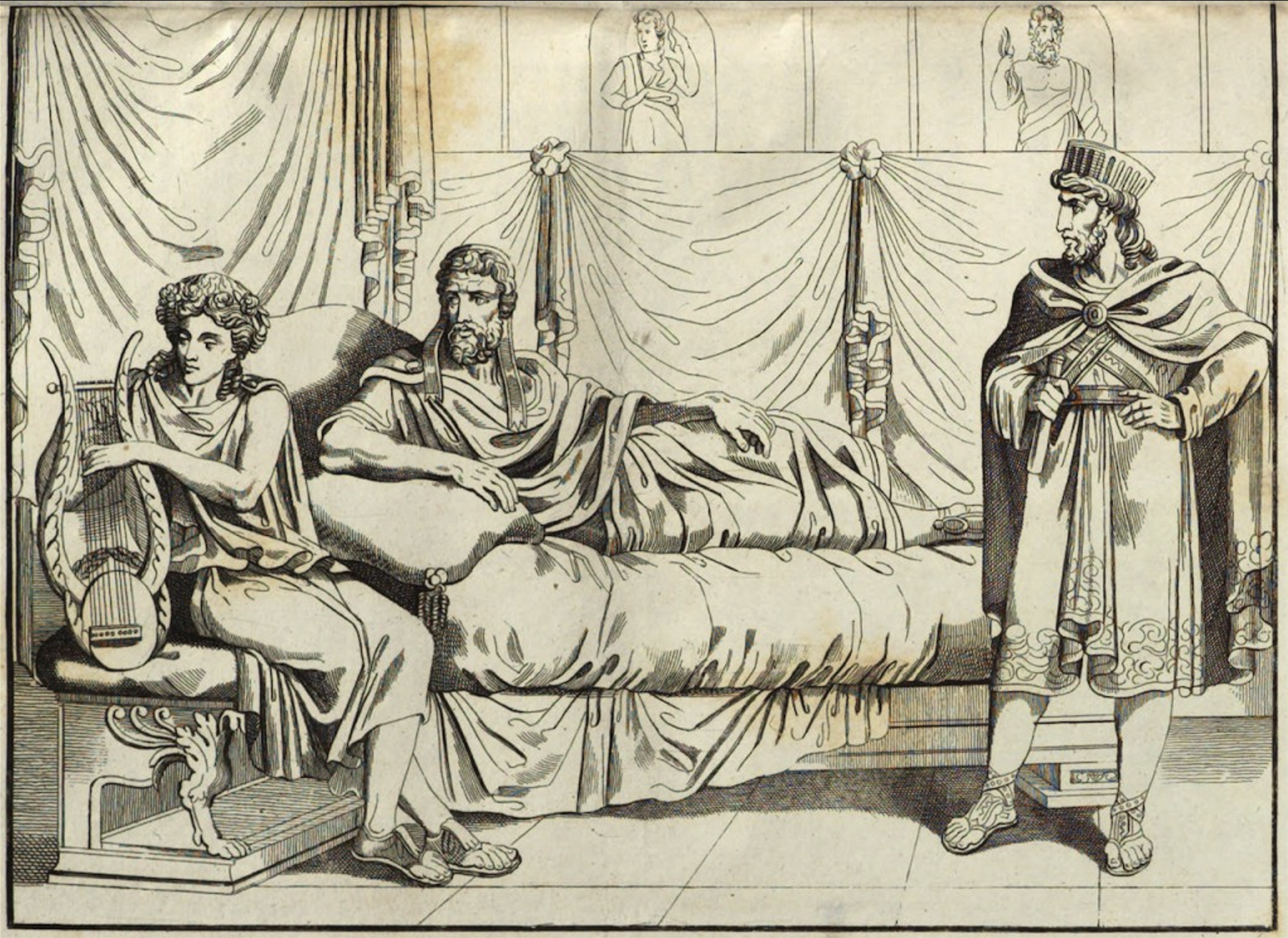
Polykrates and Anakreon (from Vorzeit und Gegenwart. Eine historische Lese, 1832)
IX 9
For this anecdote, see the article Demetrios of Phaleron, ca. 350-ca.280 BC.
| At Soli in Cilicia a boy called Xenophon was loved by a dog, and another handsome youth at Sparta was adored by a crow. | καὶ ἐν Σόλοις δὲ τῆς Κιλικίας παιδός, Ξενοφῶντος, ἠράσθη κύων, ἄλλου δὲ ὡραίου μειρακίου ἐν Σπάρτῃ κολοιός. |
X 18
| Some say the herdsman Daphnis was the loved boy[14] of Hermes, others that he was his son. | Δάφνιν τὸν βουκόλον λέγουσιν οἱ μὲν ἐρώμενον Ἑρμοῦ, ἄλλοι δὲ υἱόν· τὸ δὲ ὄνομα ἐκ τοῦ συμβάντος σχεῖν. |
XI 12
| Alkibiades sent Sokrates a large and beautifully made cake. Xanthippe[15] was annoyed in her usual way, treating the cake as a present sent by a loved boy[16] to his lover to reinforce his passion, so she emptied it out of the basket and trod on it. Sokrates laughed and said: “Well, you won’t get any of it either.” | Πλακοῦντα ὁ Ἀλκιβιάδης μέγαν καὶ ἐσκευασμένον κάλλιστα διέπεμψε Σωκράτει. ὡς οὖν ὑπὸ ἐρωμένου ἐραστῇ πεμφθὲν [τὸ] δῶρον ἐκκαυστικὸν τὸν πλακοῦντα διαγανακτήσασα κατὰ τὸν αὑτῆς τρόπον ἡ Ξανθίππη ῥίψασα ἐκ τοῦ κανοῦ κατεπάτησε. γελάσας δὲ ὁ Σωκράτης “οὐκοῦν” ἔφη “οὐδὲ σὺ μεθέξεις αὐτοῦ.” |
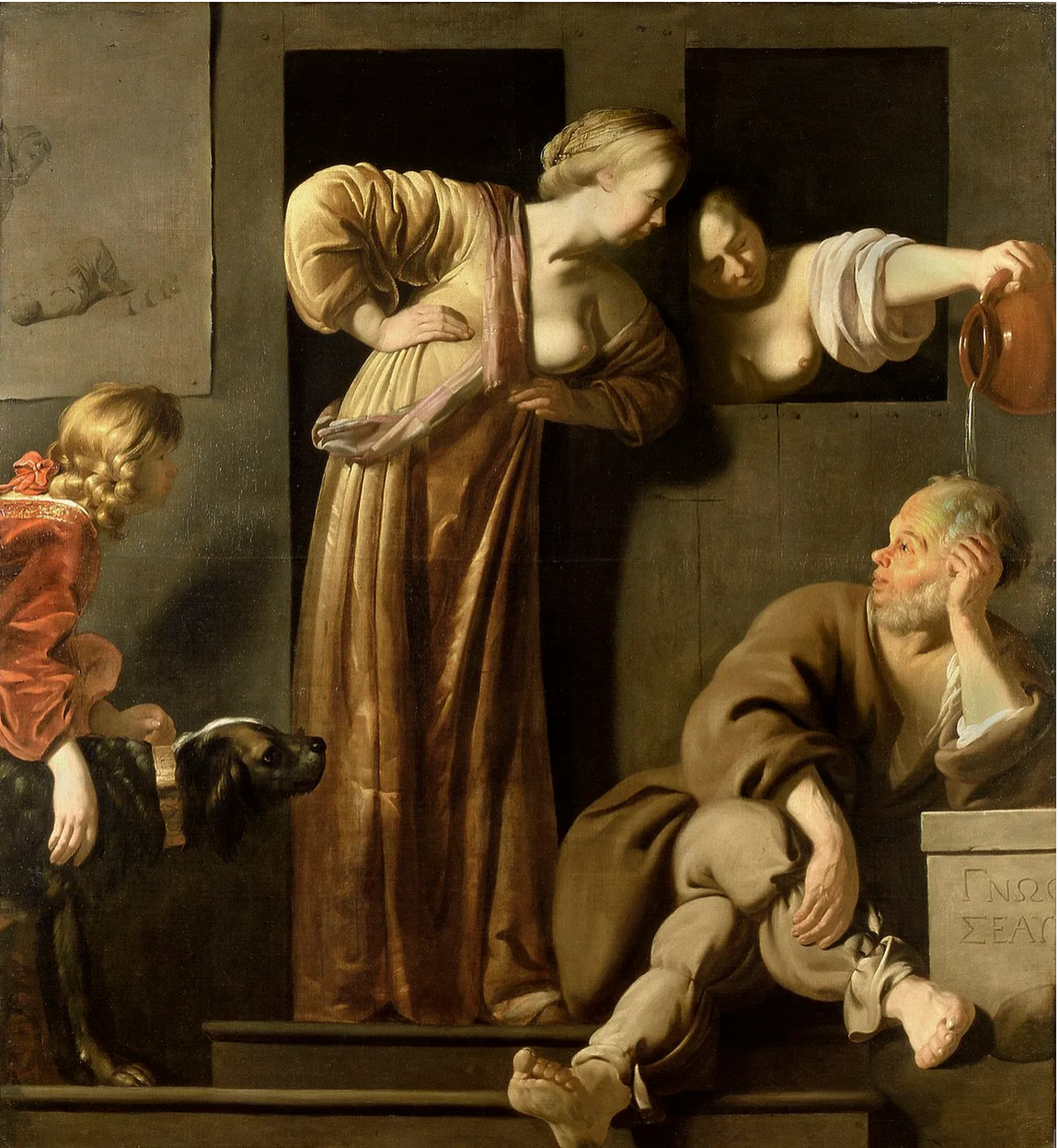
Sokrates, his Two Wives and Alkibiades by Reyer van Blommendael: Xanthippe is pouring water on the head of Sokrates, who remarked calmly that one should expect rain after thunder
XII 1
For this anecdote, see the article Pederasty in ancient Persia.
| Note that Alexander laid a wreath on Achilles’ tomb and Hephaistion on Patroklos’, hinting that he was the object of Alexander’s love, as Patroklos was of Achilles.[17] | Ὅτι Ἀλέξανδρος τὸν Ἀχιλλέως τάφον ἐστεφάνωσε καὶ Ἡφαιστίων τὸν τοῦ Πατρόκλου, αἰνιττόμενος ὅτι καὶ αὐτὸς ἦν ἐρώμενος τοῦ Ἀλεξάνδρου, ὥσπερ Ἀχιλλέως ὁ Πάτροκλος. |
XIII 5
See the article Laios and Chrysippos.
[1] Galestes, there spelt Galaistes, was mentioned as a friend of Ptolemy VI Philometor (186-145 BC) King of Egypt 180-145 BC by Diodoros of Sicily in his Library of History XXXIII 20 and 22. Diodoros says he was a son of Amynandros King of the Athamanians (a Greek people living between Epeiros and Thessaly), that he went on to be the general of Ptolemy VI, after whose death he was driven into exile in Greece, apparently with the King’s son, whose guardian he had been made and whom he tried [in vain] to make King. Amynandros had died in 178 and his kingdom was completely conquered by the Romans in 164-3 BC, when most of the population left. One can reasonably surmise that Galestes was born around the end of his father’s reign and fled in his teens or earlier into exile in Egypt where he soon became the beloved of Ptolemy VI and thereafter his trusted friend.
[2] “Young man” has been replaced by youth as a translation of μειράκιον, used for males in the third seven-year phase of life, ie. over 14 and under 21.
[3] Though the text of this iambic line is not entirely certain, the sense is clear. For the Dioscuri as saviours see the evidence assembled e.g. by W. Burkert, Greek Religion (Oxford and Cambridge, Mass., 1985), pp. 212–213. [Translator’s note]
[4] Phalaris, tyrant of Akragas from 570 to 554 B.C., was a byword for cruelty, most famous for his hollow bronze bull in which the condemned were roasted to death.
[5] “Young man” has been replaced by “youth” as a translation of νεανίσκος. While the latter word merely means a young male, μειράκιον, also used for Melanippos, makes “youth” the most accurate of the various words that could be used.
[6] “Young men” has been replaced by “youths” as a translation of νεανίσκων. While the latter word merely means young males, the use of μειράκιον (a youth of 14-20) for Melanippos and the implication through “other” that those he tried to enlist were his own age, makes “youths” the most accurate of the various words that could be used.
[7] “Young man” has been replaced by “youth” as a translation of μειράκιον, used for males in the third seven-year phase of life, ie. over 14 and under 21.
[8] The Pythian prophet was regarded as the mouthpiece of Apollo. This oracle is no. 327 in H. W. Parke and D. E. W. Wormell, The Delphic Oracle (Oxford, 1956). It is cited in Athenaeus 602 B and Eusebius, Praeparatio evangelica 5.35.1–3. See also J. Hammerstaedt, Die Orakelkritik des Kynikers Oenomaus (Frankfurt, 1988), pp. 13 n. 3 and 223. [Translator’s footnote]
[9] “Favourite boy” has been replaced by “loved boy” as a translation of παιδικὰ, the boy in a pederastic love affair. “Boy favourite” would have been fair enough, but “favourite boy” (implying the lover had other boys) is simply wrong.
[10] The Athenian philosopher Sokrates (469-399 BC) filled the public role of lover of the future general Alkibiades (ca. 450-404 BC) for several years of his adolescence, though the best-known accounts say their affair was chaste. The philosopher Aristokles, better known as Platon (ca. 426-348/7 BC) was the lover of the future Syracusan tyrant Dion (408-354 BC), who studied in Athens as a teenager. Whereas Alkibiades was widely considered to have gone off the rails, Dion imbibed his lover’s philosophical ideas for life.
[11] “Favourite boy” has been replaced by “loved boy” as a translation of παιδικὰ, the boy in a pederastic love affair. “Boy favourite” would have been fair enough, but “favourite boy” (implying the lover had other boys) is simply wrong.
[12] “Favourite boy” has been replaced by “loved boy” as a translation of παιδικὰ, the boy in a pederastic love affair. “Boy favourite” would have been fair enough, but “favourite boy” (implying the lover had other boys) is simply wrong.
Polykrates was tyrant of Samos from ca. 543 to 522 BC. He was a patron of the great lyric poet Anakreon (ca. 570-486 BC), well-known as a lover of boys and not usually presented as a chaste one.
[13] The Greek is difficult here; it seems to indicate that Smerdies brought disaster upon himself by being too attractive. [Translator’s note]
[14] “Favourite boy” has been replaced by “loved boy” as a translation of ἐρώμενον, a boy loved in an erotic/romantic sense by a man. “Boy favourite” would have been fair enough, but “favourite boy” (implying the lover had other boys) is simply wrong.
[15] Xanthippe was the famously ill-tempered wife of the Athenian philosopher Sokrates (469-399 BC), who was reputed to be the lover of the future general Alkibiades (ca. 450-404 BC) for at least the years 435-432 BC.
[16] “Favourite boy” has been replaced by “loved boy” as a translation of ἐρωμένου, a boy loved in an erotic/romantic sense by a man. “Boy favourite” would have been fair enough, but “favourite boy” (implying the lover had other boys) is simply wrong.
[17] The idea that Patroklos was the eromenos of Achilles, as opposed to vice versa (if they were lovers at all) seems to have gained a following from Aischylos’s lost 5th century BC play about them, The Myrmidons, but it runs counter to the older and thus more legitimate tradition. As Phaidros put it in Plato’s Symposium, “Aischylos talks nonsense in claiming that it was Achilles who was in love with Patroklos, for he was more beautiful than not only Patroklos but all the other heroes as well, and still beardless, and, as Homer says, far younger than him.” (Symposium 180a)
What, if anything, this tells us about the love of Alexander and Hephaistion is unclear, since they were the same age. All else besides age being equal, one might have expected Alexander, as the stronger character and of higher status, to have taken the role of erastes, if they were really ever lovers (which is as contentious as Achilles and Patroklos having been). Certainly their intimacy went back to their boyhood, and it is during that time that any sexual dimension to their relationship should be placed, not to the spring of 334 BC, when they were 21 and celebrated their equivalence to Achilles and Patroklos by sacrificing at their tombs. Alexander and Hephaistion had many bitter enemies, but none accused either of being a kinaidos, a (despised, adult) pathic. Saying this is not to underestimate the extremely strong lifelong bond between them, whether or not eros had had a role in forging it.
Comments powered by CComment