
MAGNUS ENCKELL’S SYMBOLIC BOYS
BY GORRIT GOSLINGA
Knut Magnus Enckell (9 November 1870 – 27 November 1925) was a Finnish symbolist painter. The following account of his painting of boys and young men by Dutch teacher Gorrit Goslinga (1949-2009) appeared in issue 28 of Koinos magazine, published in Amsterdam in 2000, pp. 4-9. The illustrations all appeared in the original article.
After a brief explanation of how Goslinga came to visit exhibitions in Helsinki in 2000, …
The one which made by far the greatest impression on me was a retrospective exhibition of the work of painter and draughtsman Magnus Enckell (1870-1925), whose work is being reassessed in recent years in Finland. Anyone who sees the multitude of erotic nudes of boys and young men in his oeuvre has difficulty imagining that art historians only first openly recognized its homoerotic character in 1994. The brilliantly published catalog contains three essays which are essential to an understanding of Enckell and to the realization of this article. Harri Kalha dissects Enckell’s biographers, Riika Stewen analyzes his mythological motives, and finally Juha-Heikki Tihinen considers the painter's work from a homoerotic perspective.
Symbolism
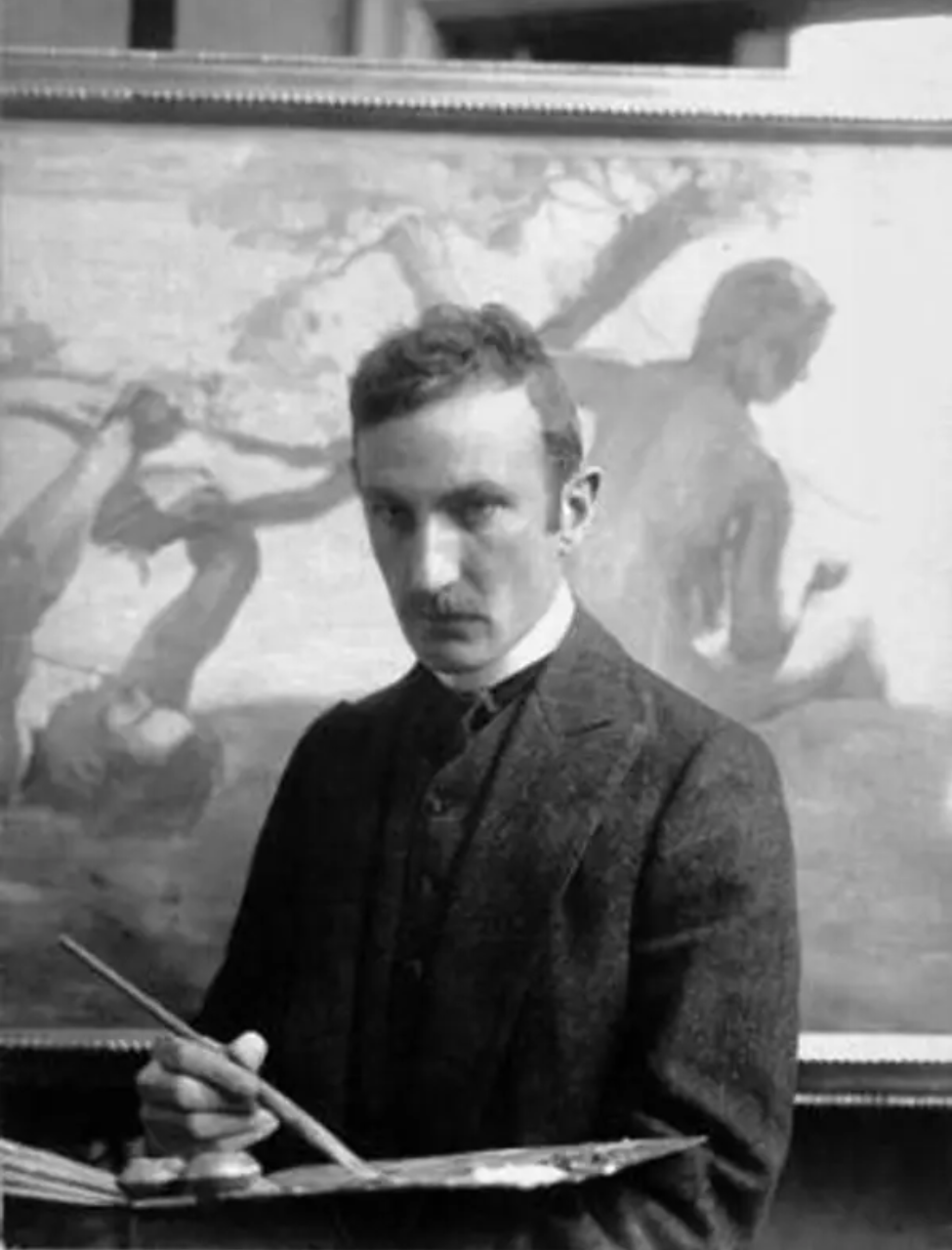
Knut Magnus Enckell was born in 1870, the youngest child of a Lutheran preacher, a member of the small but very noticeably present Swedish community in Finland. Until eight years before his death, as a result of the political relationships of his time, Enckell was a subject of the Russian empire, which had taken over Finland from Sweden in the Napoleonic age. Unlike most of his fellow artists, young Magnus did not feel drawn to nationalistic or folkloristic themes, possibly because nationalism has a self-evident homophobic component: the dislike of that which is unfamiliar. Instead he made an early choice to lead a cosmopolitan way of life. He lived and worked for quite some time in Italy, Spain, and St. Petersburg, but the most important periods for his evelopment were those which he spent in Paris. The second, in 1908, is associated with his transition to a much more exuberant use of color; the first - between 1891 and 1894, interrupted by a journey to Italy - marks his introduction into the circles of the symbolists. Unlike the other artistic movements of that time, symbolism did not reject mythological themes.
The most prominent of the Parisian symbolists was Paul Gauguin, who actually only stayed briefly in Paris between two periods in Tahiti. According to Riika Stewen, a personal connection between him and Enckell cannot be proven, unlike Enckell’s association with the Salon Rose+Croix, a society of artistic adherents of the Rosicrucians, led by ‘guru’ Joseph ‘Sâr’ Peladan. In this circle, Enckell became familiar with mythological themes, the spirituality of neoplatonism, and the theme espoused by Peladan of puberty as androgynous ideal: the balance which it contains between masculine and feminine sexuality.
Awakening
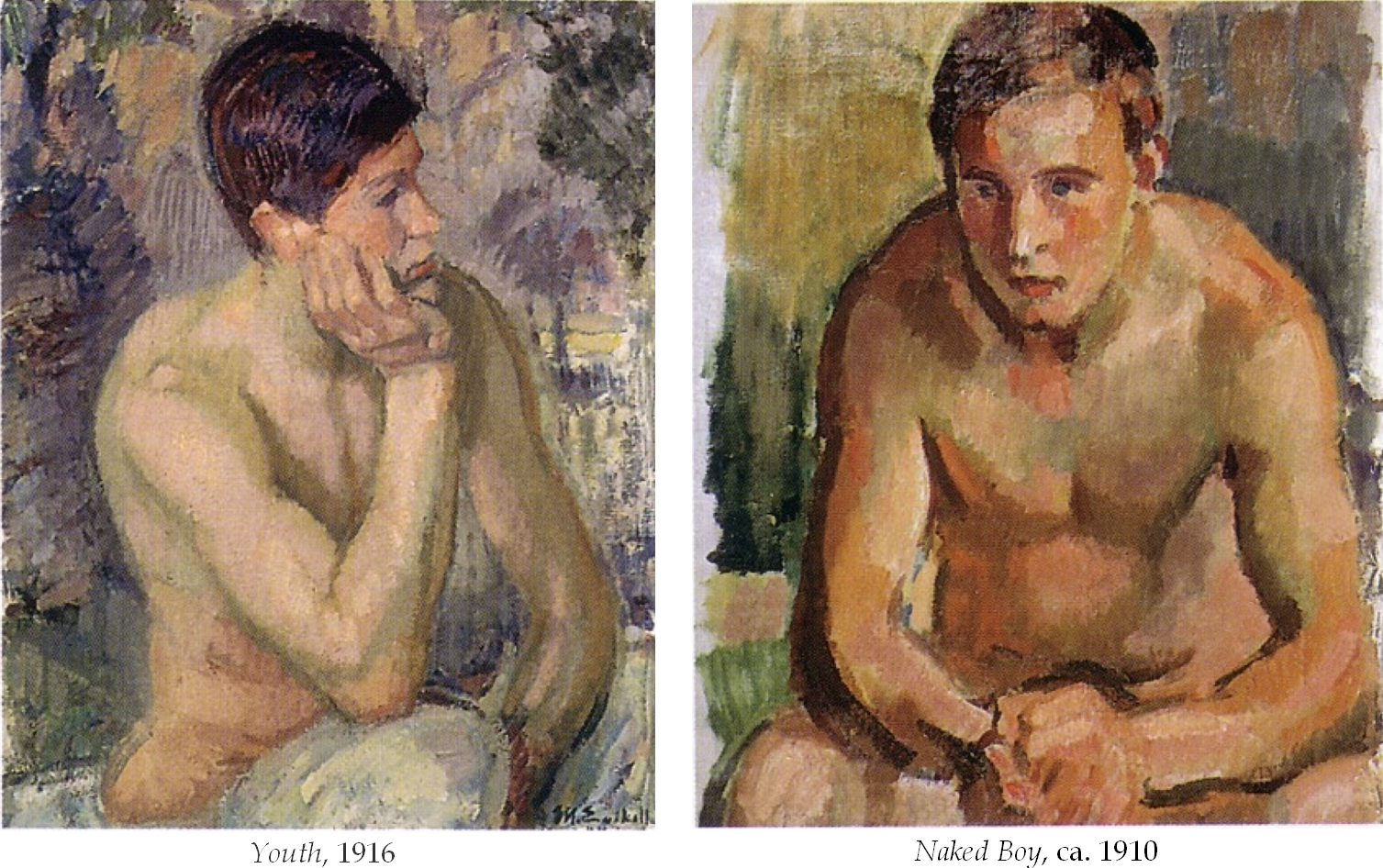
Among Enckell’s early works, in the early 1890s, are various nudes of boys - pubescent and younger - in a conventional realistic style. The most striking of these is Uppvaknande (Awakening). Stewen interprets this as a symbolic awakening to greater spirituality, and makes reference also to Peladan’s theme of androgyny. Likewise, she sees the work as an expression of the dissertation of aesthetician and philosopher Yrjö Hirn, a friend and correspondent of Enckell’s. According to Hirn, who in this respect referred back to the Roman poet Lucretius, the first moment of love - in puberty - marks the boundary between unconscious and conscious: the psychology of the transformation of impulse into action.
Tihinen has another point of view about this painting: it is about making the male body into a homoerotic object. Enckell was a dissident among his contemporaries in the sense that he depicted men as passive objects ofsexual desire. The boy’s genitals draw attention naturally through their position in the center of the image, but the boy maintains his subjectivity because he looks out of the image. In Tihinen’s opinion as well, the title of the painting refers to the attainment of consciousness, but then in the sense that the boy realizes what it means to be an ideal object. He faces the choice of determining his position with respect to his masculinity, with respect to his sexual identity.
Fantasy
Stewen draws a second parallel between Enckell’s visual language and the writings of his friend Hirn in two works which appeared almost simultaneously in 1895, both called Fantasi (Phantasy). After she has made a reasonable case that the references to the Greek gods Apollo, Aphrodite, and Dionysus identify the central figure as Orpheus, she mentions a contemporaneous study by Hirn about shamanism. In this study, he proposes that art is originally separated from the desire for sexual property, as an expression of feelings brought forth by mental images. The Fantasi in which the Orpheus-figure is deformed, with faun-like ears, naked and looking downwards away from the light, would then be a reference to the dark, sexual alternative of Dionysus, as contrasted to the light, the beauty, the spirituality, and the poetry of Apollo in the other work. Stewen also comments that the myth of Orpheus had a special significance for Enckell: according to the myth, after Orpheus once again lost his wife, he renounced the love of women and introduced boy love. Serge Diaghilev, another of Enckell’s friends and later the organizer of the Russian ballet in Paris, wrote a few years later about a group ofyoung artists who called themselves 'The Decadents' and carried on an Orpheus cult.
Narcissus
In Enckell’s more symbolic paintings, references are present to the myths from Ovid’s Metamorphoses. Stewen ascertains that here, as with Orpheus, the themes ‘love’ and ‘looking’ have a central role: Actaeon, Semele, Endymion, Daphne, Adonis and above all Narcissus, who appears in three of Enckell’s works. The glance which awakens love is itself almost as dangerous as the sensual fulfillment of love, the painter seems to say, echoing Ovid. This is thus at odds with the belief of Plato and his followers that looking at the object of love gives insight into the world of ldeas, free of all sensuality.
Tihinen sees the Narcissus motif as the key to Enckell’s homo-eroticism. The youth who falls in love with his own reflection represents a revolutionary idea - in classical antiquity at least - because love is directed to an age-mate, while conventionally a difference in age and social status was proscribed. In Enckell’s first Narcissus (1896) everything is dark and isolated except for the marble-white young man and his reflection. The closed eyes indicate that the ideal lover is only attainable in a dream state. The second Narcissus (1915) is completely different: contrasting colors, a sketchy figure, the reflection outside of the frame. The landscape participates in the undisguised eroticism and - even more clearly than in Uppvaknande - the viewer is placed in the position of the voyeur. Enckell suggests that the viewer and the object can be open to reciprocal attention and desire.
Colors
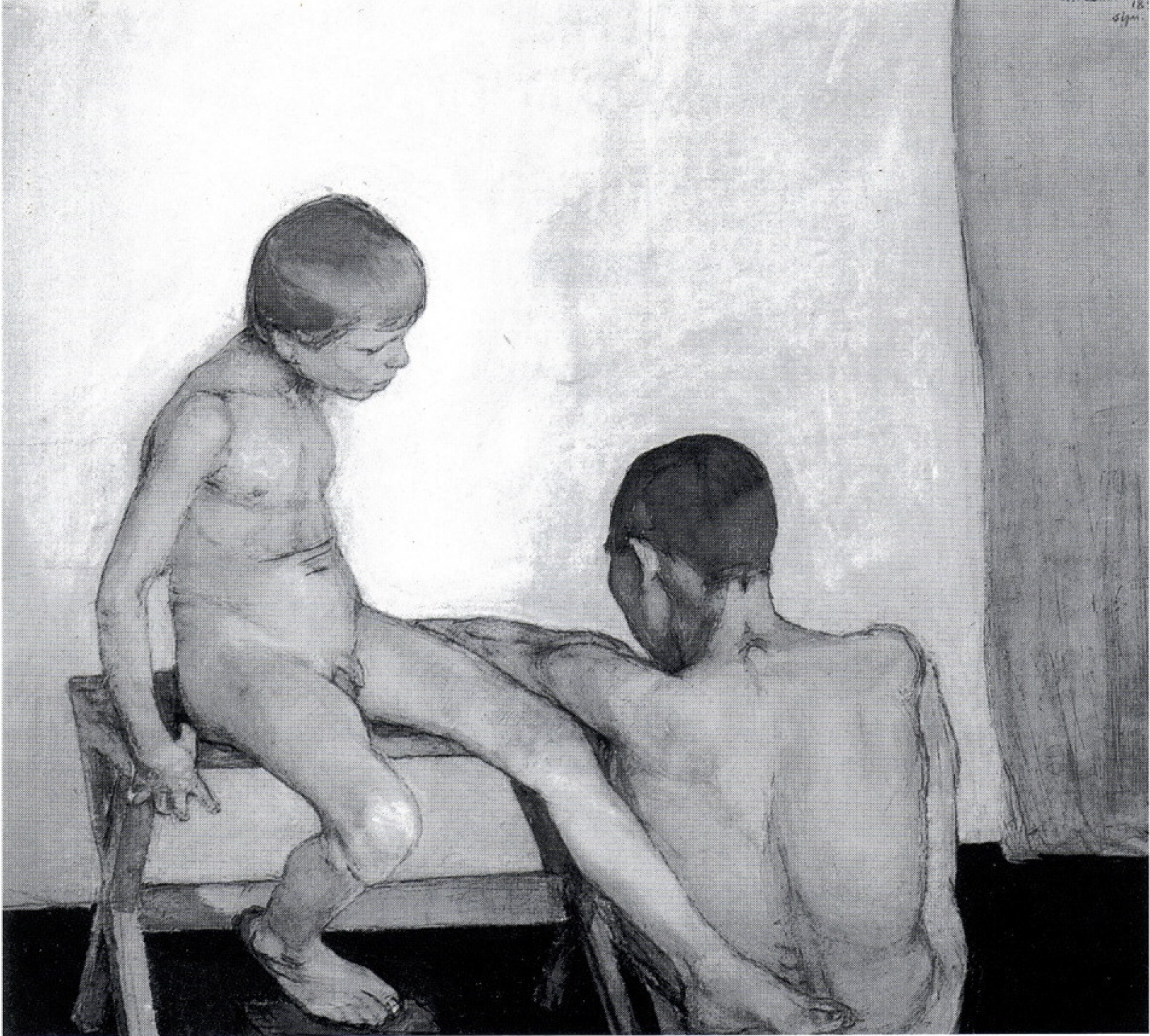
The exuberant colors which Enckell began to use after his second stay in Paris, in 1908, together with the open corporality of his male models, fit poorly into the image of him that art historians later set down. Kalha points out that the tone was set by Nils-Gustav Hahl, just a few years after the sudden death of the artist in Stockholm following a lung infection. Enckell was supposed to have been a spiritualized ascetic, for whom only aesthetics mattered. He even came across as rigid, according to Hahl, because he banned his own emotions from his work as unwelcome elements. The nudes of boys may be sensual, but because of their linear structure they are in fact sturdy (thus not feminine). According to Hahl, the male nudes are intended only to be symbols and idealized images. The ‘refined, decadent’ works produced after 1908 were considered inferior and therefore with only a few exceptions excluded from the Enckell collection of Ateneum, Finland’s most important art museum.
Enckell’s most important biographer, Jaakko Puokka, compared the painter in 1949 with a Roman patrician house: the exterior is austere, but behind the closed shutters a never-ending party is celebrated. In 1908 those shutters were thrown open - temporarily, according to Puokka. Typical of Puokka’s approach, according to Kalha, is that he quotes a poem by Enckell about Antinous, the youthful lover of Roman emperor Hadrian, but that he doesn’t translate it from the original Swedish. Puokka suggests that Enckell’s visits to Paris had influenced him ‘in a dark way’, mentions allusions in a letter from the macho painter Akseli Gallen-Kallela (in which he parted ways with Enckell and addressed him ‘as though he were speaking to a woman’), and elaborates about the mysterious Italian Giovanni, who was Enckell’s model and servant for several years in a mansion which was otherwise empty.
Aschenbach
Kalha reproaches the critics for denying Enckell’s sexuality on the one hand, but at the same time referring to it and rejecting it from the standpoint of their homophobic norms. In doing this, they turn him into a sort of Aschenbach (the writer from Death in Venice), who is confronted with his own desire under the southern sun, but because of internalized homophobia doesn’t allow himself to express it. Kalha lays the stigma of homophobia at the feet of the critics - until 1994 - and denies it as far as Enckell himself is concerned.
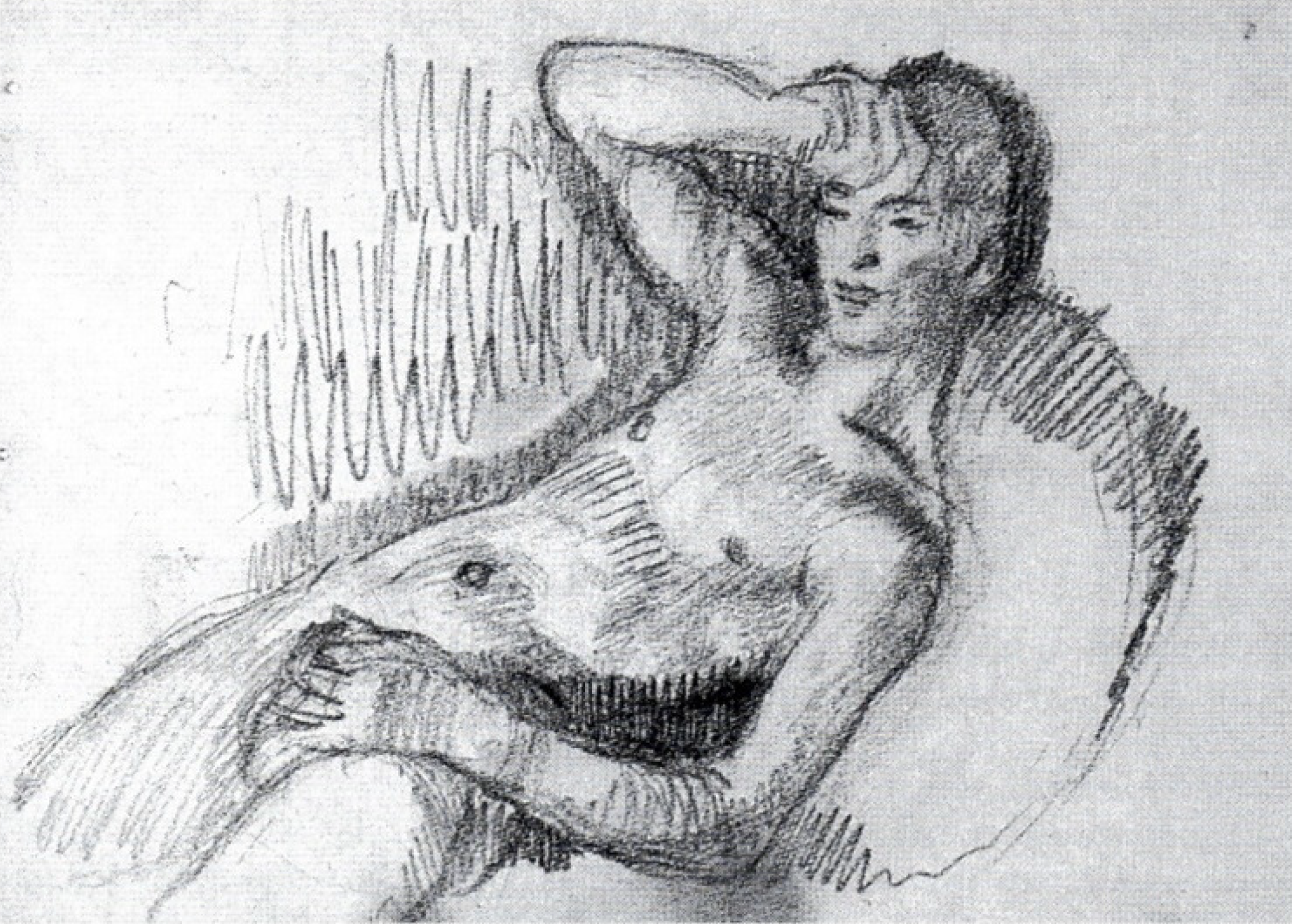
Tihinen agrees completely with this view, certainly for the period of exuberant use of color. He points out the Faun (1914) in which the thin red loincloth of the young man clearly makes an erotic reference and the pond in the background reminds one of the Narcissus motif. Even more obvious is the eroticism in Man med svan (Man with Swan) in 1917. Following Michelangelo, Enckell combines here the myths of Leda and of Ganymede. Zeus, the ruler of the gods, appears as seducer in the form ofa powerful bird: in the case of the woman a swan, in the case of the boy an eagle. But in Enckell’s hands, the boy in his forceful defense shows himself to be anything but a passive object, not a victim but an openly homoerotic adversary. Also obvious, according to Tihinen, is the series of sketches of men washing themselves which remind one of the work of David Hockney. Enckell treats his models as objects, but by concealing the gaze, the passivity remains intact and the eroticism veiled.
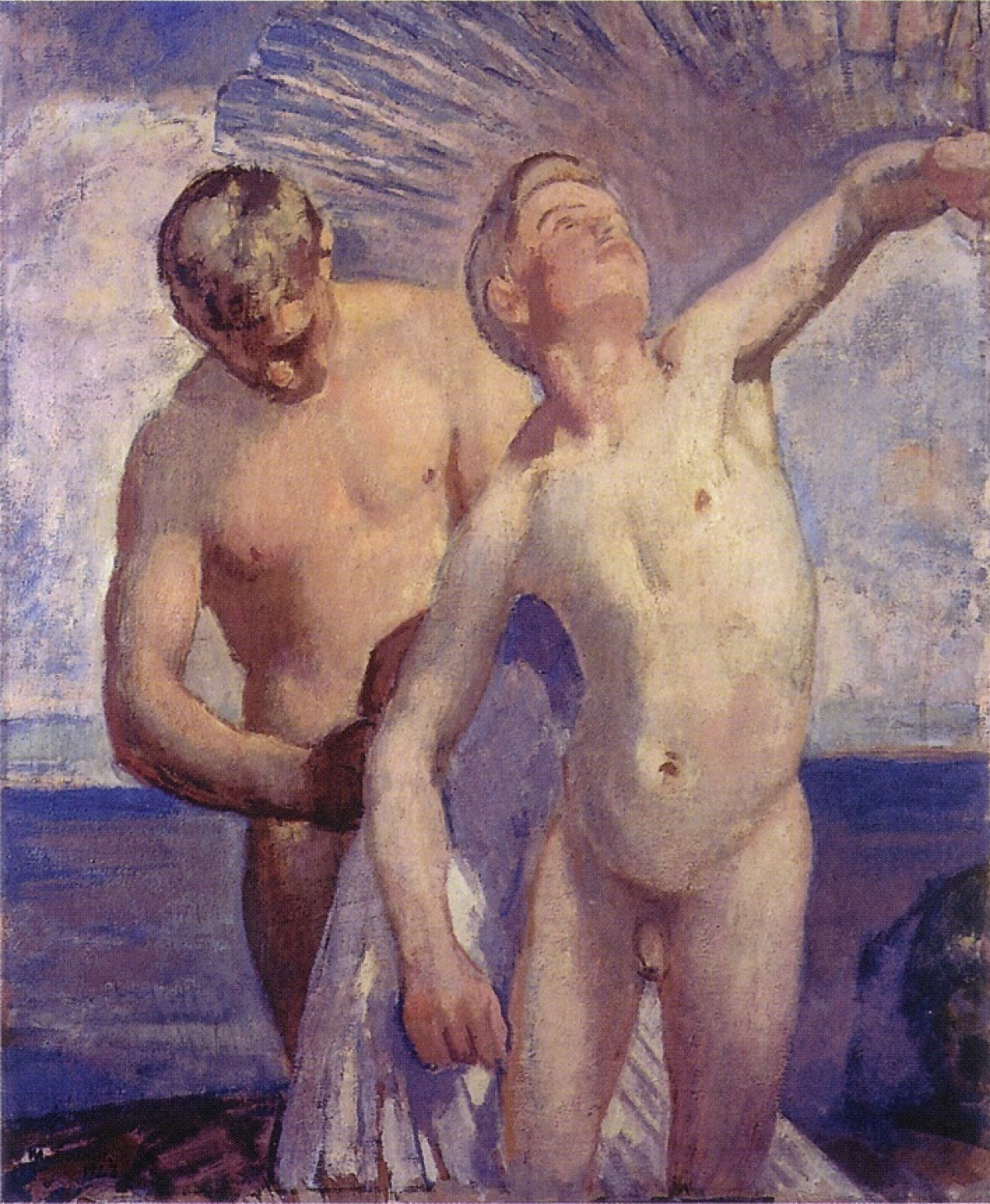
One of Enckell’s last works, and clear evidence that the shutters remained open until the end, is Vingarna (Wings), an episode from the myth of Daedalus and Icarus. Tihinen points out the strategy which Enckell often made use of: to arouse a desire in the viewer to know what it is all about. The figures differ visibly too little in age to be father and son. The younger of the two is very naturally nude and is concentrating on the wings, his new plaything. The other looks down while attaching them and has an expression of melancholy and resignation. He gives the younger one the wings which will carry him beyond his reach.
Magnus Enckell 1870-1925
Helsinki City Art Museum publications No.65
Helsinki, Finland, 2000
ISBN 951 8965 43 9
Comments powered by CComment