
TUSCULAN DISPUTATIONS BY CICERO
The Tusculanae Disputationes (Tusculan Disputations) is a series of five books of philosophy written by the Roman statesman Marcus Tullius Cicero (106-43 BC) in his villa in Tusculum in the countryside outside Rome in 45 BC. Presented here are all the references in them to Greek love.
The translation is by J. E. King for the Loeb Classical Library volume 141 published by William Heinemann in London in 1927. His Latinisation of Greek names has been undone in favour of transliteration of the Greek.
I 26
On the character of the gods:
| I do not think the gods delight in ambrosia or nectar or Hebe filling the cups, and I do not listen to Homer who says that Ganymede was carried off by the gods for his beauty to serve as cup-bearer to Zeus: there was no just reason why such cruel wrong should be inflicted on Laomedon.[1] Homer imagined these things and attributed human feelings to the gods: I had rather he had attributed divine feelings to us. | Non enim ambrosia deos aut nectare aut Iuventate pocula ministrante laetari arbitror, nec Homerum audio, qui Ganymeden ab dis raptum ait propter formam, ut Iovi bibere ministraret: non iusta causa cur Laomedonti tanta fieret iniuria. Fingebat haec Homerus et humana ad deos transferebat: divina mallem ad nos. |
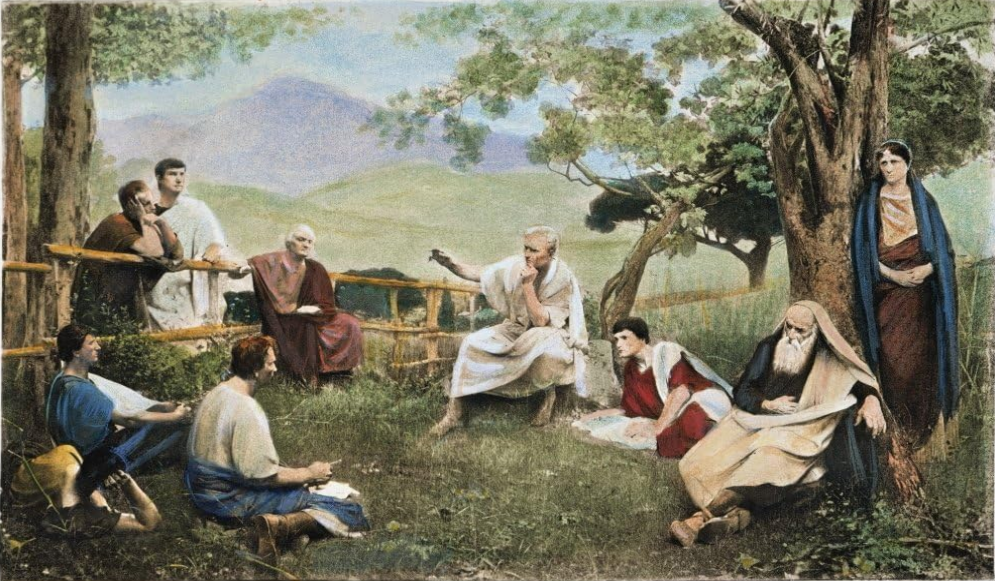
IV 33-4
On love as a disorder of the soul:
|
Let us have recourse to the teachers of virtue, the philosophers—who say that love has no part in debauchery and on that point are at daggers drawn with Epicurus, who in my belief is not in what he says much of a liar.[2] For what is the so-called love of friendship? Why is it no one is in love with either an ugly youngster or a beautiful old man? For my part I think this practice had its origin in the Greek gymnasia where that kind of love-making was free and permitted. Well then did Ennius say: Shame’s beginning is the stripping of men’s bodies openly. And though such loves be, as I see is possible, within the bounds of modesty, yet they bring anxiety and trouble and all the more because they are a law to themselves and have no other restraint. Again, not to speak of the love of women, to which nature has granted wider tolerance, who has either any doubt of the meaning of the poets in the tale of the rape of Ganymede, or fails to understand the purport of Laios’ language and his desire in Euripides’ play?[3] What disclosures lastly do men of the highest culture and poets of supreme merit make about their own life in their poems and songs? What things Alkaios,[4] a man of bravery and of note in his country, writes about the love of youths! Of Anakreon[5] I say nothing, for his work is all love-poetry. Above all, however, Ibykos of Rhegion[6] was, it is clear from his writings, a passionate lover. In fact we see that love in all the examples given is lustful. We philosophers have come forward (and on the authority indeed of our Plato[7] whom Dikaiarchos not unjustly upbraids) to attribute authority to love. |
[33] Ad magistros virtutis, philosophos, veniamus, qui amorem negant stupri esse et in eo litigant cum Epicuro non multum, ut opinio mea fert, mentiente. Quis est enim iste amor amicitiae? Cur neque deformem adolescentem quisquam amat neque formosum senem? Mihi quidem haec in Graecorum gymnasiis nata consuetudo videtur, in quibus isti liberi et concessi sunt amores. Bene ergo Ennius: Flagiti principium est nudare inter civis corpora. Qui ut sint, quod fieri posse video, pudici, solliciti tamen et anxii sunt eoque magis, quod se ipsi continent et coërcent. Atque, ut muliebres amores omittam, quibus maiorem licentiam natura concessit, quis aut de Ganymedi raptu dubitat quid poëtae velint aut non intelligit quid apud Euripidem et loquatur et cupiat Laius? quid denique homines doctissimi et summi poëtae de se ipsis et carminibus edunt et cantibus? Fortis vir in sua re publica cognitus quae de iuvenum amore scribit Alcaeus! Nam Anacreontis quidem tota poësis est amatoria. Maxime vero omnium flagrasse amore Rheginum Ibycum apparet ex scriptis. [34] Atque horum omnium libidinosos esse amores videmus. Philosophi sumus exorti et auctore quidem nostro Platone, quem non iniuria Dicaearchus accusat, qui amori auctoritatem tribueremus. |
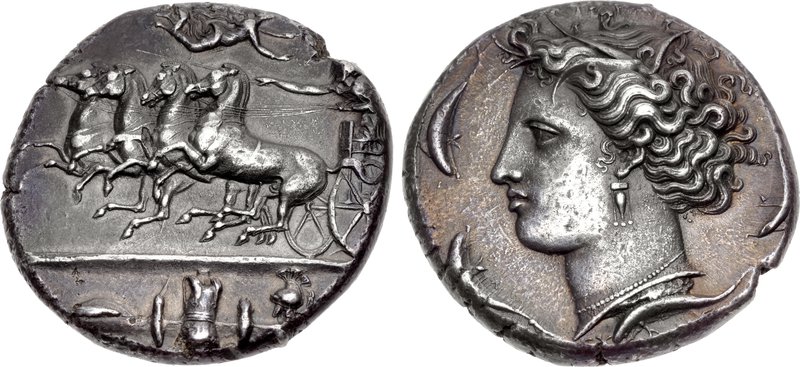
V 20-21
On Dionysios the elder, tyrant of Syracuse 405-367 BC:
|
Although he came of good parentage and was born in a respectable position (though as to this different authorities have given different accounts) and although he had many friendly relations with contemporaries and enjoyed the intimacy of kinsfolk, and certain youths too were attached to him in the loverlike fashion recognized in Greece, he trusted none of them, but committed the care of his person to slaves whom he had selected from the households of wealthy men and whom he personally had relieved of the name that marked their servile condition, as well as to certain refugees and uncivilized barbarians. […] Again, when once he wanted to play at ball (for he was devoted to this pastime) and laid aside his undergarment, it is said that he handed his sword to a youngster of whom he was fond. When a certain acquaintance jestingly remarked, “Here at any rate is one to whom you certainly entrust your life,” and the young man[8] gave a smile, Dionysius had both executed, the one for having, as he held, pointed out the way to assassinate him, and the other for having greeted the remark with a smile; and the grief he felt for this act occasioned him greater distress than anything else in his life; for he had put to death the being he fondly loved. So true is it that the passions of ungovernable men are in continual conflict: satisfy one and you have to resist another. And yet this tyrant out of his own mouth passed judgment on the reality of his happiness. |
[20] Qui cum esset bonis parentibus atque honesto loco natus, etsi id quidem alius alio modo tradidit, abundaretque aequalium famillaritatibus et consuetudine propinquorum, haberet etiam more Graeciae quosdam adolescentes amore coniunctos, credebat eorum nemini, sed iis, quos ex familiis locupletium servos delegerat, quibus nomen servitutis ipse detraxerat, et quibusdam convenis et feris barbaris corporis custodiam committebat; […]Atque is cum pila ludere vellet—studiose enim id factitabat—tunicamque poneret, adolescentulo, quem amabat, tradidisse gladium dicitur. Hic cum quidam famillaris iocans dixisset: Huic quidem certe vitam tuam committis, adrisissetque adolescens, utrumque iussit interfici, alterum, quia viam demonstravisset interimendi sui, alterum, quia dictum id risu approbavisset; atque eo facto sic doluit, nihil ut tulerit gravius in vita; quem enim vehementer amarat occiderat. Sic distrahuntur in contrarias partes impotentium cupiditates: cum huic obsecutus sis, illi est repugnandum. Quamquam hic quidem tyrannus ipse iudicavit quam esset beatus: |
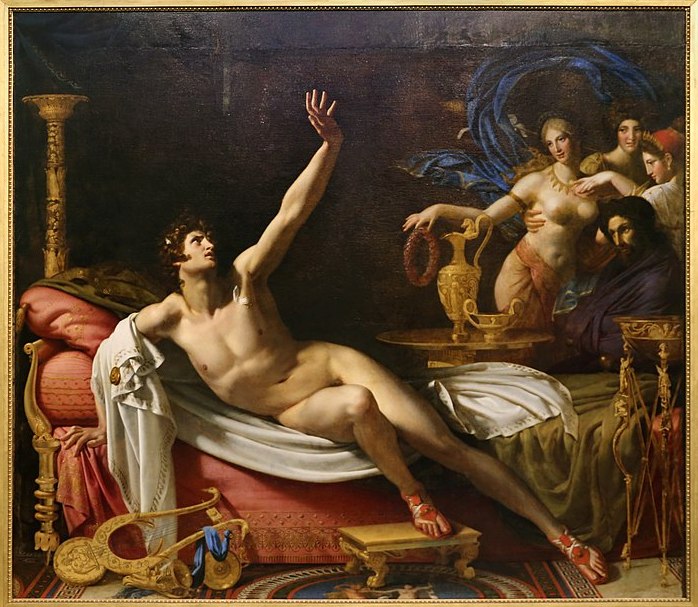
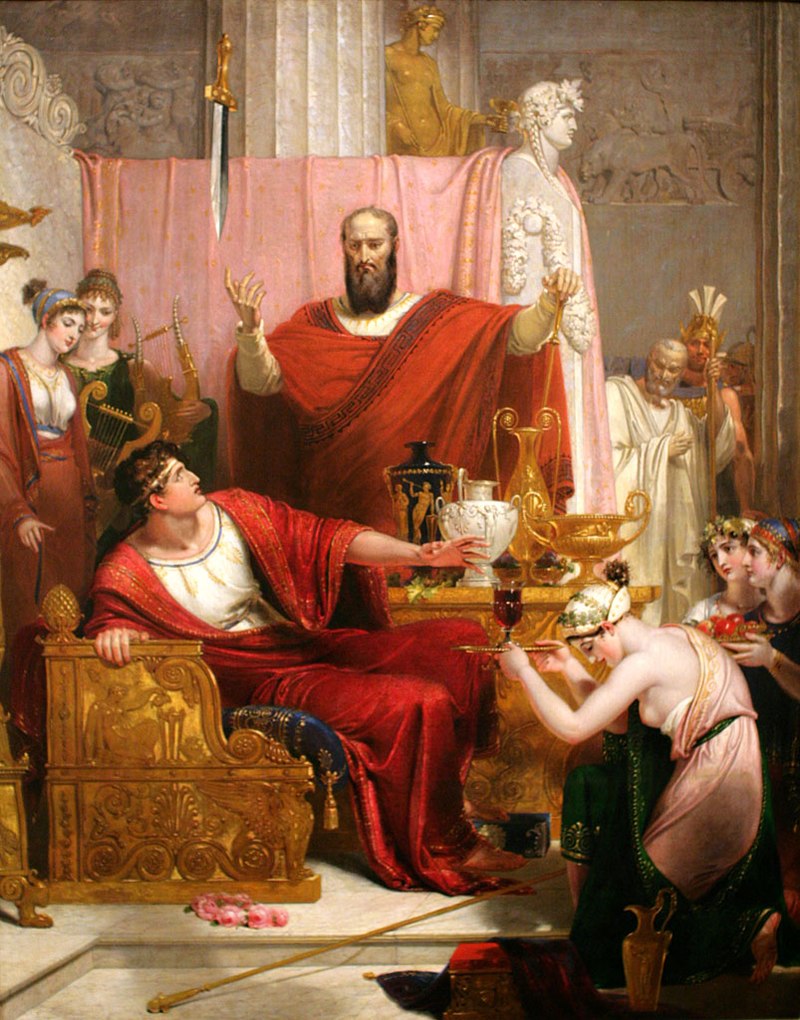
| For when one of his flatterers, named Damokles, dilated in conversation upon his troops, his resources, the splendours of his despotism, the magnitude of his treasures, the stateliness of his palaces, and said that no one had ever been happier: “Would you then, Damokles,” said he, “as this life of mine seems to you so delightful, like to have a taste of it yourself and make trial of my good fortune?” On his admitting his desire to do so Dionysios had him seated on a couch of gold covered with beautiful woven tapestries embroidered with magnificent designs, and had several sideboards set out with richly chased gold and silver plate. Next a table was brought and chosen boys of rare beauty were ordered to take their places and wait upon him [Damokles] with eyes fixed attentively upon his motions. There were perfumes, garlands; incense was burnt; the tables were loaded with the choicest banquet: Damokles thought himself a lucky man. In the midst of all this display Dionysios had a gleaming sword, attached to a horse-hair, let down from the ceiling in such a way that it hung over the neck of this happy man. And so he had no eye either for those beautiful attendants, or the richly-wrought plate, nor did he reach out his hand to the table; presently the garlands slipped from their place of their own accord; at length he besought the tyrant to let him go, as by now he was sure he had no wish to be happy. Dionysios seems (does he not?) to have avowed plainly that there was no happiness for the man who was perpetually menaced by some alarm. | [21] nam cum quidam ex eius adsentatoribus, Damocles, commemoraret in sermone copias eius, opes, maiestatem dominatus, rerum abundantiam, magnificentiam aedium regiarum, negaretque umquam beatiorem quemquam fuisse: Visne igitur, inquit, o Damocle, quoniam te haec vila delectat, ipse eam1 degustare et fortunam experiri meam? Cum se ille cupere dixisset, collocari iussit hominem in aureo lecto strato pulcherrimo textili stragulo, magnificis operibus picto, abacosque complures ornavit argento auroque caelato; turn ad mensam eximia forma pueros delectos iussit consistere eosque nutum illius intuentes diligenter ministrare. Aderant unguenta, coronae; incendebantur odores; mensae conquisitissimis epulis exstruebantur: fortunatus sibi Damocles videbatur. In hoc medio apparatu fulgentem gladium e lacunari saeta equina aptum demitti iussit, ut impenderet illius beati cervicibus. Itaque nec pulcros illos ministratores aspiciebat nec plenum artis argentum nec manum porrigebat in mensam; iam ipsae defluebant coronae; denique exoravit tyrannum, ut abire liceret, quod iam beatus nollet esse. Satisne videtur declarasse Dionysius nihil esse ei beatum, cui semper aliqui terror impendeat? |
[1] Cicero’s meaning is not clear. Laomedon King of Troy had to appease the gods for breaking his word by sacrificing his daughter. Afterwards, when he broke his word to Herakles too, the latter killed all but one of his sons. If Cicero is implying that Laomedon was the father of the Trojan boy Ganymede, with whom Zeus fell in love and abducted, this is in conflict with the usual account given by Homer, The Iliad XX 233, according to which Ganymede was Laomedon’s paternal uncle.
[2] Epicurus defined love as ὄρεξις ἀφροδισίων. [Translator’s footnote]
The pederastic behaviour in what follows was from a Roman point of view what Cicero calls stuprum (here translated as “debauchery”) because it involved the pedication of freeborn males.
[3] The play meant is Euripides’s lost play Chrysippos, named after its mythical boy protagonist whom Laios King of Thebes fell in love with and abducted in what was sometimes held to be the first act of pederasty. [Website footnote]
[4] Alkaios of Lesbos (ca. 622-ca.580 BC) was a lyric poet whose now-lost works included, according to Horace, celebration of a boy called Lykos. [Website footnote]
[5] Anakreon of Teos (ca. 573-ca. 495 BC), one of the greatest lyric poets, was a passionate lover of boys. [Website footnote]
[6] Ibykos was a 6th-century BC lyric poet whose now-lost pederastic verse was often referred to by the ancients. [Website footnote]
[7] He refers to Plato’s Symposium and Phaedros. [Translator’s footnote]
[8] The Latin word here translated as “young man” is adolescens. Earlier he was referred to by a diminutive of the same word, adolescentulus, suggesting a younger adolescent, here translated as “youngster.”
Comments powered by CComment