
A PIONEER: HAJO ORTIL
BY EDWARD BRONGERSMA
The following account of Hans-Joachim “Hajo” Ortil (10 January 1905 – 12 July 1983), a German teacher and photographer prominent in the naturist movement, is by his friend the Dutch senator and lawyer Edward Brongersma (1911-98). Both men were prolific authors and amongst the best-known men of their generation to be openly boysexual.
It was published in L’Espoir, no. 16, January-February 1985 as a translation into French (approved by the author) of a slightly longer article that appeared in the Dutch magazine Martijn No. 20, June-July 1984, under the original title “Herinneringen aan Hajo Ortil”. The translation here into English is this website’s.
Of closely related interest is an interview of Hajo Ortil published in issue nine of Pan: a magazine about boy-love, published in Amsterdam in 1981 , pp. 18-26.
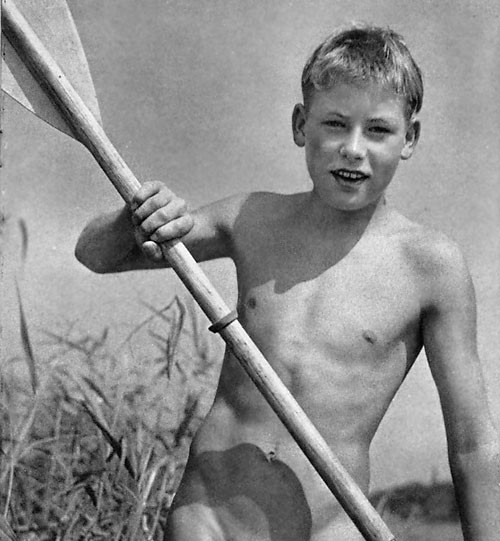
It was in 1957 that the MP Van Rijckevorsel (of the Catholic People’s Party) questioned the Minister of Justice about the distribution in the Netherlands of a brochure he considered scandalous: Hundert nackte Wilde (One hundred naked savages), with photos and a text by Hajo Ortil. The brochure was full of images of completely naked boys, photographed alone or frolicking together freely in nature. The Minister launched an investigation.
The “Special Offenses” section drew up a report, according to which none of the images showed the slightest trace of sensuality or eroticism: they were simply naked boys, shortly before or shortly after puberty. In his reply to the outraged MP, the Minister recalled a 1927 ruling by the Court of Cassation, according to which the representation of male or female nudity, including frontal nudity, is not in itself “contrary to public decency”, and can therefore be distributed freely. “But this book is bought especially by homosexuals,” Van Rijckevorsel exclaimed indignantly. To which the minister rightly replied, “So what difference does that make?”
I myself ordered this book from Germany as soon as it was published, and was thrilled. The boy-lover of 1984, who can find pictures of attractive boys galore in almost any sex shop, finds it hard to imagine what this little book meant in the fifties. Occasionally, in a naturist magazine, among countless feminine beauties, you’d find a naked boy here and there, but the rule was that there was always a hand, a leg or a tree branch that, “by chance”, shielded his sexual parts from view. There was nothing to suggest that we were dealing with one of the sexiest beings in Creation.
In the introduction to his brochure, Hajo Ortil talked about the group of young people he had created after the war, the “Hanseatic Pirates”, boys and girls aged twelve to eighteen from the Hanseatic city of Bremen, who went on expeditions in their canoes, stripping off their clothes whenever possible. One night, the boys had come to find him in his tent, reproaching him for photographing mostly girls and taking only very conventional pictures of them. Under threat of the most terrible tortures, such as pouring buckets of cold water over him while he slept, they had extracted a promise from him to devote a volume of his accounts of their adventures to them alone. What’s more, they demanded to be portrayed in their entirety, just as nature had made them, showing off that part of their bodies of which they were so proud and which made them boys.
And so, if Hajo Ortil is to be believed, this little book was born. It was an immediate success, even in the Netherlands, thanks to the publicity Van Rijckevorsel had given it. It also exerted an influence on other naturist magazines, which understood the lesson and henceforth featured more boys. At the time, Germany was years ahead of the Netherlands regarding naturism.
The first time I met Hajo in the flesh, brought to his home by a mutual friend, he invited me to attend a lecture he was giving that evening on his latest expedition with the Pirates, in front of the parents and pupils of the high school where he taught. In front of a packed audience, this short, portly man recounted various exciting and amusing adventures of his group, illustrating his account with a slide show. One could see on the screen, completely naked and larger than life, a young girl of around sixteen. Hajo commented: “This is Edeltraut. Is she in the room?” “Jawohl,” was the reply. And she immediately stood up to introduce herself, the mayor’s daughter.
Two fifteen-year-old boys were helping Hajo by handing him the slide magazines and then putting them away, and they too appeared on the screen in all their naked splendor. I was speechless with astonishment. It was unthinkable, in a school in the Netherlands at the time, for a teacher to show such photos of his pupils to their classmates and parents. The Germans were much freer in this respect. And the fact that none of these parents ever raised the slightest objection to nude photos of their son or daughter appearing in pamphlets the same year, showed a completely different attitude on their part.
Hajo wanted the young people in his group to learn not to be ashamed, not only of their naked bodies, but also of their sexual needs and how to satisfy them, alone or with others. He welcomed young girls among the Pirates, to make the expeditions more attractive to the boys. What’s more, these boys knew that in his presence they could talk freely about their sexual desires and activities, and that at his home they could find sex education books of all kinds, as well as erotic art prints and the images they liked to look at to masturbate.
As a teacher, he once led a school trip with a class of boys aged around thirteen. In the evening, as he chatted with his colleagues in the garden of the youth hostel, the “hostel father” asked him to put an end to the tremendous ruckus his group had unleashed in the dormitory. Hajo rushed upstairs and opened the door without warning. “Es war ein geradezu paradiesischer Anblick”,[1] he confided to me afterwards: it was a truly heavenly sight, these thirty naked boys chasing each other, embracing and playing sexual games with each other.
General consternation at his unexpected appearance. He scolded them severely for the noise they were making, preventing the other groups from sleeping, and ordered everyone to go to bed and keep quiet. Then he left the dormitory. A few days later, one of the boys took a walk with him. “You know what we thought was wonderful that night? That you scolded us for the rowdiness and didn’t say a word about the rest.” That rest, sexuality, which is always something so terrible in the eyes of adults! But not for this adult. For Hajo, sexuality was part of the very essence of being a child, a healthy, natural pleasure. This exceptional attitude earned him their trust and affection. He made them feel whole and themselves.
For him, sexuality was part of education. A fifteen-year-old boy from Berlin had taken a vacation trip with the Pirates to a Greek island, and had come to stay with Hajo in Bremen for a week. Hajo found him very quiet and despondent. The reason for this was revealed to him in an intimate conversation: Karl had caught his father, whom he had always loved very much, making love to another man, and this had deeply shocked and filled him with disgust. Hajo listened to this story without much comment.
In the evening, while his host was in the bathroom, Hajo went to sleep in Karl’s bed. What are you doing here?” asked the astonished boy as he came out of the bathroom. “There’s enough room here for two,” replied Hajo without further explanation. As soon as Karl lay down beside him, Hajo began to stroke him gently, and a strong protrusion in his pyjama pants soon revealed how the boy was reacting. After a few minutes, the boy murmured, “Wouldn’t it be better if we took off our pyjamas?” They did, and Hajo stroked him to orgasm.
Not a word was exchanged about these pleasures, and the next evening Hajo went to bed as usual in his own room. But Karl soon came knocking at his door. He had already stripped off his pyjamas. “Why don’t we do tonight what we did yesterday?” he asked. And so it went on all week. It was always Karl asking to do it again. On the last day, Hajo asked him: “Now you see what a beautiful thing sex is between friends, and how you can derive deep pleasure from it. Why shouldn’t your father experience this pleasure too? Wasn’t it wonderful, what we did together in bed?” Karl had to admit that it was, and the result of this “educational seduction” was that the boy was reconciled with his father.
The boys appreciated the presence of girls in their group, on their far-flung expeditions to Finland, Spain, Corsica, Sicily, Greece and Turkey. The annals also mention a visit to the naturist grounds of the Netherlands. Several future couples met as Pirates and Piratesses. The boys got used to playing with the girls in a healthy and natural way, and to mixing with them in the simplest of manners.
The difference between this and more traditional education was amusingly illustrated when another group of young sea scouts, driven from their camp by a flood on the Weser, came to ask if they could pitch their tents on the Pirates’ higher ground. Hajo consulted his group, as he was a great believer in democracy. And the decision was that the sea scouts could come, as long as they went naked like the others: “We don’t want any guests with clothes on.” And so it was.
But no sooner had the guests, all at the age of extreme sexual sensitivity, arrived, than the sight, unknown to them, of all these naked girls triggered a veritable epidemic of vigorous erections. The prudish sea scouts were terribly embarrassed by their young erect masts. But the Piratesses reacted quite differently: “We take that as a compliment,” they said very fittingly. Three days later, the newcomers were also perfectly adapted to the situation.
Hajo, who had earned his doctorate with a brilliant philosophy thesis and went on to become a teacher of English and gymnastics, was put in a concentration camp under Hitler’s regime, because of his left-wing sympathies. In their drunken victory after the fall of France, the country’s masters released him in 1940, along with many others. But they forbade him to become a teacher again. However, he became one again secretly, in Vienna, and it was there in 1944, while on a skiing trip with his pupils, that he met soldiers of the Russian vanguard who mistook him for a spy and nearly killed him.
After the war, people wanted to appoint him mayor of his home town in the Harz Mountains or rector of a gymnasium. But he preferred the freedom left to him by a simple post of teaching at the secondary school of Bremen, where he founded the Hanseatic Pirates in 1949.
In 1968, I took a two-month trip with him through Sicily, Tunisia, Algeria, Morocco, Spain, Portugal and France. And throughout those two months, he told me stories over and over again, an art in which he was a master. The following year, we set off together to discover Troy in Turkey, whose ruins he wanted to visit at least once in his life, as a great admirer of Homer. “Big Old Joe”, as the Pirates called him, had always won boys’ hearts with his sometimes childlike naivety, humour and zest for life.
But he also had his bouts of depression. One day, he addressed a circular letter to all his friends, saying: “As a result of a torn Achilles heel, I can now only walk on crutches. My liver is diseased, I suffer from diabetes, my intestines no longer function, my lungs are ruined, my heart is failing; I can now only read the headlines of newspapers, for my eyesight is quite poor; my memory is like a Gruyère cheese, full of holes. Please don’t write to or visit me again. A dying man sends his regards.”
A fortnight later, he left with a fifteen-year-old boy for an expedition by canoe around a Greek island, and signed up for an ascent of the Himalayas. He still had ten years to live...
This life was essentially about boys. As a gymnastics teacher, he used to gather the whole class under one huge shower after every lesson. “For years, I was able to admire the most beautiful boys in Bremen, completely naked”, he said proudly. The Pirates’ games on their own land on the banks of the Weser, the trips he took with them during the holidays (sometimes very daring, but fortunately never troubled by any serious accident) and with another similar group, the many young visitors he received at his home, filled him all these years with joy at the bodily beauty and vitality of boys.
Many made him happy; a few saddened or disappointed him, but none ever betrayed him. Three brothers, who visited him to his last days, contributed with their youth and freshness to bring him some consolation during those years of old age and decline. He died on 12th July 1983.
He had previously donated his sexological library and countless photos of his Pirates to the Brongersma Foundation, as a token of sympathy for its aims.[2] This collection is a monument to his work as a photographer of youthful nudity, playing freely in nature or posing in an interior. Alas, he was never able to put together the great book on boys’ sexuality that he had planned to write. He would have had so much to say about the reality of this sexuality, having observed it for so long and in so many different forms.
He was a man like no other.
[1] This was left untranslated in the French, but means “It was a truly paradisiacal sight.”
[2] A few of these photos were published for the first time in the issue (9) of Pan magazine, in which an interview of Ortil was published. The huge majority that remained unpublished were lost to posterity when the Dutch police seized them in 2000, together with most of the Brongersma Foundation’s unique Archive, a story recounted in Burning the Library, 2000, and apparently soon after incinerated them. Those who controlled what was left of the Foundation, including Brongersma’s house that he had bequeathed, soon diverted its funds from the purposes he had designed it for, and later even shamelessly changed its name, expressly in order to distance itself from its founder.
Comments powered by CComment