
TABLE-TALK BY PLUTARCH
Table-Talk Συμποσιακά, a set of philosophical dinner conversations written in the form of dialogues by the Boiotian Greek historian and philosopher Plutarch Πλούταρχος of Chaironeia (ca. AD 46-120) who won Roman imperial favour and rose to become procurator of Achaia, was one of the many essays in his Moralia (612c-748d), written around AD 100. Presented here are all the allusions in it to Greek love. All of them come in the context of discussion of love in general, so their greatest significance may be in showing that the love of boys was seen in much the same light as the love of women.
The translation is by Paul A. Clement in Moralia, Volume VIII, the Loeb Classical Library Volume 424, published by William Heinemann in London in 1969. His romanisation of Greek names have been replaced by transliterations of the Greek.
Book I
619a
|
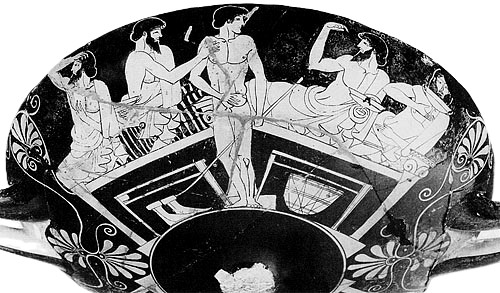
Question 2. Whether the host should arrange the placing of his guests or leave it to the guests themselves And I shall put together men who like to drink,—and lovers too, not only those “Who feel the bite of love for lads,” as Sophokles says,[1] but also those bitten by love for women and for maidens[2]. For they will cleave to each other all the more for being heated by the same fire, like welded iron,—unless, by Zeus, they happen to be in love with the same lad or the same girl[3].” |
πρόβλημα α. Πότερον αὐτὸν δεῖ κατακλίνειν τοὺς ἑστιωμένους τὸν ὑποδεχόμενον ἢ ἐπ᾿ αὐτοῖς ἐκείνοις ποιεῖσθαι συνάγω δὲ καὶ ποτικοὺς εἰς ταὐτὸ καὶ ἐρωτικούς, οὐ μόνον ‘ὅσοις ἔρωτος δῆγμα παιδικῶν πρόσεστιν,’ ὥς φησι Σοφοκλῆς, ἀλλὰ καὶ τοὺς ἐπὶ γυναιξὶ καὶ τοὺς ἐπὶ παρθένοις δακνομένους· τῷ γὰρ αὐτῷ θαλπόμενοι πυρὶ μᾶλλον ἀλλήλων ἀντιλήψονται, καθάπερ ὁ κολλώμενος σίδηρος, ἂν μὴ νὴ Δία τοῦ αὐτοῦ τύχωσιν ἢ τῆς αὐτῆς ἐρῶντες.” |
622f-623a
|
Question 5. Why it is held that “love teaches a poet” For inasmuch as lovers have persuaded themselves that the objects of their affections are fair and noble, they want everybody to be persuaded. This desire incited the Lydian Candaules to drag his servant into his own wife’s bedroom to gaze upon her[4]: for lovers want others to bear them witness. Thus, when they write eulogies of their fair beloved, they adorn their eulogies with melody and rhythm and song, as men beautify statues with gold, so that the praise of their beloved may be more likely to come to the ears of many people and be remembered. And indeed, if they give their beloved a horse, a cock, or anything else, they want the gift to be beautiful and splendidly, exquisitely groomed; if it is a flattering address they offer, they particularly want it to appear agreeable, elegant, and exquisite, qualities which are characteristic of poetry.[5] |
πρόβλημα ε. Πῶς εἴρηται τὸ “ποιητὴν δ᾿ ἄρα Ἔρως διδάσκει” [e] καὶ μὴν ἥδιστα τοὺς ἐρωμένους ὁρῶντες οὐχ ἧττον ἡδέως ἐγκωμιάζουσιν ἢ ὁρῶσιν, καὶ πρὸς πάντα λάλος ὢν ἔρως λαλίστατός ἐστιν ἐν τοῖς ἐπαίνοις. αὐτοί τε γὰρ οὕτως πεπεισμένοι τυγχάνουσιν καὶ [f] βούλονται πεπεῖσθαι πάντας ὡς καλῶν καὶ ἀγαθῶν ἐρῶντες. τοῦτο καὶ τὸν Λυδὸν ἐπῆρεν Κανδαύλην τῆς ἑαυτοῦ γυναικὸς ἐπισπᾶσθαι θεατὴν εἰς τὸ δωμάτιον τὸν οἰκέτην· βούλονται γὰρ ὑπ᾿ ἄλλων μαρτυρεῖσθαι· διὸ καὶ γράφοντες ἐγκώμια τῶν καλῶν ἐπικοσμοῦσιν αὐτὰ μέλεσι καὶ μέτροις καὶ ᾠδαῖς, ὥσπερ εἰκόνας χρυσῷ καλλωπίζοντες, ὅπως ἀκούηταί τε μᾶλλον ὑπὸ πολλῶν καὶ μνημονεύηται· καὶ γὰρ ἂν ἵππον καὶ ἀλεκτρυόνα κἂν ἄλλο τι τοῖς ἐρωμένοις διδῶσι, καλὸν εἶναι καὶ κεκοσμημένον ἐκπρεπῶς βούλονται καὶ περιττῶς τὸ δῶρον, μάλιστα δὲ λόγον κόλακα προσφέροντες ἡδὺν ἐθέλουσι φαίνεσθαι καὶ γαῦρον καὶ περιττόν, οἷος ὁ ποιητικός ἐστιν. |
Book II
633f-634a
|
Question 1. What the subjects are about which Xenophon says people, when they are drinking, are more pleased to be questioned and teased than not In the presence of those they love, men find it very agreeable to be teased about love itself, but about nothing else. And if they happen to be in love with their own wives or to have a generous love for elegant youths[6], they are perfectly delighted and proud to be teased about them. Accordingly, when at one of the lectures of Arkesilaos[7] an auditor at the moment engaged in a love-affair advanced the following proposition, ‘In my opinion nothing touches anything else,’ Arkesilaos pointed to a youth who was sitting beside the gentleman—a fine handsome one[8]—and said, ‘Am I to infer that you in particular are not touching this lad? |
πρόβλημα α. Τίν᾿ ἐστὶν ἃ Ξενοφῶν παρὰ πότον ἥδιον ἐρωτᾶσθαί φησι καὶ σκώπτεσθαι ἢ μή [f] εἰς αὐτὸ τὸ ἐρᾶν εἰς ἄλλο δ᾿ οὐδέν. ἐὰν δὲ καὶ γυναικῶν ἐρῶντες ἰδίων τύχωσιν ἢ νεανίσκων [a] φιλοκάλων ἔρωτα γενναῖον, παντάπασι γάνυνται καὶ καλλωπίζονται τῷ σκώπτεσθαι πρὸς αὐτούς. διὸ καὶ Ἀρκεσίλαος, ἐν τῇ σχολῇ τοιαύτης μεταδόσεως αὐτῷ γενομένης ὑπό τινος τῶν ἐρωτικῶν· ‘δοκεῖ μοι μηδὲν ἅπτεσθαι μηδενός,’ ‘οὐδὲ σὺ τοίνυν,’ ἔφη, ‘τοῦδ᾿ ἅπτῃ;’ δείξας τινὰ τῶν καλῶν καὶ ὡραίων παρακαθήμενον. |
[1] Nauck, Trag. Gr. Frag.2, p. 309, frag. 757; Pearson, The Fragments of Sophocles, iii, p. 55, frag. 841. [Translator’s note]
[2] The extremely misleading “girls” has been replaced by “maidens” as a translation of παρθένοις. For Greeks, the significant distinction to make regarding females who had reached puberty/marriageable age was not between “girls” (whatever exactly that is supposed to mean) and women, but between those who were still unmarried/presumed virgins and those who were not.
[3] The translator’s “girl” has been allowed to stand here for good English, but “female” would be more accurate as Plutarch merely says “the same” referring back implicitly to women or maidens.
[4] Candaules was King of Lydia. The story, told by Herodotos in his Histories I 8, took place in ca. 687 BC.
[5] This passage refers at least as much to boys loved by men as to women. Not only is ἐρωμένους, the word used for those loved, masculine, but a horse or a cock was a gift one gave to a boy beloved, not a female one.
[6] “Young men” has been replaced by “youths” as a translation of νεανίσκων, which is the diminutive form for “young males” (without distinction as to whether they were boys or men).
[7] Arkesilaos (316/5-241/0 BC) was an Aiolian philosopher. For his life, including his own love of boys, see Diogenes Laertios, Lives and Opinions of Eminent Philosophers IV 6.
[8] “Young man” has been replaced by “one”, as there is no noun here in the Greek.
Comments powered by CComment