
THE DIALOGUE ON LOVE III
BY PLUTARCH
This is the third part of the Greek writer Plutarch’s Dialogue on Love Ἐρωτικός, written early in the 2nd century AD as part of his Moralia, and introduced here.
Third part: 760d-766d
|
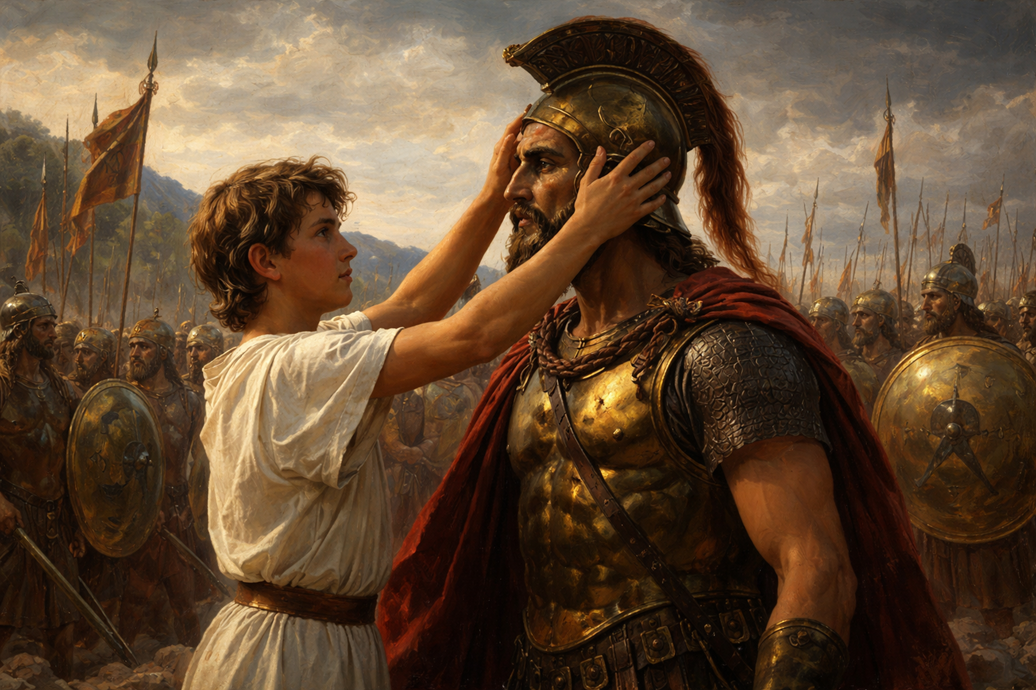
“And now consider,” he said, “the extent of Eros’ superiority in the sphere of battle, in Ares’ sphere. He is not idle, as Euripides said; he has seen service in the field; he does not Spend his nights on the soft cheeks of girls. A man filled with Love has no need of Ares to fight his enemies; if he has his own god with him, he is Ready to cross fire and sea, the air itself, on behalf of his friend, wherever the friend may bid him. When the sons of Niobê in Sophokles’ play are being shot at and about to die, one of them calls for help—and for no other helper or ally than his lover: O . . . place about me … “You know, of course, the story of Kleomachos of Pharsalia and the reason for his death in battle.”[1] “No, we don’t,” said Pemptides and his party. “But we should be glad to hear it told.” “It’s worth hearing,” said my father. “Kleomachos came to help the Chalkidians when the Lelantine War against the Eretrians was at its height. The Chalkidian infantry was thought to have considerable strength, but they found it difficult to resist the enemy cavalry. Accordingly his allies requested Kleomachos, a man of splendid courage, to be the first to charge the horse. His beloved was there and Kleomachos asked him if he was going to witness the battle. The youth said that he was, embraced Kleomachos tenderly, and put on his helmet for him. Filled with ardour, Kleomachos assembled the bravest of the Thessalians about himself, made a fine charge, and fell upon the enemy with such vigour that their cavalry was thrown into confusion and was thoroughly routed. When subsequently their hoplites also fled, the Chalkidians had a decisive victory. It was, however, Kleomachos’ bad fortune to be killed in the battle. The Chalkidians point out his tomb in the market-place with the great pillar standing on it to this day. Formerly they had frowned on paederasty, but now they accepted it and honoured it more than others did. Now Aristotle says that the circumstances of Kleomachos’ death in victorious battle with the Eretrians were different and that the lover embraced by his friend was one of the Chalkidians from Thrace sent as an ally to the Chalkidians of Euboea. And this, he says, is the reason for the Chalkidian popular song: Ye lads of grace and sprung from worthy stock, Anton was the name of the lover and Philistos was his beloved, as the poet Dionysios relates in his Origins. |
[17] “Σκόπει τοίνυν αὖθις,” ἔφη, “τοῖς ἀρηίοις ἔργοις ὅσον Ἔρως περίεστιν, οὐκ ἀργὸς ὤν, ὡς Εὐριπίδης ἔλεγεν, οὐδ᾿ ἀστράτευτος οὐδ᾿ ἐν μαλακαῖσιν ἐννυχεύων παρειαῖς νεανίδων. ἀνὴρ γὰρ ὑποπλησθεὶς Ἔρωτος οὐδὲν Ἄρεος δεῖται μαχόμενος πολεμίοις, ἀλλὰ τὸν αὑτοῦ θεὸν ἔχων συνόντα πῦρ καὶ θάλασσαν καὶ πνοὰς τὰς αἰθέρος περᾶν ἕτοιμος ὑπὲρ τοῦ φίλου οὗπερ ἂν κελεύῃ. τῶν μὲν γὰρ τοῦ Σοφοκλέους Νιοβιδῶν βαλλομένων καὶ θνησκόντων [e] ἀνακαλεῖταί τις οὐθένα βοηθὸν ἄλλον οὐδὲ σύμμαχον ἢ τὸν ἐραστήν, ὦ . . . ἀμφ᾿ ἐμοῦ στεῖλαι. “Κλεόμαχον δὲ τὸν Φαρσάλιον ἴστε δήπουθεν ἐξ ἧς αἰτίας ἐτελεύτησεν ἀγωνιζόμενος.” “Οὐχ ἡμεῖς γοῦν,” οἱ περὶ Πεμπτίδην ἔφασαν, “ἀλλ᾿ ἡδέως ἂν πυθοίμεθα.” “Καὶ γὰρ ἄξιον,” ἔφη ὁ πατήρ· “ἧκεν ἐπίκουρος Χαλκιδεῦσι τοῦ Ληλαντικοῦ πολέμου πρὸς Ἐρετριεῖς ἀκμάζοντος· καὶ τὸ μὲν πεζὸν ἐδόκει τοῖς Χαλκιδεῦσιν ἐρρῶσθαι, τοὺς δ᾿ ἱππέας μέγ᾿ ἔργον ἦν ὤσασθαι τῶν πολεμίων· παρεκάλουν δὴ τὸν Κλεόμαχον ἄνδρα λαμπρὸν ὄντα τὴν ψυχὴν οἱ σύμμαχοι πρῶτον ἐμβάλλειν εἰς τοὺς ἱππέας. ὁ δ᾿ [f] ἠρώτησε παρόντα τὸν ἐρώμενον, εἰ μέλλοι θεᾶσθαι τὸν ἀγῶνα· φήσαντος δὲ τοῦ νεανίσκου καὶ φιλοφρόνως αὐτὸν ἀσπασαμένου καὶ τὸ κράνος ἐπιθέντος, ἐπιγαυρωθεὶς ὁ Κλεόμαχος καὶ τοὺς ἀρίστους τῶν Θεσσαλῶν συναγαγὼν περὶ αὑτὸν ἐξήλασε λαμπρῶς καὶ προσέπεσε τοῖς πολεμίοις, ὥστε συνταράξαι καὶ τρέψασθαι τὸ ἱππικόν· ἐκ δὲ τούτου [761a] καὶ τῶν ὁπλιτῶν φυγόντων, ἐνίκησαν κατὰ κράτος οἱ Χαλκιδεῖς. τὸν μέντοι Κλεόμαχον ἀποθανεῖν συνέτυχε· τάφον δ᾿ αὐτοῦ δεικνύουσιν ἐν ἀγορᾷ Χαλκιδεῖς, ἐφ᾿ οὗ μέχρι νῦν ὁ μέγας ἐφέστηκε κίων· καὶ τὸ παιδεραστεῖν πρότερον ἐν ψόγῳ τιθέμενοι τότε μᾶλλον ἑτέρων ἠγάπησαν καὶ ἐτίμησαν. Ἀριστοτέλης δὲ τὸν μὲν Κλεόμαχον ἄλλως ἀποθανεῖν φησι, κρατήσαντα τῶν Ἐρετριέων τῇ μάχῃ· τὸν δ᾿ ὑπὸ τοῦ ἐρωμένου φιληθέντα τῶν ἀπὸ Θρᾴκης Χαλκιδέων γενέσθαι, πεμφθέντα τοῖς ἐν Εὐβοίᾳ Χαλκιδεῦσιν ἐπίκουρον· ὅθεν ᾄδεσθαι παρὰ τοῖς Χαλκιδεῦσιν ὦ παῖδες, οἳ χαρίτων τε καὶ πατέρων λάχετ᾿ ἐσθλῶν, Ἄντων ἦν ὄνομα τῷ ἐραστῇ τῷ δ᾿ ἐρωμένῳ Φίλιστος, ὡς ἐν τοῖς Αἰτίοις Διονύσιος ὁ ποιητὴς ἱστόρησε. |
|
“In your city, Thebes, Pemptides, isn’t it true that the lover made his beloved a present of a complete suit of armour when the boy was registered as a man? Pammenes[2], a man versed in love, changed the order of battle-line for the hoplites, censuring Homer as knowing nothing about love, because he arranged the companies of Achaians by tribes and clans and did not station lover beside beloved, in order to bring it about that Shield supported shield and helmet helmet, for he considered that Love is the only invincible general. It is a fact that men desert their fellow tribesmen and relatives and even (God knows) their parents and children; but lover and beloved, when their god is present, no enemy has ever encountered and forced his way through. In some cases, even when there is no need for it, they are moved to exhibit their love of danger, their disregard for mere life. This was what prompted Theron of Thessaly to place his left hand on the wall, draw his sword, and cut off the thumb, challenging his rival to do the same. When another man had fallen in battle on his face and an enemy was about to kill him, he begged the latter to wait for a moment in order that his beloved might not see him wounded from behind. “It is not only the most warlike peoples, Boiotians, Spartans, Cretans, who are the most susceptible to love, but also the great heroes of old, Meleagros, Achilles, Aristomenes, Kimon,[3] Epameinondas. Epameinondas, in fact, had two loved boys,[4] Asopichos and Kaphisodoros. The latter died with him at Mantineia and is buried close to him; while Asopichos showed himself a most formidable warrior and so redoubtable to his foes that the first man who stood up to him and struck back, Euknamos of Amphissa, received heroic honours among the Phokians. “As for Herakles, it would be difficult to list all his loves, they are so numerous. For example, believing Iolaos to have been beloved by him, to this very day lovers worship and honour Iolaos, exchanging vows and pledges with their beloved at his tomb.[5] It is also related that Herakles exhibited his talent for healing by rescuing Alkestis from a mortal disease to please Admetos, who was not only in love with his wife, but had also been Herakles’ beloved. In fact, Apollo also was Admetos’ lover according to the tale: He served Admetos for a mighty year. |
“Παρ᾿ ὑμῖν δ᾿, ὦ Πεμπτίδη, τοῖς Θηβαίοις οὐ πανοπλίᾳ ὁ ἐραστὴς ἐδωρεῖτο τὸν ἐρώμενον εἰς ἄνδρας ἐγγραφόμενον; ἤλλαξε δὲ καὶ μετέθηκε τάξιν τῶν ὁπλιτῶν ἐρωτικὸς ἀνὴρ Παμμένης, Ὅμηρον ἐπιμεμψάμενος ὡς ἀνέραστον, ὅτι κατὰ φῦλα καὶ φρήτρας συνελόχιζε τοὺς Ἀχαιούς, οὐκ ἐρώμενον ἔταττε παρ᾿ ἐραστήν, ἵν᾿ οὕτω γένηται τὸ ἀσπὶς δ᾿ ἀσπίδ᾿ ἔρειδε κόρυς δὲ κόρυν, ὡς μόνον ἀήττητον ὄντα τὸν Ἔρωτα τῶν στρατηγῶν. [c] καὶ γὰρ φυλέτας καὶ οἰκείους καὶ νὴ Δία γονεῖς καὶ παῖδας ἐγκαταλείπουσιν· ἐραστοῦ δ᾿ ἐνθέου καὶ ἐρωμένου μέσος οὐδεὶς πώποτε διεξῆλθε πολέμιος οὐδὲ διεξήλασεν· ὅπου καὶ μηδὲν δεομένοις ἔπεισιν ἐπιδεικνύναι τὸ φιλοκίνδυνον κἀφιλόψυχον· ὡς Θήρων ὁ Θεσσαλὸς προσβαλὼν τὴν χεῖρα τῷ τοίχῳ τὴν εὐώνυμον καὶ σπασάμενος τὴν μάχαιραν ἀπέκοψε τὸν ἀντίχειρα προκαλούμενος τὸν ἀντεραστήν. ἕτερος δέ τις ἐν μάχῃ πεσὼν ἐπὶ πρόσωπον, ὡς ἔμελλε παίσειν αὐτὸν ὁ πολέμιος, ἐδεήθη περιμεῖναι μικρόν, ὅπως μὴ ὁ ἐρώμενος ἴδῃ κατὰ νώτου τετρωμένον. [d] “Οὐ μόνον τοίνυν τὰ μαχιμώτατα τῶν ἐθνῶν ἐρωτικώτατα, Βοιωτοὶ καὶ Λακεδαιμόνιοι καὶ Κρῆτες, ἀλλὰ καὶ τῶν παλαιῶν ὁ Μελέαγρος ὁ Ἀχιλλεὺς ὁ Ἀριστομένης ὁ Κίμων ὁ Ἐπαμεινώνδας· καὶ γὰρ οὗτος ἐρωμένους ἔσχεν Ἀσώπιχον καὶ Καφισόδωρον, ὃς αὐτῷ συναπέθανεν ἐν Μαντινείᾳ καὶ τέθαπται πλησίον· τὸν δ᾿ Ἀσώπιχον φοβερώτατον γενόμενον τοῖς πολεμίοις καὶ δεινότατον ὁ πρῶτος ὑποστὰς καὶ πατάξας Εὔκναμος Ἀμφισσεὺς ἡρωικὰς ἔσχε τιμὰς παρὰ Φωκεῦσιν. “Ἡρακλέους δὲ τοὺς μὲν ἄλλους ἔρωτας ἔργον ἐστὶν εἰπεῖν διὰ πλῆθος· Ἰόλαον δὲ νομίζοντες ἐρώμενον αὐτοῦ γεγονέναι μέχρι νῦν σέβονται καὶ Eτιμῶσιν οἱ ἐρῶντες ὅρκους τε καὶ πίστεις ἐπὶ τοῦ τάφου παρὰ τῶν ἐρωμένων λαμβάνοντες. λέγεται δὲ καὶ τὴν Ἄλκηστιν ἰατρικὸς ὢν ἀπεγνωσμένην σῶσαι τῷ Ἀδμήτῳ χαριζόμενος, ἐρῶντι μὲν αὐτῷ τῆς γυναικός, ἐρωμένου δ᾿ αὐτοῦ γενομένου· καὶ γὰρ τὸν Ἀπόλλωνα μυθολογοῦσιν ἐραστὴν γενόμενον Ἀδμήτῳ πάρα θητεῦσαι μέγαν εἰς ἐνιαυτόν. |
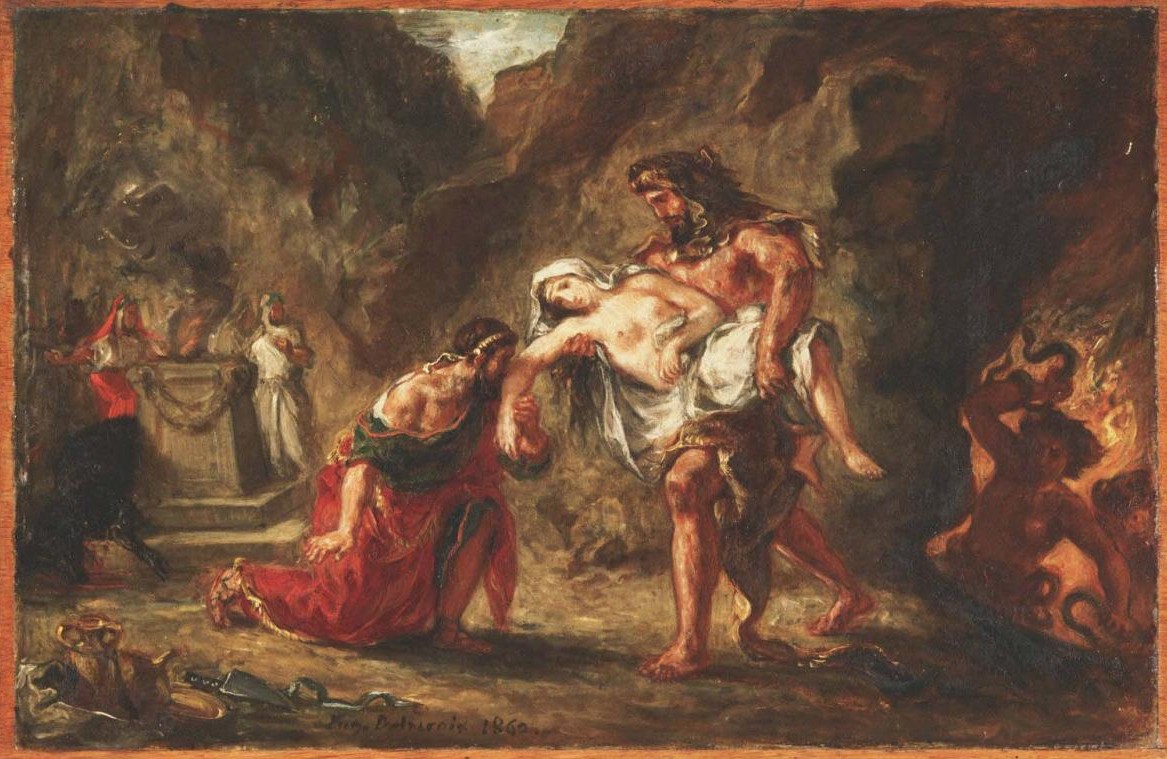
Herakles and Alkestis by Eugène Delacroix, 1862: Herakles brings Alkestis, whom he had rescued from Thanatos (death) back to Admetos
|
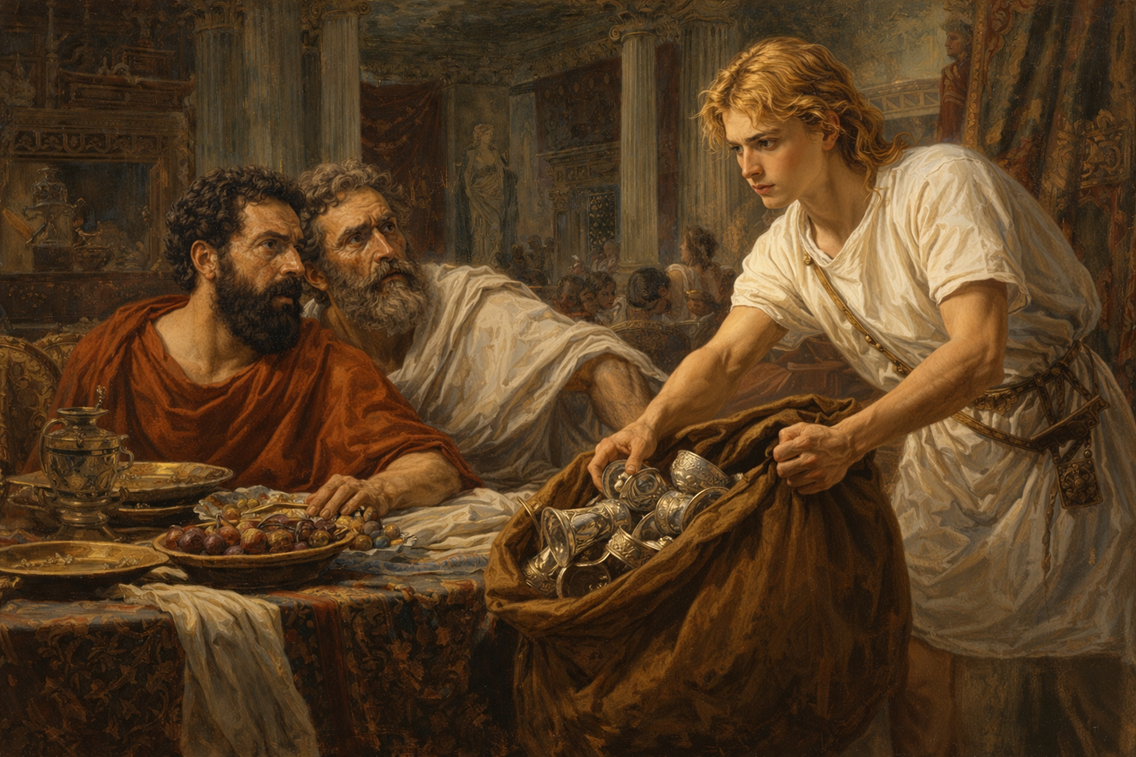
“It is fortunate that I mentioned the name of Alkestis. Women have no part at all in Ares; but if Love possesses them, it leads them to acts of courage beyond the bounds of nature, even to die. If it is ever any use to cite the evidence of mythology, we may learn from the tales about Alkestis and Protesilaos and Orpheus’ Eurydikê that Love is the only one of the gods whose commands are obeyed by Hades. As for all the others, as Sophokles says, He knows no kindness and no favour, To lovers, however, he shows respect; for them alone he ceases to be ‘inflexible, implacable.’ So though it is true, my friend, that it is a good thing to be initiated into the mysteries at Eleusis, I observe that celebrants of Love’s mysteries have a higher place in Hades. It isn’t that I’m completely persuaded by old tales, yet I cannot withhold from them some credence. They do well to say—and indeed by some divine chance they touch the truth when they say—that lovers are able to return to the light even from Hades. It is true that they do not know where and how this was accomplished; they missed the path, as it were, that Plato through his philosophy was the first of all human beings to discern. There are, however, dim, faint effluvia of the truth scattered about in Egyptian mythology, but a man needs a keen wit to track them down, one which can draw important conclusions from tiny scraps of evidence. “Let us, then, leave this subject. Now that we have seen how great is the power of Love, let us next examine his kindness and his favours to mankind. I am not speaking about the many benefits which he procures for those who are loved (these are perfectly obvious to everybody); I mean the even greater and more numerous benefits that he bestows on lovers themselves. Euripides, though experienced in love, marvels only at the least of them when he says Love will be the poet’s teacher, For love makes a man clever, even if he was slow-witted before; and, as we noted, the coward brave, just as men make soft wood tough by hardening it in the fire. Every lover becomes generous, singlehearted, high-minded, even though he was miserly before. His meanness and avarice are melted away like iron in the fire, so that he is made happier giving to those he loves than he is made by receiving gifts from others himself. “Of course, you know the tale of Anthemion’s son Anytos, a lover of Alkibiades, He was lavishly and sumptuously entertaining strangers at a banquet when Alkibiades stormed drunkenly in, took about half the goblets from the table, and went away. The strangers were annoyed and said,’ How insolently, how contemptuously, that boy treats you!’ ‘Not at all,’ said Anytos.’ It was very kind of him when he might have taken all the cups to leave me as many as he did.” |
“Εὖ δέ πως ἐπὶ μνήμην ἦλθεν ἡμῖν Ἄλκηστις. Ἄρεος γὰρ οὐ πάνυ μέτεστι γυναικί, ἡ δ᾿ ἐξ Ἔρωτος κατοχὴ προάγεταί τι τολμᾶν παρὰ φύσιν καὶ ἀποθνήσκειν. εἰ δέ πού τι καὶ μύθων πρὸς πίστιν ὄφελός ἐστι, δηλοῖ τὰ περὶ Ἄλκηστιν καὶ [f]Πρωτεσίλεων καὶ Εὐρυδίκην τὴν Ὀρφέως, ὅτι μόνῳ θεῶν ὁ Ἅιδης Ἔρωτι ποιεῖ τὸ προσταττόμενον· καίτοι πρός γε τοὺς ἄλλους, ὥς φησι Σοφοκλῆς, ἅπαντας οὔτε τοὐπιεικὲς οὔτε τὴν χάριν αἰδεῖται δὲ τοὺς ἐρῶντας καὶ μόνοις τούτοις οὐκ ἔστιν ἀδάμαστος οὐδ᾿ ἀμείλιχος. ὅθεν ἀγαθὸν μέν, ὦ ἑταῖρε, τῆς ἐν Ἐλευσῖνι τελετῆς μετασχεῖν· ἐγὼ [762a] δ᾿ ὁρῶ τοῖς Ἔρωτος ὀργιασταῖς καὶ μύσταις ἐν Ἅιδου βελτίονα μοῖραν οὖσαν, οὔτι τοῖς μύθοις πειθόμενος οὐ μὴν οὐδ᾿ ἀπιστῶν παντάπασιν· εὖ γὰρ δὴ λέγουσι, καὶ θείᾳ τινὶ τύχῃ ψαύουσι τἀληθοῦς οἱ λέγοντες κἀξ Ἅιδου τοῖς ἐρωτικοῖς ἄνοδον εἰς φῶς ὑπάρχειν, ὅπη δὲ καὶ ὅπως ἀγνοοῦσιν, ὥσπερ ἀτραποῦ διαμαρτόντες ἣν πρῶτος ἀνθρώπων διὰ φιλοσοφίας Πλάτων κατεῖδε. καίτοι λεπταί τινες ἀπορροαὶ καὶ ἀμυδραὶ τῆς ἀληθείας ἔνεισι ταῖς Αἰγυπτίων ἐνδιεσπαρμέναι μυθολογίαις, ἀλλ᾿ ἰχνηλάτου δεινοῦ δέονται καὶ μεγάλα μικροῖς ἑλεῖν δυναμένου. [b] “Διὸ ταῦτα μὲν ἐῶμεν, μετὰ δὲ τὴν ἰσχὺν τοῦ Ἔρωτος οὖσαν τοσαύτην ἤδη τὴν πρὸς ἀνθρώπους εὐμένειαν καὶ χάριν ἐπισκοπῶμεν, οὐκ εἰ πολλὰ τοῖς ἐρωμένοις ἀγαθὰ περιποιεῖ (δῆλα γάρ ἐστι ταῦτά γε πᾶσιν) ἀλλ᾿ εἰ πλείονα καὶ μείζονα τοὺς ἐρῶντας αὐτοὺς ὀνίνησιν· ἐπεί, καίπερ ὢν ἐρωτικὸς ὁ Εὐριπίδης, τὸ σμικρότατον ἀπεθαύμασεν εἰπών, ποιητὴν ἄρα συνετόν τε γὰρ ποιεῖ, κἂν ῥάθυμος ᾖ τὸ πρίν· καὶ ἀνδρεῖον, ᾗ λέλεκται, τὸν ἄτολμον, ὥσπερ οἱ τὰ ξύλα πυρακτοῦντες ἐκ μαλακῶν ἰσχυρὰ ποιοῦσι. δωρητικὸς δὲ καὶ ἁπλοῦς καὶ μεγαλόφρων γίνεται [c] πᾶς ἐραστής, κἂν γλίσχρος ᾖ πρότερον, τῆς μικρολογίας καὶ φιλαργυρίας δίκην σιδήρου διὰ πυρὸς ἀνιεμένης· ὥστε χαίρειν τοῖς ἐρωμένοις διδόντας, ὡς παρ᾿ ἑτέρων οὐ χαίρουσιν αὐτοὶ λαμβάνοντες. “Ἴστε γὰρ δήπου, ὡς Ἀνύτῳ τῷ Ἀνθεμίωνος, ἐρῶντι μὲν Ἀλκιβιάδου ξένους δ᾿ ἑστιῶντι φιλοτίμως καὶ λαμπρῶς, ἐπεκώμασεν ὁ Ἀλκιβιάδης καὶ λαβὼν ἀπὸ τῆς τραπέζης εἰς ἥμισυ τῶν ἐκπωμάτων ἀπῆλθεν. ἀχθομένων δὲ τῶν ξένων καὶ λεγόντων, ‘ὑβριστικῶς σοι κέχρηται καὶ ὑπερηφάνως τὸ μειράκιον,’ ‘φιλανθρώπως μὲν οὖν,’ ὁ Ἄνυτος εἶπε· ‘πάντα γὰρ ἐνῆν αὐτῷ λαβεῖν, ὁ δὲ κἀμοὶ τοσαῦτα καταλέλοιπεν.’” |
|
Zeuxippos was delighted and remarked, “Good heavens, how near it comes to making me renounce my ancestral feud with Anytos, deriving as it does from his treatment of Sokrates[6] and philosophy, if in a love affair Anytos could behave so like a well-bred gentleman!” “Very well then,” said my father. “Doesn’t Love change the ill-tempered and sullen and make them more sociable and agreeable? When hearth’s ablaze, a house appears more cheerful; likewise a man seems to become more radiant through the heat of love. But people react irrationally: if they see a light blazing in the house at night, they consider it supernatural and marvel at it; but when they observe a mean, base, ignoble soul suddenly invaded by high thoughts, liberality, aspiration, kindness, generosity, they are not compelled to cry out with Telemachos, Surely some god is within! By all the Graces, Daphnaios,” he asked, “is not this wonderful? I mean the fact that a man in love thinks little of practically everything else, not merely companions and relatives, but even laws and magistrates and kings. He fears nothing, he admires nothing, he pays service to nothing. He’s capable of braving’ even the Thunderbolt, the spear-wielder’; but once he catches sight of the handsome boy, He flinches like a cock that droops his vanquished wing. His confidence is broken to bits and the pride of his soul is overthrown. “Being, as we are, at the Muses’ shrine, it is only right and proper to mention Sappho. Roman writers relate that Kakos, the son of Hephaistos, emitted torrents of fire and flame that poured from his mouth. In the same way Sappho speaks words mingled truly with fire; through her song she communicates the heat of her heart, With sweet-voiced Muses healing her love, as Philoxenos says. Now, Daphnaios, if through the influence of Lysandra you have not completely forgotten your old loves, recite for us the ode in which the fair Sappho describes how her voice is lost and her body burns; how she turns pale, reels, and grows giddy when her beloved appears.” |
[18] Ἡσθεὶς οὖν ὁ Ζεύξιππος, “ὦ Ἡράκλεις,” εἶπεν, “ὡς ὀλίγου διελύσατο πρὸς Ἄνυτον τὴν ἀπὸ Σωκράτους καὶ φιλοσοφίας πατρικὴν ἔχθραν, εἰ πρᾶος ἦν οὕτω περὶ ἔρωτα καὶ γενναῖος.” “Εἶεν,” εἶπεν ὁ πατήρ· “ἐκ δὲ δυσκόλων καὶ σκυθρωπῶν τοῖς συνοῦσιν οὐ ποιεῖ φιλανθρωποτέρους καὶ ἡδίους; ‘αἰθομένου’ γὰρ ‘πυρὸς γεραρώτερον οἶκον ἰδέσθαι’ καὶ ἄνθρωπον ὡς ἔοικε φαιδρότερον ὑπὸ τῆς ἐρωτικῆς θερμότητος. ἀλλ᾿ οἱ πολλοὶ παράλογόν τι πεπόνθασιν· ἂν μὲν ἐν οἰκίᾳ νύκτωρ σέλας ἴδωσι, θεῖον ἡγοῦνται καὶ θαυμάζουσι· [e] ψυχὴν δὲ μικρὰν καὶ ταπεινὴν καὶ ἀγεννῆ ὁρῶντες ἐξαίφνης ὑποπιμπλαμένην φρονήματος, ἐλευθερίας, φιλοτιμίας, χάριτος, ἀφειδίας, οὐκ ἀναγκάζονται λέγειν ὡς ὁ Τηλέμαχος ἦ μάλα τις θεὸς ἔνδον ἐκεῖνο δ᾿,” εἶπεν, “ὦ Δαφναῖε, πρὸς Χαρίτων οὐ δαιμόνιον; ὅτι τῶν ἄλλων ὁ ἐρωτικὸς ὀλίγου δεῖν ἁπάντων περιφρονῶν, οὐ μόνον ἑταίρων καὶ οἰκείων, ἀλλὰ καὶ νόμων καὶ ἀρχόντων καὶ βασιλέων, φοβούμενος δὲ μηδὲν μηδὲ θαυμάζων μηδὲ θεραπεύων, ἀλλὰ καὶ τὸν ‘αἰχματὰν κεραυνὸν’ οἷος ὢν ὑπομένειν, ἅμα τῷ τὸν καλὸν ἰδεῖν ἔπτηξ᾿ ἀλέκτωρ δοῦλον ὣς κλίνας πτερόν, καὶ τὸ θράσος ἐκκέκλασται καὶ κατακέκοπταί οἱ [f] τὸ τῆς ψυχῆς γαῦρον. “Ἄξιον δὲ Σαπφοῦς παρὰ ταῖς Μούσαις μνημονεῦσαι· τὸν μὲν γὰρ Ἡφαίστου παῖδα Ῥωμαῖοι Κᾶκον ἱστοροῦσι πῦρ καὶ φλόγας ἀφιέναι διὰ τοῦ στόματος ἔξω ῥεούσας· αὕτη δ᾿ ἀληθῶς μεμιγμένα πυρὶ φθέγγεται καὶ διὰ τῶν μελῶν ἀναφέρει τὴν ἀπὸ τῆς καρδίας θερμότητα Μούσαις εὐφώνοις ἰωμένη τὸν ἔρωτα [763a] κατὰ Φιλόξενον. ἀλλ᾿ εἴ τι μὴ διὰ Λυσάνδραν, ὦ Δαφναῖε, τῶν παλαιῶν ἐκλέλησαι παιδικῶν, ἀνάμνησον ἡμᾶς, ἐν οἷς ἡ καλὴ Σαπφὼ λέγει τῆς ἐρωμένης ἐπιφανείσης τήν τε φωνὴν ἴσχεσθαι καὶ φλέγεσθαι τὸ σῶμα καὶ καταλαμβάνειν ὠχρότητα καὶ πλάνον αὐτὴν καὶ ἴλιγγον.” |
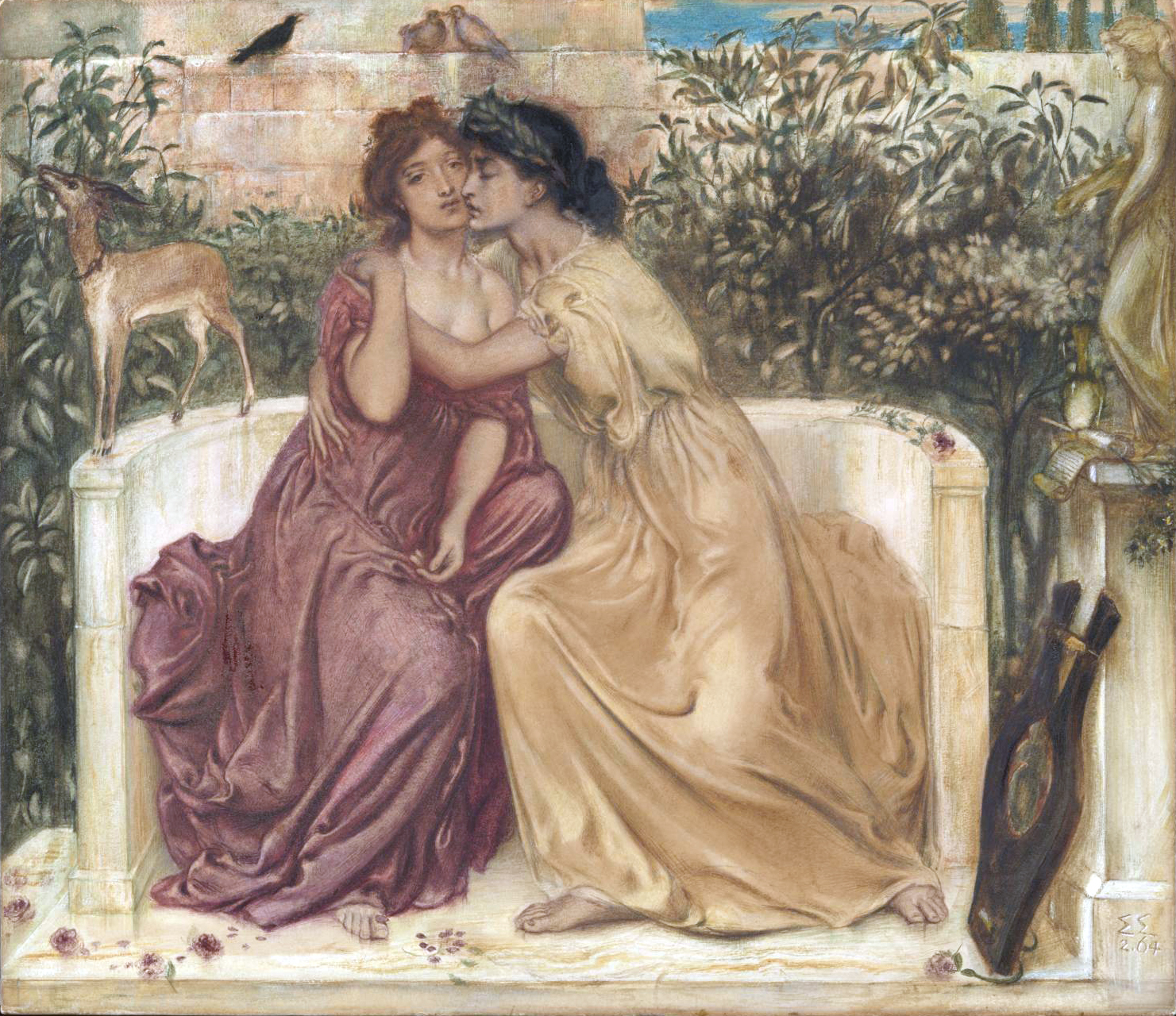
Sappho and Erinna in a Garden at Mytilene by Simeon Solomon, 1864
|
When Daphnaios had recited these verses,[7] my father resumed. “In heaven’s name,” he asked, “is not this a plain case of divine possession? Is it not a supernatural agitation of the soul? Is the disturbance of the Pythia grasping her tripod so great? Do the flute, the tambourine, the hymns to Kybelê, cause so much ecstasy in any of the devotees? “Moreover, while many behold the same body and the identical beauty, only one, the lover, is seized by it. Why? For surely we are not instructed by Menander nor do we understand when he says, It’s malady of mind that turns the scale; rather, it is the god that makes the difference by pouncing on one and letting another go free. “There is something that might better have been stated at the beginning, but even now— Since only now has it come to my lips, as Aischylos says—since it is very important, I do not believe that I shall leave it unspoken. Perhaps, my friend, our belief in all our notions, except those derived from the senses, comes from three sources: myth, law, and rational explanation; so it is undoubtedly the poets, the legislators, and thirdly the philosophers who have been our guides and teachers in what we think about the gods. They are alike in stating that gods exist; but they hold widely varying views about their number and rank, as well as their nature and function. Now the philosophers believe that the gods are Untroubled by illness or age, For this reason they do not admit the Strifes and the Prayers of the poets, nor do they allow Fear and Panic to be gods or acknowledged as the children of Ares. They are at variance on many points with the legislators, as when Xenophanes told the Egyptians not to honour Osiris as a god if they thought he was mortal, or not to weep for him if they believed him a god. On the other hand, when the philosophers put forth as gods certain patterns and numbers, monads and spirits, the poets and legislators haven’t the patience to listen to them, nor are they able to understand what is meant. “In short, their opinions have considerable variety and much divergence. Once upon a time there were three factions in Athens, of the Coast, the Hills, and the Plain. They had much enmity and many differences with each other; but they subsequently compromised to give all their votes to Solon. They jointly elected him mediator, chief magistrate, and legislator, since he seemed indisputably to hold the palm of virtue. In just the same way the three factions who theorize about the gods are at variance: they differ in their votes and find it difficult to accept each other’s candidates. Yet there is one god about whom all firmly agree. The most eminent of poets, legislators, philosophers, join together in enrolling Love among the gods With one voice of great approval, as Alkaios says the people of Mitylenê elected Pittakos tyrant. So we see Love chosen as king, chief magistrate, and harmonizer by Hesiod, Plato, Solon.[8] He is brought down with a crown on his head from Helikon to the Academy. Richly adorned, he is given a triumphal procession in which there are many two-horse chariots bound in a communion of love—not such as Euripides describes, Yoked in bonds not forged by metal, for he is imposing a cold constraint that is oppressive in practice because of shame. No, this is a winged communion that soars to the region of the fairest and most divine realities. But of these, others have spoken better than I.” 19. When my father had concluded his remarks, Soklaros asked, “Don’t you see that this is now the second time that, when you encounter the same subject, you make a detour and somehow break off violently and turn your back on it? If I may speak my mind, it’s not giving due justice to the argument, which is a holy thing. In fact, just a moment ago you touched, as though unwillingly, upon Plato and the Egyptians, then turned aside; and now you are doing the same thing. To be sure, as far as Plato’s ‘well-known utterances’ are concerned—or rather, my friend, those utterances of the goddesses through the mouth of Plato—don’t rehearse them ‘even if we beg you to do so.’ But as for your hint that the Egyptian tales bear a resemblance to the Platonic doctrine of Love, you can no longer avoid revealing and expounding to us your meaning; and we shall be perfectly content if we hear only ‘tiny scraps of evidence’ about ‘important conclusions.’” The others added their entreaties, whereupon my father said that the Egyptians recognize two Loves, just as the Greeks do, Uranios and Pandemos,[9] but they believe that the sun is a third Love; Aphroditê ... they reverence greatly. “We also observe that there is considerable similarity between Eros and the sun. Neither of them is really fire, as some think, but a radiance of sweet and fertile warmth. The radiance that proceeds from the sun gives nourishment, light, and the power of growth to the body, while the gleaming ray from Love does the same for the souls. The sun is warmer after a fog or upon emerging from clouds; so after rages and jealousies a reconciliation with the beloved makes love sweeter and more pungent. Then too, just as some believe that the sun is both illumined and extinguished, so they hold the same view about love, that it is a mortal and unstable thing. Finally, just as a body not conditioned by exercise cannot endure the sun without damage, neither can the guiding principle of an uncultivated soul sustain love without hurt: each degenerates alike and becomes afflicted, blaming the power of the god and not its own weakness. “Yet there is, it seems, a difference to be pointed out: the sun with equal candour exhibits both the beautiful and the ugly to men’s eyes, while Love illumines only what is beautiful. Only this does he persuade lovers to contemplate and turn to; everything else they must overlook. “Now if they call Aphroditê earth, in no respect do they attain any verisimilitude ... The moon, in fact, is both earthly and heavenly, a place where the immortal is blended with the mortal, ineffective by herself and without illumination when the sun is not shining on her, just as Aphroditê is nothing without the presence of Eros. “It is, then, likely that the resemblances of the moon to Aphroditê and of the sun to Eros are much stronger than those which these stars have to the other gods; yet they are by no means identical, for body is not the same as soul, but different, just as the sun is visible while Eros is merely intelligible. One might even say, if the statement is not too unpalatable, that the sun’s activities are directly opposed to those of Love. For it is the sun that turns our attention from intelligibles to sensibles, bewitching us by the charm and brilliance of vision, and convincing us that truth and everything else is to be found in the sun, or in the realm of sun, and not in any other place. It’s clear that we unwisely love as Euripides says, Because we have not known another life— or rather because of our forgetfulness of the realities of which Love is a recollection. |
Λεχθέντων οὖν ὑπὸ τοῦ Δαφναίου τῶν μελῶν ἐκείνων, “ὡς . . .” ὑπολαβὼν ὁ πατήρ, “ταῦτ,’” εἶπεν, “ὦ πρὸς τοῦ Διός, οὐ θεοληψία καταφανής; οὗτος οὐ δαιμόνιος σάλος τῆς ψυχῆς; τί τοσοῦτον ἡ Πυθία πέπονθεν ἁψαμένη τοῦ τρίποδος; τίνα τῶν ἐνθεαζομένων οὕτως ὁ αὐλὸς καὶ τὰ μητρῷα Bκαὶ τὸ τύμπανον ἐξίστησιν; “Καὶ μὴν ταὐτὸ σῶμα πολλοὶ καὶ ταὐτὸ κάλλος ὁρῶσιν, εἴληπται δ᾿ εἷς ὁ ἐρωτικός· διὰ τίν᾿ αἰτίαν; οὐ γὰρ μανθάνομέν γέ που τοῦ Μενάνδρου λέγοντος οὐδὲ συνίεμεν, καιρός ἐστιν ᾗ νόσος ἀλλ᾿ ὁ θεὸς αἴτιος τοῦ μὲν καθαψάμενος τὸν δ᾿ ἐάσας. “Ὃ τοίνυν ἐν ἀρχῇ καιρὸν εἶχε ῥηθῆναι μᾶλλον, οὐδὲ νῦν ‘ὅτι νῦν ἦλθεν ἐπὶ στόμα’ κατ᾿ Αἰσχύλον, ἄρρητον ἐάσειν μοι δοκῶ· καὶ γάρ ἐστι παμμέγεθες. ἴσως μὲν γάρ, ὦ ἑταῖρε, καὶ τῶν ἄλλων [c] ἁπάντων, ὅσα μὴ δι᾿ αἰσθήσεως ἡμῖν εἰς ἔννοιαν ἥκει, τὰ μὲν μύθῳ τὰ δὲ νόμῳ τὰ δὲ λόγῳ πίστιν ἐξ ἀρχῆς ἔσχηκε· τῆς δ᾿ οὖν περὶ θεῶν δόξης παντάπασιν ἡγεμόνες καὶ διδάσκαλοι γεγόνασιν ἡμῖν οἵ τε ποιηταὶ καὶ οἱ νομοθέται καὶ τρίτον οἱ φιλόσοφοι, τὸ μὲν εἶναι θεοὺς ὁμοίως τιθέμενοι, πλήθους δὲ πέρι καὶ τάξεως αὐτῶν οὐσίας τε καὶ δυνάμεως μεγάλα διαφερόμενοι πρὸς ἀλλήλους. ἐκεῖνοι μὲν γὰρ οἱ τῶν φιλοσόφων ἄνοσοι καὶ ἀγήραοι ὅθεν οὐ προσίενται ποιητικὰς Ἔριδας οὐ Λιτάς, οὐ Δεῖμον οὐδὲ Φόβον ἐθέλουσι θεοὺς εἶναι καὶ παῖδας Ἄρεος ὁμολογεῖν· μάχονται δὲ περὶ πολλῶν καὶ τοῖς νομοθέταις, ὥσπερ Ξενοφάνης Αἰγυπτίους [d] ἐκέλευσε τὸν Ὄσιριν, εἰ θνητὸν νομίζουσι, μὴ τιμᾶν ὡς θεόν, εἰ δὲ θεὸν ἡγοῦνται μὴ θρηνεῖν. αὖθις δὲ ποιηταὶ καὶ νομοθέται, φιλοσόφων ἰδέας τινὰς καὶ ἀριθμοὺς μονάδας τε καὶ πνεύματα θεοὺς ποιουμένων, οὔτ᾿ ἀκούειν ὑπομένουσιν οὔτε συνιέναι δύνανται. “Πολλὴν δ᾿ ὅλως ἀνωμαλίαν ἔχουσιν αἱ δόξαι καὶ διαφοράν. ὥσπερ οὖν ἦσάν ποτε τρεῖς στάσεις Ἀθήνησι, Παράλων Ἐπακρίων Πεδιέων, χαλεπῶς ἔχουσαι καὶ διαφερόμεναι πρὸς ἀλλήλας· ἔπειτα δὲ πάντες ἐν ταὐτῷ γενόμενοι καὶ τὰς ψήφους λαβόντες ἤνεγκαν πάσας Σόλωνι, καὶ τοῦτον εἵλοντο [e] κοινῇ διαλλακτὴν καὶ ἄρχοντα καὶ νομοθέτην, ὃς ἔδοξε τῆς ἀρετῆς ἔχειν ἀδηρίτως τὸ πρωτεῖον· οὕτως αἱ τρεῖς στάσεις αἱ περὶ θεῶν διχοφρονοῦσαι καὶ ψῆφον ἄλλην ἄλλη φέρουσαι καὶ μὴ δεχόμεναι ῥᾳδίως τὸν ἐξ ἑτέρας περὶ ἑνὸς βεβαίως ὁμογνωμονοῦσι καὶ κοινῇ τὸν Ἔρωτα συνεγγράφουσιν εἰς θεοὺς ποιητῶν οἱ κράτιστοι καὶ νομοθετῶν καὶ φιλοσόφων ‘ἀθρόᾳ φωνᾷ μέγ᾿ ἐπαίνεντες,’ ὥσπερ ἔφη, ‘τὸν Πιττακὸν’ ὁ Ἀλκαῖος αἱρεῖσθαι τοὺς Μυτιληναίους ‘τύραννον.’ ἡμῖν δὲ βασιλεὺς καὶ ἄρχων καὶ ἁρμοστὴς ὁ Ἔρως ὑφ᾿ Ἡσιόδου καὶ Πλάτωνος καὶ Σόλωνος ἀπὸ τοῦ Ἑλικῶνος εἰς τὴν [f] Ἀκαδήμειαν ἐστεφανωμένος κατάγεται καὶ κεκοσμημένος εἰσελαύνει πολλαῖς συνωρίσι φιλίας καὶ κοινωνίας, οὐχ οἵαν Εὐριπίδης φησὶν ἀχαλκεύτοισιν ἐζεῦχθαι πέδαις, ψυχρὰν οὗτός γε καὶ βαρεῖαν ἐν χρείᾳ περιβαλὼν ὑπ᾿ αἰσχύνης ἀνάγκην, ἀλλ᾿ ὑποπτέρου φερομένης ἐπὶ τὰ κάλλιστα τῶν ὄντων καὶ θειότατα, περὶ ὧν ἑτέροις εἴρηται βέλτιον.” [764a 19] Εἰπόντος δὲ ταῦτα τοῦ πατρός, ὁ Σώκλαρος, “ὁρᾷς,” εἶπεν, “ὅτι δεύτερον ἤδη τοῖς αὐτοῖς περιπεσών, οὐκ οἶδ᾿ ὅπως βίᾳ σαυτὸν ἀπάγεις καὶ ἀποστρέφεις, οὐ δικαίως χρεωκοπῶν, εἴ γε δεῖ τὸ φαινόμενον εἰπεῖν, ἱερὸν ὄντα τὸν λόγον; καὶ γὰρ ἄρτι τοῦ Πλάτωνος ἅμα καὶ τῶν Αἰγυπτίων ὥσπερ ἄκων ἁψάμενος παρῆλθες καὶ νῦν ταὐτὰ ποιεῖς. τὰ μὲν οὖν ‘ἀριζήλως εἰρημένα’ Πλάτωνι, μᾶλλον δὲ ταῖς θεαῖς ταύταις διὰ Πλάτωνος, ὦγαθέ, ‘μηδ᾿ ἂν κελεύωμεν εἴπῃς᾿· ᾗ δ᾿ ὑπῃνίξω τὸν Αἰγυπτίων μῦθον εἰς ταὐτὰ τοῖς Πλατωνικοῖς συμφέρεσθαι περὶ Ἔρωτος, οὐκέτ᾿ ἔστι σοι μὴ διακαλύψαι μηδὲ Bδιαφῆναι πρὸς ἡμᾶς· ἀγαπήσομεν δέ, κἂν μικρὰ περὶ μεγάλων ἀκούσωμεν.” Δεομένων δὲ καὶ τῶν ἄλλων ἔφη ὁ πατὴρ ὡς Αἰγύπτιοι δύο μὲν Ἕλλησι παραπλησίως Ἔρωτας, τόν τε πάνδημον καὶ τὸν οὐράνιον, ἴσασι, τρίτον δὲ νομίζουσιν Ἔρωτα τὸν ἥλιον, Ἀφροδίτην . . . ἔχουσι μάλα σεβάσμιον. “Ἡμεῖς δὲ πολλὴν μὲν Ἔρωτος ὁμοιότητα πρὸς τὸν ἥλιον ὁρῶμεν οὖσαν· πῦρ μὲν γὰρ οὐδέτερός ἐστιν ὥσπερ οἴονταί τινες, αὐγὴ δὲ καὶ θερμότης γλυκεῖα καὶ γόνιμος, καὶ ἡ μὲν ἀπ᾿ ἐκείνου φερομένη σώματι παρέχει τροφὴν καὶ φῶς καὶ αὔξησιν, ἡ δ᾿ ἀπὸ τούτου ψυχαῖς. ὡς δ᾿ ἥλιος ἐκ νεφῶν καὶ Cμεθ᾿ ὁμίχλην θερμότερος, οὕτως Ἔρως μετ᾿ ὀργὰς καὶ ζηλοτυπίας ἐρωμένου διαλλαγέντος ἡδίων καὶ δριμύτερος· ἔτι δ᾿ ὥσπερ ἥλιον ἅπτεσθαι καὶ σβέννυσθαι δοκοῦσιν ἔνιοι, ταὐτὰ καὶ περὶ Ἔρωτος ὡς θνητοῦ καὶ ἀβεβαίου διανοοῦνται. καὶ μὴν οὔτε σώματος ἀγύμναστος ἕξις ἥλιον, οὔτ᾿ Ἔρωτα δύναται φέρειν ἀλύπως τρόπος ἀπαιδεύτου ψυχῆς· ἐξίσταται δ᾿ ὁμοίως ἑκάτερον καὶ νοσεῖ, τὴν τοῦ θεοῦ δύναμιν οὐ τὴν αὑτοῦ μεμφόμενον ἀσθένειαν. “Πλὴν ἐκείνῃ γε δόξειεν ἂν διαφέρειν, ᾗ δείκνυσιν ἥλιος μὲν ἐπίσης τὰ καλὰ καὶ τὰ αἰσχρὰ τοῖς ὁρῶσιν· Ἔρως δὲ μόνων τῶν καλῶν φέγγος ἐστὶ Dκαὶ πρὸς ταῦτα μόνα τοὺς ἐρῶντας ἀναπείθει βλέπειν καὶ στρέφεσθαι, τῶν δ᾿ ἄλλων πάντων ὑπερορᾶν. “Γῆν δὲ κατ᾿ οὐδὲν Ἀφροδίτην καλοῦντες ἅπτονταί τινος ὁμοιότητος· καὶ γὰρ χθονία3 καὶ οὐρανία καὶ μίξεως χώρα τοῦ ἀθανάτου πρὸς τὸ θνητόν, ἀδρανὴς δὲ καθ᾿ ἑαυτὴν καὶ σκοτώδης ἡλίου μὴ προσλάμποντος, ὥσπερ Ἀφροδίτη μὴ παρόντος Ἔρωτος. “Ἐοικέναι μὲν οὖν᾿ Ἀφροδίτῃ σελήνην ἥλιον δὲ Ἔρωτι τῶν ἄλλων θεῶν μᾶλλον εἰκός ἐστιν, οὐ μὴν εἶναί γε παντάπασι τοὺς αὐτούς· οὐ γὰρ ψυχῇ σῶμα ταὐτὸν ἀλλ᾿ ἕτερον, ὥσπερ ἥλιον μὲν ὁρατὸν Ἔρωτα δὲ νοητόν. εἰ δὲ μὴ δόξει πικρότερον Eλέγεσθαι, καὶ τἀναντία φαίη τις ἂν ἥλιον Ἔρωτι ποιεῖν· ἀποστρέφει γὰρ ἀπὸ τῶν νοητῶν ἐπὶ τὰ αἰσθητὰ τὴν διάνοιαν, χάριτι καὶ λαμπρότητι τῆς ὄψεως γοητεύων καὶ ἀναπείθων ἐν ἑαυτῷ καὶ περὶ αὑτὸν κεῖσθαι τά τ᾿ ἄλλα καὶ τὴν ἀλήθειαν, ἑτέρωθι δὲ μηδέν· δυσέρωτες δὴ φαινόμεθ᾿ ὄντες ὡς Εὐριπίδης φησί, δι᾿ ἀπειροσύνην ἄλλου βιότου, μᾶλλον δὲ λήθην ὧν ὁ Ἔρως ἀνάμνησίς ἐστιν. |
|
“If we awaken in the face of a great brilliant light, everything that has been seen in our dreams leaves our souls and vanishes; just so, when we pass from one life to another and are born on this earth, the sun seems to dazzle our memory and drug our minds, through the pleasure and wonder it rouses, into forgetting what went before. And yet the soul’s true period of wakefulness is there in that other life and in that realm; since its arrival in this world, it is by means of dreams that it joyfully greets and gazes upon that which is most beautiful and most divine.[10] About it are shed sweet but treacherous dreams, for the soul is persuaded that beauty and value exist nowhere but here, unless it secures divine, chaste Love to be its physician, its saviour, its guide. Love, who has come to it through the medium of bodily forms, is its divine conductor to the truth from the realm of Hades here; Love conducts it to the Plain of Truth where Beauty, concentrated and pure and genuine, has her home. When we long to embrace and have intercourse with her after our separation, it is Love who graciously appears to lift us out of the depths and escort us upward, like a mystic guide beside us at our initiation. “But while we are being brought safely to that higher ground, Love does not approach our souls in isolation by themselves, but through the body. Teachers of geometry, when their pupils are not yet capable of initiation into purely intellectual conceptions of incorporeal and unchanging substance, offer them tangible and visible copies of spheres and cubes and dodecahedrons; in the same way heavenly Love contrives for us, as in a glass, beautiful reflections of beautiful realities. These are, however, merely mortal reflections of the divine, corruptible of the incorruptible, sensible of the intelligible. By showing us these in the form and hue and aspect of young men radiant in the prime of their beauty, Love gently excites our memory, which is first kindled by this means. Hence some, because of maladroit friends or relatives who tried by violence and unreasonably to extinguish the flame of love, have derived no benefit from it; instead they either fill themselves with the smoke of humbug and passion or slip away to dark and illicit pleasures and fall into a shameful decay. But all those who by sober reason and modesty have excluded the raging element, as if it were literally fire, have kept in their souls only its light and radiance and warmth. This warmth does not, as someone has affirmed, set up a churning that leads to the formation of seed through the gliding of atoms that are rubbed off in the smooth, tickling contact; rather, it produces a marvellous and fruitful circulation of sap, as in a plant that sprouts and grows, a circulation that opens the way to acquiescence and affection. Nor is it long before lovers learn to disregard the body of the beloved; they move inward instead and attach themselves to his character. The veil is stripped from their eyes and they see clearly and have intercourse—now through reasoned discourse, for the most part, but through moral behaviour as well—to discover whether the beloved may have in his thoughts an image that is cut to the pattern of ideal beauty. If he does not, they have no more to do with him and turn to others, like bees that abandon many fresh and charming flowers because these have no honey. But wherever they catch a trace of the divine, some emanation or beguiling resemblance, they are intoxicated with joy and wonder and pay court to it, basking in the memory of ideal beauty and renewing their radiance in the presence of that genuine object of love, blessed as it is and beloved of all and worthy of all affection. “Now generally poets who write or sing of the god seem to be making fun of him or carousing in a drunken revel; but they have some serious productions to their credit, either because they have taken careful thought, or else by the god’s help they have really grasped the truth. One such concerns his birth: Most fearful of the gods unless you have let yourselves be persuaded by literary critics who affirm that the imagery symbolizes the variegated brilliance of the emotion.” Daphnaios asked, “Why, what other interpretation can one give to the words?” “Listen,” said my father, “for this account is forced upon us by the phenomenon. What happens to our vision when we see a rainbow is, of course, refraction, which occurs whenever the sight encounters a slightly moist, but smooth and moderately thick cloud and has contact with the sun by refraction. Seeing the radiance in this way produces in us the illusion that the thing we see is in the cloud. Now the devices and ruses of Love’s operations on noble souls who love beauty are of the very same kind: he refracts their memories from the phenomena of this world, which are called beautiful, to the marvellous Beauty of that other world, that divine and blessed entity which is the real object of love. “Yet most men, since they pursue in boys and women merely the mirrored image of Beauty, can attain by their groping nothing more solid than a pleasure mixed with pain. Probably this is the meaning of Ixion’s constant whirling and irregular course, for the object of his desire and pursuit was an illusion in the clouds, as it were an empty shadow. It is like the eagerness of children to catch the rainbow in their hands, attracted by its mere appearance. “But the noble and self-controlled lover has a different bent. His regard is refracted to the other world, to Beauty divine and intelligible. When he encounters beauty in a visible body, he treats it as an instrument to memory. He welcomes and delights in it, yet the pleasure of its company only serves the more to inflame his spirit. While he is in this world and involved with bodies, he is not content to confine his activity to a wonder-struck yearning for the illumination of visible beauty; nor when he comes to the other world after death does he attempt to wrench himself away and run back for an erotic wallow at the chamber doors of the newly wed—those ill-omened dreams of men and women in love with the pleasures of the body: it is very wrong to call them lovers. “The true lover, when he has reached the other world and has consorted with true beauty in the holy way, grows wings and joins in the continual celebration of his god’s mysteries, escorting him in the celestial dance until it is time for him to go again to the meadows of the Moon and Aphrodite and fall asleep before he begins another existence in this world. “But these topics,” said my father, “take us beyond the purposes of the present discussion. Love, like the other gods, as Euripides says, Can be pleased by honours given him by men; but he can also be displeased: he is most gracious to those who receive him as they should and severe with those who have stubbornly rejected him. Neither does the god of Hospitality so quickly pursue and avenge wrongs done to strangers and suppliants, nor the god of the Family a father’s curse, as is Eros swift to respond to the complaints of outraged lovers and quick to punish the ill-mannered and disdainful. “Why tell the tale of Euxynthetos and Leukokoma? Or repeat the story of the girl who is still called Parakyptousa in Cyprus? But perhaps you haven’t heard the punishment of the Cretan Gorgo, who was treated very much like Parakyptousa, except that the latter was turned to stone at the moment when she peeped out of the window to watch the funeral procession of her lover. “Well, a certain Asandros, an upright youth from a distinguished family, fell in love with Gorgo. Though he had fallen on evil, disreputable days after his distinguished beginnings, nevertheless he did not think that anything was too good for him. He even asked Gorgo to be his wife, since he was her kinsman. The lady was, it seems, much sought after for her wealth, so that Asandros had plenty of worthy rivals. He, however, was able to win over all the girl’s guardians and relatives ...[11] |
“Ὥσπερ γὰρ εἰς φῶς πολὺ καὶ λαμπρὸν ἀνεγρομένων ἐξοίχεται πάντα τῆς ψυχῆς τὰ καθ᾿ ὕπνους φανέντα καὶ διαπέφευγεν, οὕτω τῶν γενομένων ἐνταῦθα καὶ μεταβαλόντων ἐκπλήττειν ἔοικε τὴν [f] μνήμην καὶ φαρμάττειν τὴν διάνοιαν ὁ ἥλιος, ὑφ᾿ ἡδονῆς καὶ θαύματος ἐκλανθανομένων ἐκείνων. καίτοι τό γ᾿ ὕπαρ ὡς ἀληθῶς ἐκεῖ καὶ περὶ ἐκεῖνα τῆς ψυχῆς ἐστι, δευρὶ δ᾿ ἐλθοῦσα διὰ τῶν ἐνυπνίων ἀσπάζεται καὶ τέθηπε τὸ κάλλιστον καὶ θειότατον. ἀμφὶ δέ οἱ δολόεντα φιλόφρονα χεῦεν ὄνειρα, πᾶν ἐνταῦθα πειθομένῃ τὸ καλὸν εἶναι καὶ τίμιον, ἂν μὴ τύχῃ θείου καὶ σώφρονος Ἔρωτος ἰατροῦ καὶ σωτῆρος καὶ ἡγεμόνος ὃς διὰ σωμάτων ἀφικόμενος [765a] ἀγωγὸς ἐπὶ τὴν ἀλήθειαν ἐξ Ἅιδου κεἰς ‘τὸ ἀληθείας πεδίον,’ οὗ τὸ πολὺ καὶ καθαρὸν καὶ ἀψευδὲς ἵδρυται κάλλος, ἀσπάσασθαι καὶ συγγενέσθαι διὰ χρόνου ποθοῦντας ἐξαναφέρων καὶ ἀναπέμπων εὐμενὴς οἷον ἐν τελετῇ παρέστη μυσταγωγός. “Ἐνταῦθα δὲ πάλιν πεμπομένων αὐτῇ μὲν οὐ πλησιάζει ψυχῇ καθ᾿ ἑαυτήν, ἀλλὰ διὰ σώματος. ὡς δὲ γεωμέτραι παισὶν οὔπω δυναμένοις ἐφ᾿ ἑαυτῶν τὰ νοητὰ μυηθῆναι τῆς ἀσωμάτου καὶ ἀπαθοῦς οὐσίας εἴδη πλάττοντες ἁπτὰ καὶ ὁρατὰ μιμήματα σφαιρῶν καὶ κύβων καὶ δωδεκαέδρων προτείνουσιν· [b] οὕτως ἡμῖν ὁ οὐράνιος Ἔρως ἔσοπτρα καλῶν καλά, θνητὰ μέντοι θείων καὶ ἀπαθῶν παθητὰ καὶ νοητῶν αἰσθητὰ μηχανώμενος ἔν τε σχήμασι καὶ χρώμασι καὶ εἴδεσι νέων ὥρᾳ στίλβοντα δείκνυσι καὶ κινεῖ τὴν μνήμην ἀτρέμα διὰ τούτων ἀναφλεγομένην τὸ πρῶτον. ὅθεν διὰ σκαιότητος ἔνιοι φίλων καὶ οἰκείων, σβεννύναι πειρωμένων βίᾳ καὶ ἀλόγως τὸ πάθος, οὐδὲν ἀπέλαυσαν αὐτοῦ χρηστὸν ἀλλ᾿ ἢ καπνοῦ καὶ ταραχῆς ἐνέπλησαν ἑαυτοὺς ἢ πρὸς ἡδονὰς σκοτίους καὶ παρανόμους ῥυέντες ἀκλεῶς ἐμαράνθησαν. ὅσοι δὲ σώφρονι λογισμῷ μετ᾿ αἰδοῦς οἷον ἀτεχνῶς πυρὸς ἀφεῖλον τὸ μανικόν, αὐγὴν [c] δὲ καὶ φῶς ἀπέλιπον τῇ ψυχῇ μετὰ θερμότητος, οὐ σεισμὸν μέν, ὥς τις εἶπε, κινούσης ἐπὶ σπέρμα κατ᾿ ὄλισθον ἀτόμων ὑπὸ λειότητος καὶ γαργαλισμοῦ θλιβομένων, διάχυσιν δὲ θαυμαστὴν καὶ γόνιμον ὥσπερ ἐν φυτῷ βλαστάνοντι καὶ τρεφομένῳ καὶ πόρους ἀνοίγουσαν εὐπειθείας καὶ φιλοφροσύνης, οὐκ ἂν εἴη πολὺς χρόνος, ἐν ᾧ τό τε σῶμα τὸ τῶν ἐρωμένων παρελθόντες ἔσω φέρονται καὶ ἅπτονται τοῦ ἤθους, ἐκκεκαλυμμένοι τὰς ὄψεις καθορῶσι καὶ συγγίνονται διὰ λόγων τὰ πολλὰ καὶ πράξεων ἀλλήλοις, ἂν περίκομμα τοῦ καλοῦ καὶ [d] εἴδωλον ἐν ταῖς διανοίαις ἔχωσιν· εἰ δὲ μή, χαίρειν ἐῶσι καὶ τρέπονται πρὸς ἑτέρους ὥσπερ αἱ μέλιτται πολλὰ τῶν χλωρῶν καὶ ἀνθηρῶν μέλι δ᾿ οὐκ ἐχόντων ἀπολιπόντες· ὅπου δ᾿ ἂν ἔχωσιν ἴχνος τι τοῦ θείου καὶ ἀπορροὴν καὶ ὁμοιότητα σαίνουσαν, ὑφ᾿ ἡδονῆς καὶ θαύματος ἐνθουσιῶντες καὶ περιέποντες, εὐπαθοῦσι τῇ μνήμῃ καὶ ἀναλάμπουσι πρὸς ἐκεῖνο τὸ ἐράσμιον ἀληθῶς καὶ μακάριον καὶ φίλιον ἅπασι καὶ ἀγαπητόν. [20] “Τὰ μὲν οὖν πολλὰ ποιηταὶ προσπαίζοντες ἐοίκασι τῷ θεῷ γράφειν περὶ αὐτοῦ καὶ ᾄδειν ἐπικωμάζοντες, ὀλίγα δὲ εἴρηται μετὰ σπουδῆς αὐτοῖς, εἴτε κατὰ νοῦν καὶ λογισμὸν εἴτε σὺν θεῷ τῆς ἀληθείας [e] ἁψαμένοις· ὧν ἕν ἐστι καὶ τὸ περὶ τῆς γενέσεως· δεινότατον θέων εἰ μή τι καὶ ὑμᾶς ἀναπεπείκασιν οἱ γραμματικοί, λέγοντες πρὸς τὸ ποικίλον τοῦ πάθους καὶ τὸ ἀνθηρὸν γεγονέναι τὴν εἰκασίαν.” Καὶ ὁ Δαφναῖος, “πρὸς τί γάρ,” ἔφη, “ἕτερον;” “Ἀκούετ᾿,” εἶπεν ὁ πατήρ· “οὕτω γὰρ βιάζεται τὸ φαινόμενον λέγειν. ἀνάκλασις δή που τὸ περὶ τὴν ἶρίν ἐστι τῆς ὄψεως πάθος, ὅταν ἡσυχῆ νοτερῷ λείῳ δὲ καὶ μέτριον πάχος ἔχοντι προσπεσοῦσα νέφει τοῦ ἡλίου ψαύσῃ κατ᾿ ἀνάκλασιν, καὶ τὴν [f] περὶ ἐκεῖνον αὐγὴν ὁρῶσα καὶ τὸ φῶς δόξαν ἡμῖν ἐνεργάσηται τοῦ φαντάσματος ὡς ἐν τῷ νέφει ὄντος. ταὐτὸ δὴ τὸ ἐρωτικὸν μηχάνημα καὶ σόφισμα περὶ τὰς εὐφυεῖς καὶ φιλοκάλους ψυχάς· ἀνάκλασιν ποιεῖ τῆς μνήμης ἀπὸ τῶν ἐνταῦθα φαινομένων καὶ προσαγορευομένων καλῶν εἰς τὸ θεῖον καὶ ἐράσμιον καὶ μακάριον ὡς ἀληθῶς ἐκεῖνο καὶ θαυμάσιον καλόν. “Ἀλλ᾿ οἱ πολλοὶ μὲν ἐν παισὶ καὶ γυναιξὶν ὥσπερ ἐν κατόπτροις εἴδωλον αὐτοῦ φανταζόμενον [766a] διώκοντες καὶ ψηλαφῶντες οὐδὲν ἡδονῆς μεμιγμένης λύπῃ δύνανται λαβεῖν βεβαιότερον· ἀλλ᾿ οὗτος ἔοικεν ὁ τοῦ Ἰξίονος ἴλιγγος εἶναι καὶ πλάνος, ἐν νέφεσι κενὸν ὥσπερ σκιαῖς θηρωμένου τὸ ποθούμενον· ὥσπερ οἱ παῖδες προθυμούμενοι τὴν ἶριν ἑλεῖν τοῖν χεροῖν, ἑλκόμενοι πρὸς τὸ φαινόμενον. “Εὐφυοῦς δ᾿ ἐραστοῦ καὶ σώφρονος ἄλλος τρόπος· ἐκεῖ γὰρ ἀνακλᾶται πρὸς τὸ θεῖον καὶ νοητὸν καλόν· ὁρατοῦ δὲ σώματος ἐντυχὼν κάλλει καὶ χρώμενος οἷον ὀργάνῳ τινὶ τῆς μνήμης ἀσπάζεται καὶ ἀγαπᾷ, καὶ συνὼν καὶ γεγηθὼς ἔτι μᾶλλον ἐκφλέγεται τὴν διάνοιαν· καὶ οὔτε μετὰ σωμάτων ὄντες ἐνταῦθα τουτὶ τὸ φῶς ἐπιποθοῦντες κάθηνται [b] καὶ θαυμάζοντες· οὔτ᾿ ἐκεῖ γινόμενοι μετὰ τὴν τελευτήν, δεῦρο πάλιν στρεφόμενοι καὶ δραπετεύοντες ἐν θύραις νεογάμων καὶ δωματίοις κυλινδοῦνται, δυσόνειρα φαντασμάτια φιληδόνων καὶ φιλοσωμάτων ἀνδρῶν καὶ γυναικῶν οὐ δικαίως ἐρωτικῶν προσαγορευομένων. “Ὁ γὰρ ὡς ἀληθῶς ἐρωτικὸς ἐκεῖ γενόμενος καὶ τοῖς καλοῖς ὁμιλήσας ᾗ θέμις, ἐπτέρωται καὶ κατωργίασται καὶ διατελεῖ περὶ τὸν αὑτοῦ θεὸν ἄνω χορεύων καὶ συμπεριπολῶν, ἄχρι οὗ πάλιν εἰς τοὺς Σελήνης καὶ Ἀφροδίτης λειμῶνας ἐλθὼν καὶ καταδαρθὼν ἑτέρας ἄρχηται γενέσεως. [c] “Ἀλλὰ ταῦτα μέν,” ἔφη, “μείζονας ἔχει τῶν παρόντων λόγων ὑποθέσεις. τῷ δ᾿ Ἔρωτι καὶ τοῦτο καθάπερ τοῖς ἄλλοις θεοῖς ‘ἔνεστιν,’ ὡς Εὐριπίδης φησί, ‘τιμωμένῳ χαίρειν ἀνθρώπων ὕπο’ καὶ τοὐναντίον· εὐμενέστατος γάρ ἐστι τοῖς δεχομένοις ἐμμελῶς αὐτὸν βαρὺς δὲ τοῖς ἀπαυθαδισαμένοις. οὔτε γὰρ ξένων καὶ ἱκετῶν ἀδικίας ὁ Ξένιος οὔτε γονέων ἀρὰς ὁ Γενέθλιος οὕτω διώκει καὶ μέτεισι ταχέως ὡς ἐρασταῖς ἀγνωμονηθεῖσιν ὁ Ἔρως ὀξὺς ὑπακούει, τῶν ἀπαιδεύτων καὶ ὑπερηφάνων κολαστής. “Τί γὰρ ἂν λέγοι τις Εὐξύνθετον καὶ Λευκοκόμαν; τί δὲ τὴν ἐν Κύπρῳ Παρακύπτουσαν ἔτι νῦν προσαγορευομένην; ἀλλὰ τὴν Γοργοῦς ἴσως [d] ποινὴν οὐκ ἀκηκόατε τῆς Κρήσσης, παραπλήσια τῇ Παρακυπτούσῃ παθούσης· πλὴν ἐκείνη μὲν ἀπελιθώθη παρακύψασα τὸν ἐραστὴν ἰδεῖν ἐκκομιζόμενον. “Τῆς δὲ Γοργοῦς Ἄσανδρός τις ἠράσθη, νέος ἐπιεικὴς καὶ γένει λαμπρός, ἐκ δὲ λαμπρῶν εἰς ταπεινὰ πράγματα καὶ ἀδοξίαν ἀφιγμένος, ὅμως αὑτὸν οὐδενὸς ἀπηξίου ἀλλὰ τὴν Γοργώ, διὰ πλοῦτον ὡς ἔοικε περιμάχητον οὖσαν καὶ πολυμνήστευτον, ᾔτει γυναῖκα συγγενὴς ὤν, πολλοὺς ἔχων καὶ ἀγαθοὺς συνερῶντας αὑτῷ, πάντας δὲ τοὺς περὶ τὴν κόρην ἐπιτρόπους καὶ οἰκείους πεπεικώς ... |
Continue to the fourth and last part
[1] This story belongs to the time of the Lelantine War in the archaic age, undatable but probably around the early 7th century BC. [Website note]
[2] Cf. Moralia 618d and Plutarch Life of Pelopidas XVIII, though these record only that Pammenes thought positioning men beside their boys was a good idea and not the important fact that he actually implemented this change which was thought critical to the Sacred Band’s success in establishing Theban military supremacy in Greece for a generation of the mid 4th century BC. [Website note].
Pammenes was a close political adherent of Epameinondas, according to Mor. 805 e. [Translator’s note]
[3] Life of Kimon, iv (481 b f.). Meleagros and Kimon, so far as we know, were inspired by the love of women. In literature Achilles is sometimes bisexual, Epameinondas is not. Nothing is known of Aristomenes’ proclivities, though Plutarch, since he wrote a life of him, as well as one of Epameinondas, was doubtless well informed. [Translator’s note]
[4] The translator’s absurdly inaccurate “loved two young men” has been replaced by “had two loved boys” as a translation of ἐρωμένους ἔσχεν. [Website note]
[5] The shrine was still standing in Pausanias’ day (ix. 23. 1), shortly after Plutarch’s. See also Life of Pelopidas, xviii (287 d). For another and more miraculous shrine of Iolaos see Diodoros, iv. 24. 4; and for the connexions of Iolaüs and Thespiae Diodoros, iv. 29. 4. [Translator’s note]
Given the importance explained here of Iolaos in the Greek imagination as the symbol of the boy in a pederastic love affair, it is worth remembering that Plutarch said earlier, 754e, in his Dialogue on Love that Iolaos, at a time when he was already well established as Herakles’s beloved, “was then only sixteen.” [Website note]
[6] Anytos was foremost among those who demanded the prosecution of Sokrates in 399 BC for “corrupting the youth”. [Website note]
[7] There is a long lacuna in the mss., as though for the verses to be inserted. [Translator’s note]
[8] As the most eminent of poets, philosophers, legislators. [Translator’s note]
[9] Heavenly and Vulgar, or Earthly. [Translator’s note]
[10] Much of this sentence is conjecturally supplied to fill a gap in the mss.; cf. Plato, Phaidros, 249 c. [Translator’s note[
[11] Here unfortunately the story ends, though the mss. indicate no lacuna. The gap must be a long one; for when the dialogue is resumed, we have left the Shrine of the Muses and are on the way back to Thespiai. Zeuxippos has spoken against conjugal love and Plutarch is in the act of replying to him. [Translator’s note]
Comments powered by CComment