
LI CHENGQIAN, CROWN PRINCE OF CHINA (619-645)
Li Chéngqián 李承乾 (619 – 5 January 645) was Crown Prince of China from his father Taizong’s accession to the imperial throne in September 626 until deposed for conspiring against him in April 643. Presented here are what two of the three main sources for the history of the Chinese Tang dynasty had to say about his passionate love of a boy aged about ten whom he named Chengxin 稱心, meaning “satisfying the heart.”
The context of both passages is the growing rivalry between Li Chengqian and his younger brother, Li Tai, who hoped to usurp his right to be heir and was gaining favour in their father’s eyes, leading to Chengqian’s disastrous conspiracy.
The translations are this website’s.
The Old Book of Tang, Volume 76: Taizong’s Sons
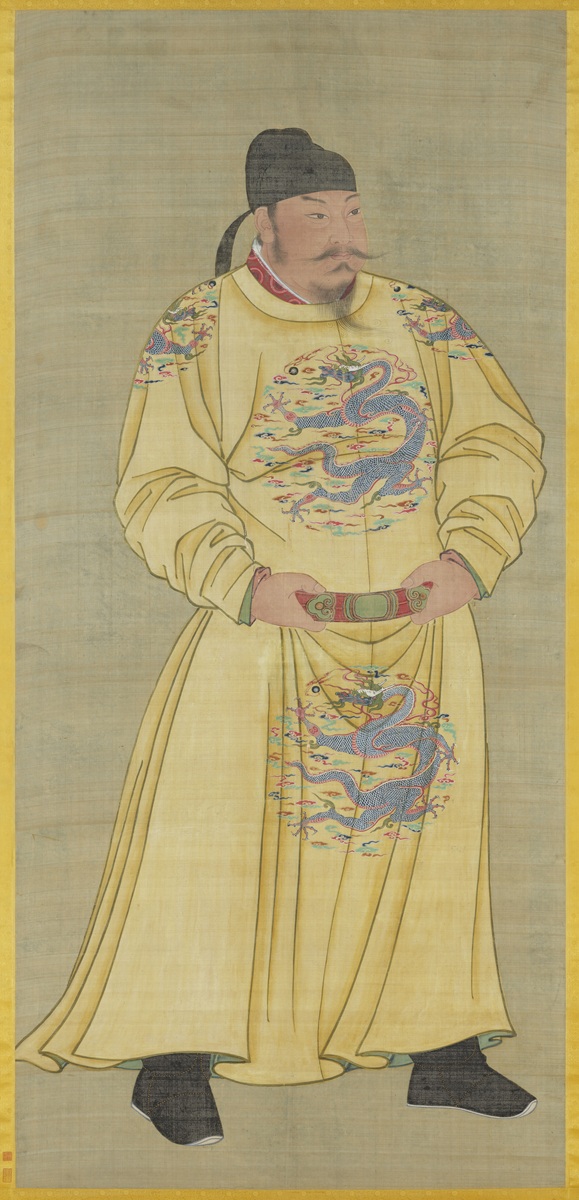
Taizong, emperor 626-49, (Ming dynasty scroll, after a con-temporary painting by Yan Liben)
The Old Book of Tang was compiled by imperial command issued in 941 in two hundred volumes by various writers working under two successive editors.
Thereupon, each formed factions, and divisions arose. There was a musician of the Court of Music, about ten-odd years old,[1] of beautiful appearance and skilled in singing and dancing. Chengqian showed him exceptional favour and called him Chengxin.
Emperor Taizong, upon learning of this, was greatly enraged, arrested Chengxin and had him executed; several others were also put to death on his account. Chengqian suspected Tai of exposing the matter, and his resentment grew even deeper.
He mourned Chengxin intensely and without cease. Within the palace he built a chamber, set up his image, arranged figurines of attendants, carriages, and horses before it, and ordered palace attendants to make offerings to him morning and evening.
Chengqian repeatedly went to that place, wandering about and shedding tears. He then built a tomb within the palace and buried him there, and also posthumously granted him an official rank and erected a stele, in order to express his grief.[2] From this point on, Chengqian would feign illness and not attend court audiences, and each time this happened it would last for several months.
The New Book of Tang, Volume 80: Sons of Taizu
The New Book of Tang was compiled by imperial command to supersede the preceding Old Book as the official history of the Tang dynasty. It was written by a team of scholars between 1044 and 1060.
In the Eastern Palace there was a young actor, good in appearance and bearing, whom Chengqian loved and favoured.[3] When the emperor heard of it, he was greatly angered, arrested the boy and killed him; several people were implicated and put to death. Chengqian thought that Tai had reported it, and greatly resented him. Inwardly he kept thinking of the boy without cease; he built a chamber and painted his likeness, posthumously gave him office and set up a stele, and raised a tomb for him within the park, sacrificing morning and evening. When Chengqian came to that place, he lingered back and forth, tears falling in several streams. He became still more resentful and embittered, pleaded illness and did not attend court for several months.
[1] Literally, he is said to have been a bit older than [traditional Chinese] ten [=English eight or nine].
[2] Earlier, we were told that Chengqian “developed a fondness for music and women, indulging in frivolous pursuits without restraint”, which (together with his fathering three sons by his wife) should correct any modernist assumption that his love of a boy was likely in conflict with love of women. Rather, his excessive indulgence in both was perceived as stemming from his frivolity.
In the biography of the chancellor Du Zhenlun in Book 74 of the Old Book of Tang, it is explained that in AD 636/7, the Emperor appointed Du Left Attendant to Chenqian (then aged about sixteen) with a view to guiding him away from his waywardness, of which the prime example the Emperor complained of was that “he liked to be intimate with petty people.” It thus appears that the cause of the Emperor’s rage and savage treatment of the boy Chengxin was not that the Crown Prince was having sex with him, but that he was acting unworthily by devoting himself excessively to such a “petty” person.
[3] Like the Old Book of Tang, the New Book had also reported a little earlier on how Li Chengqian’s reputation suffered from his having become “fond of music, women, and idle roaming” and likewise how “with a group of unruly people, [he was] intimate and insolent.”
Comments powered by CComment