
SEXUAL PERSONAE
BY CAMILLE PAGLIA
Camille Paglia (b. 1947) is an American scholar, writer, and social critic. She was a professor at the University of the Arts in Philadelphia, Pennsylvania from 1984 to 2024. Her book Sexual Personae: Art and Decadence from Nefertiti to Emily Dickinson (1990) examines western art, literature, and sexuality from ancient Egypt to 1900. Paglia states in the preface: "I show how much of western life, art, and thought is ruled by personality, which the book traces through recurrent types or personae ('masks')."
Early in chapter one, Paglia says, "I will speak at length of the beautiful boy, one of the west's most stunning sexual personae." The following excerpts provide three primary instances.
From Chapter 4 Pagan Beauty
The Athenian cult of beauty had a supreme theme: the beautiful boy. ...
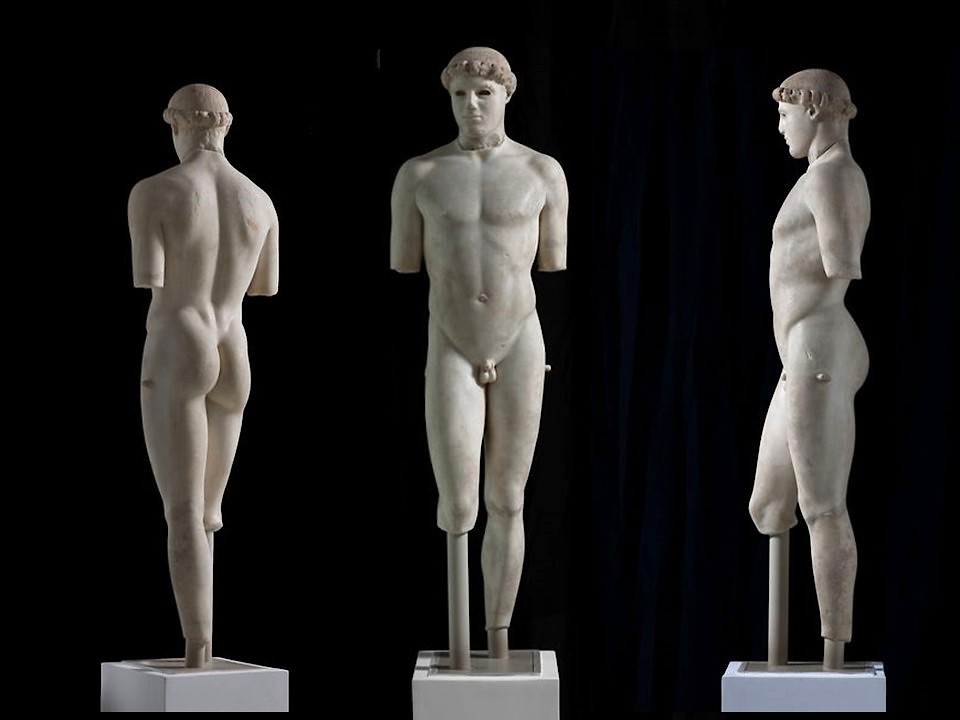
Though the homosexuality of Greek high culture has been perfectly obvious since Winckelmann, the facts have been suppressed or magnified, depending on period and point of view. Late nineteenth-century aestheticism, for example, was full of heady effusions about “Greek love.” Yet Harvard’s green and red Loeb Library translations of classical literature, published early this century, are heavily censored. The pendulum has now swung toward realism. In Greek Homosexuality (1978), K. J. Dover wittily reconstructs from the evidence of vase painting the actual mechanics of sexual practice. But I depart from sociological rationales for Greek love. For me, aesthetics are primary. The Athenian turn away from women toward boys was a brilliant act of conceptualization. Unjust and ultimately self-thwarting, it was nevertheless a crucial movement in the formation of western culture and identity.
The Greek beautiful boy, as I remarked earlier, is one of the west’s great sexual personae. Like Artemis, he has no exact equivalent in other cultures. His cult returns whenever Apollonianism rebounds, as in Italian Renaissance art. The beautiful boy is an androgyne, luminously masculine and feminine. He has male muscle structure but a dewy girlishness. In Greece he inhabited the world of hard masculine action. His body was on view, striving nude in the palestra. Greek athletics, like Greek law, were theater, a public agon. They imposed mathematics on nature: how fast? how far? how strong? The beautiful boy was the focus of Apollonian space. All eyes were on him. His broad-shouldered, narrow-waisted body was a masterwork of Apollonian articulation, every muscle group edged and contoured. There was even a ropy new muscle, looping the hips and genitals. Classic Athens found the fatty female body unbeautiful, because it was not a visible instrument of action. The beautiful boy is Adonis, the Great Mother’s son-lover, now removed from nature and cleansed of the chthonian. Like Athena, he is reborn through males and clad in the Apollonian armour of his own hard body.
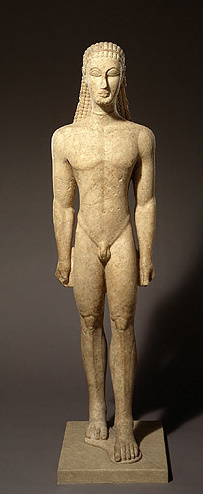
Major Greek art begins in the late seventh century B.C. with the Archaic kouros (“youth”), a more than life-size nude statue of a victorious athlete. He is monumental human assertion, imagined in Apollonian stillness. He stands like Pharaoh, fists clenched and one foot forward. But Greek artists wanted their work to breathe and move. What was unchanged for thousands of years in Egypt leaps to life in a single century. The muscles curve and swell; the heavy wiglike hair curls and tufts. The smiling kouros is the first fully free-standing sculpture in art. Strict Egyptian symmetry was preserved until the early classic Kritios Boy, who looks one way while shifting his weight to the opposite leg. In the broken record of Greek artifacts, the Kritios Boy is the last kouros. He is not a type but a real boy, serious and regal. His smooth, shapely body has a white sensuality. The Archaic kouros was always callipygian, the large buttocks more stressed and valued than the face. But the buttocks of the Kritios Boy have a feminine refinement, as erotic as breasts in Venetian painting. The contrapposto flexes one buttock and relaxes the other. The artist imagines them as apple and pear, glowing and compact.
For three hundred years, Greek art is filled with beautiful boys, in stone and bronze. We know the name of none of them. The old-fashioned generic term, “Apollo,” had a certain wisdom, for the solitary, self-supporting kouros was an Apollonian idea, a liberation of the eye. His nudity was polemical. The Archaic kore (“maiden”) was always clothed and utilitarian, one hand proffering a votive plate. The kouros stands heroically bare in Apollonian externality and visibility. Unlike two-dimensional pharaonic sculptures, he invites the strolling spectator to admire him in the round. He is not king or god but human youth. Divinity and stardom fall upon the beautiful boy. Epiphany is secularized and personality ritualized. The kouros records the first cult of personality in western history. It is an icon of the worship of beauty, a hierarchism self-generated rather than dynastic.
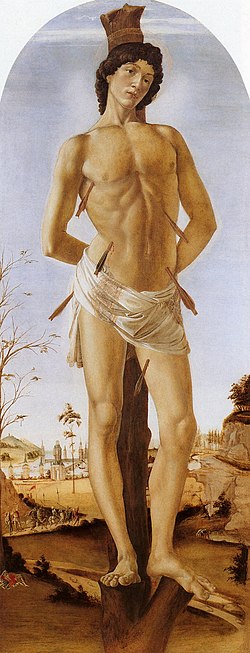
The kouros bore strange fruit. From its bold clarity and unity of design came all major Greek sculpture, by the fourth century female as well as male. Hellenic art spread throughout the eastern Mediterranean as Hellenistic art. From that grew medieval Byzantine art in Greece, Turkey, and Italy, with its dour mosaic icons of Christ, Virgin, and saint. The Italian Renaissance begins in the Byzantine style. Thus there is a direct artistic line from Archaic Greek kouroi to the standing saints of Italian altarpieces and the stained-glass windows of Gothic cathedrals. Homoerotic iconicism goes full circle in the popular Italian theme, St. Sebastian, a beautiful seminude youth pierced by phallic arrows. Those arrows are glances of the aggressive western eye, solar shafts of Apollo the archer. The Greek kouros, inheriting Egypt’s cold Apollonian eye, created the great western fusion of sex, power, and personality.
In Greece the beautiful boy was always beardless, frozen in time. At manhood, he became a lover of boys himself. The Greek boy, like the Christian saint, was a martyr, victim of nature’s tyranny. His beauty could not last and so was caught full-flower by Apollonian sculpture. There are hundreds of pots, shards, and graffiti hailing so-and-so kalos, “the beautiful,” flirtatious public praise of males by males. Dover demonstrates the criteria governing depiction of male genitalia, opposite to ours: a small thin penis was fashionable, a large penis vulgar and animalistic. Even brawny Hercules was shown with boy’s genitals. Therefore, despite its political patriarchy, Athens cannot be considered—horrid word—a phallocracy. On the contrary, the Greek penis was edited down from an exclamation point to a dash. The beautiful boy was desired but not desiring. He occupied a presexual or suprasexual dimension, the Greek aesthetic ideal. In convention, his adult admirer could seek orgasm, while he remained unaroused.
The beautiful boy was an adolescent, hovering between a female past and male future. J. H. Van den Berg claims the eighteenth century invented adolescence.[1] It is true children once passed more directly into adult responsibilities than they do now. In Catholicism, for example, seven is the dawn of moral consciousness. After one’s First Communion, it’s hell or high water. Brooding identity crises were indeed the Romantic creations of Rousseau and Goethe. But Van den Berg is wrong to make adolescence entirely modern. The Greeks saw it and formalized it in art. Greek pederasty honored the erotic magnetism of male adolescents in a way that today brings the police to the door. Children are more conscious and perverse than parents like to think. I agree with Bruce Benderson that children can and do choose. The adolescent male, one step over puberty, is dreamy and removed, oscillating between vigor and languor. He is a girl-boy, masculinity shimmering and blurred, as if seen through a cloudy fragment of ancient glass. J. Z. Eglinton cites images of youthful “bloom” in Greek poetry: “The adolescent in bloom is a synthesis of male and female beauties.”[2] The slightly older ephebos gained in gravity but retained a half-feminine glamour. We see it in the pedimental Apollo, the Delphic Charioteer, the bronze Apollo at Chatsworth, the white-lekythos Eretrian warrior seated before a gravestone. These youths have a distinctly ancient Greek face: high brow, strong straight nose, girlishly fleshy cheeks, full petulant mouth, and short upper lip. It is the face of Elvis Presley, Lord Byron, and Bronzino’s glossy Mannerist blue boy. Freud saw the androgyny in the Greek adolescent: “Among the Greeks, where the most manly men were found among inverts, it is quite obvious that it was not the masculine character of the boy which kindled the love of man; it was his physical resemblance to woman as well as his feminine psychic qualities, such as shyness, demureness, and the need of instruction and help.”[3] Certain boys, especially blondes, seem to carry adolescent beauty into adulthood. They form an enduring class of homosexual taste that I call the Billy Budd topos, fresh, active, and ephebic.
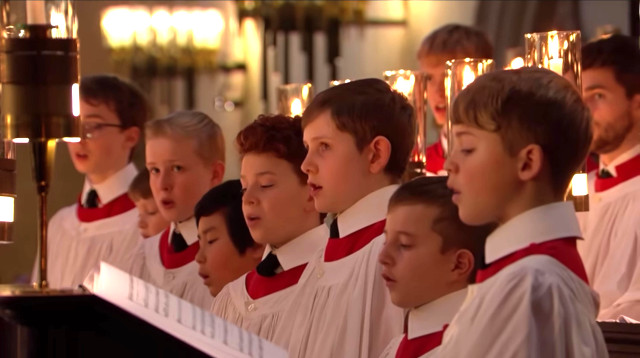
The beautiful boy is the Greek angel, a celestial visitor from the Apollonian realm. His purity is inadvertently revealed in Joseph Campbell’s negative critique of fifth-century Athens: “Everything that we read of it has a wonderful adolescent atmosphere of opalescent, timeless skies—untouched by the vulgar seriousness of a heterosexual commitment to mere life. The art, too, of the lovely standing nude, for all its grace and charm, is finally neuter—like the voice of a singing boy.” Campbell quotes Heinrich Zimmer’s praise of the “heterosexual flavor” and yogic awareness of Hindu sculpture: “Greek art was derived from experiences of the eye; Hindu from those of the circulation of the blood.”[4] Campbell’s “neuter” is a blank, a moral nothing. But the beautiful boy’s androgyny is visionary and exalted. Let us take Campbell’s own example, “the voice of a singing boy.” In a Seraphim recording of Fauré’s Requiem that substitutes the King’s College choir for the usual women, the treble parts are taken by boys from eight to thirteen. Alec Robertson’s review seeks a tonality of emotion for which our only language is religious: boys’ voices “add an unforgettable radiance and serenity to their part, impossible to sopranos, however good”; the soloist’s singing has “an ethereal beauty that no words can describe.”[5] The rosy English or Austrian choirboy, disciplined, reserved, and heart-stoppingly beautiful, is a symbol of spiritual and sexual illumination, fused in the idealizing Greek manner. We see the same thing in Botticelli’s exquisite long-haired boy-angels. These days, especially in America, boy-love is not only scandalous and criminal but somehow in bad taste. On the evening news, one sees handcuffed teachers, priests, or Boy Scout leaders hustled into police vans. Therapists call them maladjusted, emotionally immature. But beauty has its own laws, inconsistent with Christian morality. As a woman, I feel free to protest that men today are pilloried for something that was rational and honorable in Greece at the height of civilization.
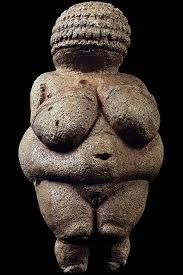
The Greek beautiful boy was a living idol of the Apollonian eye. As a sexual persona, the kouros represents that tense relation between eye and object that I saw in Nefertiti and that was absent in the Venus of Willendorf, with her easy, forgiving, spongy female amplitude. Zimmer correctly opposes heterosexual Hindu “circulation of the blood” to Greek aesthetics of the eye. The beautiful boy is a rebuke to mother nature, an escape from the labyrinth of the body, with its murky womb and bowels. Woman is the Dionysian miasma, the world of fluids, the chthonian swamp of generation. Athens, says Campbell, was “untouched by the vulgar seriousness of a heterosexual commitment to mere life.” Yes, mere life is indeed rejected by the idealizing Apollonian mode. It is the divine human privilege to make ideas greater than nature. We are born into the indignities of the body, with its relentless inner movements pushing us moment by moment toward death. Greek Apollonianism, freezing the human form into absolute male externality, is a triumph of mind over matter. Apollo, slaying the Python at Delphi, the navel of the world, halts the flood of time, for the coiled serpent we carry in our abdomen is the eternal wave-motion of female fluidity. Every beautiful boy is an Icarus seeking the Apollonian sun. He escapes the labyrinth only to fall into nature’s sea of dissolution.
Cults of beauty have been persistently homosexual from antiquity to today’s hair salons and houses of couture. Professional beautification of women by homosexual men is a systematic reconceptualizing of the brute facts of female nature. As at the nineteenth-century fin de siècle, the aesthete is always male, never female. There is no lesbian parallel to Greek worship of the adolescent. The great Sappho may have fallen in love with girls, but to all evidence she internalized rather than externalized her passions. Her most famous poem invents the hostile distance between sexual personae that will have so long a history in western love poetry. Gazing across a room at her beloved sitting with a man, she suffers a physical convulsion of jealousy, humiliation, and helpless resignation. This separation is not the aesthetic distance of Apollonian Athens but a desert of emotional deprivation. It is a gap that can be closed—as Aphrodite laughingly promises Sappho in another poem. Lascivious delectation of the eye is conspicuously missing in female eroticism. Visionary idealism is a male art form. The lesbian aesthete does not exist. But if there were one, she would have learned from the perverse male mind. The eye-intense pursuit of beauty is an Apollonian correction of life in our mother-born bodies.

The beautiful boy, suspended in time, is physicality without physiology. He does not eat, drink, or reproduce. Dionysus is deeply immersed in time—rhythm, music, dance, drunkenness, gluttony, orgy. The beautiful boy as angel floats above the turmoil of nature. Angels, in Judaism too, defy chthonian femaleness. This is why the angel, though sexless, is always a youthful male. Eastern religion does not have our angels of incorporeal purity, for two reasons. A “messenger” (angelos) or mediator between the divine and human is unnecessary, since the two realms are coexistent. Second, eastern femaleness is symbolically equivalent to and harmonious with maleness—though this has never improved real women’s social status.
The pink-cheeked beautiful boy is emotional vernality, spring only. He is a partial statement about reality. He is exclusive, a product of aristocratic taste. He flees the superfluity of matter, the womb of female nature devouring and spewing out creatures. Dionysus, we noted, is “the Many,” all-inclusive and ever-changing. Life’s totality is summer and winter, floridity and devastation. The Great Mother is both seasons in her benevolent and malevolent halves. If the beautiful boy is pink and white, she is the red and purple of her labial maw. The beautiful boy represents a hopeless attempt to separate imagination from death and decay. He is form seceding from form-making, natura naturata dreaming itself free of natura naturans. As an epiphany, eye-created, he binds up the many into a transient vision of the one, like art itself.
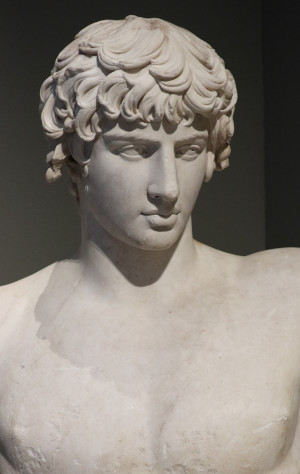
Besides the Kritios Boy, the preeminent examples of this persona are the bronze Benevento Boy of the Louvre, the Antinous sculptures commissioned by the emperor Hadrian, Donatello’s David, and Thomas Mann’s Tadzio in Death in Venice. The Apollonian is a mode of silence, suppressing rhythm to focus the eye. The beautiful boy, sexually self-complete, is sealed in silence, behind a wall of aristocratic disdain. The adolescent dreaminess of the Antinous sculptures is not true inwardness but a melancholy premonition of death. Antinous drowned, like Icarus. The beautiful boy dreams but neither thinks nor feels. His eyes fix on nothing. His face is a pale oval upon which nothing is written. A real person could not remain at this stage without decadence and mummification. The beautiful boy is cruel in his indifference, remoteness, and serene self-containment. We rarely see these things in a girl, but when we do, as in the magnificent portrait photographs of the young Virginia Woolf, we sense catatonia and autism. Narcissistic beauty in a postadolescent (like Hitchcock’s Marnie) may mean malice and ruthlessness, a psychopathic amorality. There is danger in beauty.
The beautiful boy has flowing or richly textured hyacinthine hair, the only luxuriance in this chastity. Long male hair, sometimes wrapped round the head, was an aristocratic fashion in Athens. Antinous’ thick hair is crisply layered, as in Van Dyck’s silky princes or Seventies rock stars. In its artful negligence and allure, the hair traps the beholder’s eye. It is a nimbus, a pre-Christian halo, scintillating with fiery flakes of stars. The beautiful boy, glittering with charisma, is matter transformed, penetrated by Apollonian light. Greek visionary materialism makes hard crystal of our gross fleshiness. The beautiful boy is without motive force or deed; hence he is not a hero. Because of his emotional detachment, he is not a heroine. He occupies an ideal space between male and female, effect and affect. Like the Olympians, he is an objet d’art, which also affects without acting or being acted upon. The beautiful boy is the product of chance or destiny, a sport thrown up by the universe. He is, I suggested, a secular saint. Light makes beautiful boys incandescent. Divinity swoops down to ennoble them, like the eagle falling upon Ganymede, who is kidnapped to Olympus, unlike the pack of female lovers like Leda whom Zeus casually abandons as types of the generative mother.
In the Phaedrus, Plato sets forth Greek homosexuality’s ritualization of the eye. Socrates says the man who gazes upon “a god-like countenance or physical form,” a copy of “true beauty,” is overcome by a shudder of awe, “an unusual fever and perspiration”: “Beholding it, he reverences it as he would a god; and if he were not afraid of being accounted stark mad, he would offer sacrifice to the beloved as to a holy image of divinity.”[6] Beauty is the first step of a ladder leading to God. Writing in the fourth century about memories of the fifth, Plato is already postclassical. He is suspicious of art, which he banishes from his ideal republic. Visionary materialism has failed. In the Phaedrus, however, we still see the aesthetic distance vibrating between Greek personae. Plato has Sappho’s fever, but it is cooled by the dominating and dominated western eye. In Greece, beauty was sacred and ugliness or deformity hateful. When Odysseus bludgeons Thersites, a lame, hunchback commoner, Homer’s heroes laugh. Christ’s ministry to the lepers was unthinkable in Greek terms. In the Greek cult of beauty, there was mystical elevation and hierarchical submission, but significantly without moral obligation.

...
The beautiful boy, the object of all eyes, looks downward or away or keeps his eyes in soft focus because he does not recognize the reality of other persons or things. By making the glamourous Alcibiades burst drunk into the Symposium, ending the intellectual debate, Plato is commenting in retrospect on the political damage done to Athens by its fascination with beauty. Spoiled, captivating Alcibiades was to betray his city and end in exile and disgrace. When the beautiful boy leaves the realm of contemplation for the realm of action, the result is chaos and crime. Wilde’s Alcibiades, Dorian Gray, makes a science of corruption. Refusing to accept the early death that preserved the beauty of Adonis and Antinous, Dorian compacts with a fellow art object, his portrait, projecting human mutability onto it. The ephebic Dorian is serene and heartless, the beautiful boy as destroyer. In Death in Venice, Mann’s homage to Wilde, the beautiful boy does not even have to act to destroy. His blinding Apollonian light is a radiation disintegrating the moral world.
The beautiful boy is the representational paradigm of high classic Athens. He is pure Apollonian objectification, a public sex object. His lucid contour and hardness originate in Egypt’s monumental architectonics and in Homer’s gleaming Olympian sky-cult. The Apollonian beautiful boy dramatizes the special horror of dissolved form to Pheidian Athens, with its passionate vision of the sunlit human figure. Unity of image and unity of personality were the Athenian norm, satirized by Euripides in his chthonian dismemberments, symbol of fragmentation and multiplicity. The androgynous beautiful boy has an androgynous sponsor, the male-born Uranian Aphrodite whom Plato identifies with homosexual love. While the Archaic kouros is vigorously masculine, the early and high classic beautiful boy perfectly harmonizes masculine and feminine. With the Hellenistic tilt toward women, prefigured by Euripides, the beautiful boy slides toward the feminine, a symptom of decadence.
Chapter 5 Renaissance Form: Italian Art
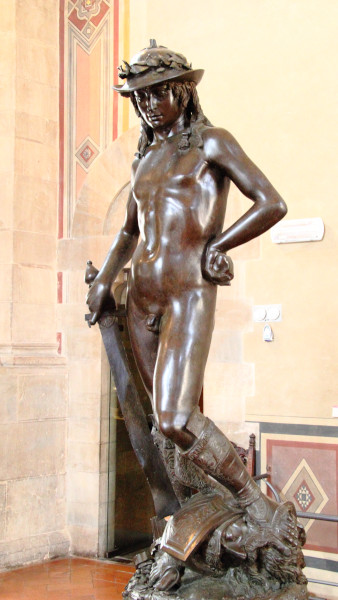
Perseus was Cellini’s answer to the heroic marble David made by Michelangelo forty years earlier for the same public square. Both statues descend from Donatello’s bronze David, the first beautiful nude and the first truly free-standing sculpture since the fall of Rome. Blatantly homosexual in inspiration, it shows David standing victorious over the severed head of Goliath, which he tramples underfoot. The story of David and Goliath, like that of Judith and Holofernes, would become a political symbol of Florentine resistance to tyranny. Donatello’s David is astonishingly young, even younger than the Kritios Boy. David’s contrapposto is languorously Hellenistic. The hand on hip and cocked knee create an air of sexual solicitation. From the side, one is struck by the peachy buttocks, bony shoulder blades, and petulantly protruding boy-belly. The combination of child’s physique with female body language is perverse and pederastic. Michelangelo is to adopt this erotic formula for his more athletic nudes, where it becomes overtly sadomasochistic.
For H. W. Janson, Donatello’s David is “strangely androgynous,” “le beau garçon sans merci, conscious only of his own sensuous beauty.” There may be a connection to Beccadelli’s poetry collection, Hermaphroditus.[7] David has long feminine locks of hair, tangled with ribbons, and a splendidly raffish wreathed hat, a version of the traveller’s hat of Hermes Psychopompos. But here is no traveller’s cloak, only exquisitely etched leather buskins. A pornographic trope: the half-dressed is more erotic than the totally nude. The feathery wing of Goliath’s helmet, like an escaping thought, climbs ticklishly up the inside of David’s thigh, pointing toward the genitals. Roman putti often display their genitals or mischievously urinate, a motif adopted for Renaissance fountains. Donatello poeticizes the ostentatio genitalium, a pagan showing. The hoary head of a monster conquered is a familiar iconographic detail, but here it vomits a wreathlike flood of blood ringing the statue. The stream is the giant’s, and the artist’s, own desire. David, plunging his massive sword to the center, has stolen the adult penis, as he has stolen hearts. The gushing blood, wing-topped, is a carnal cloud, Zeus as a maimed eagle bearing up Ganymede.
I think Donatello’s David, even more than the ancient Venus Pudica, was the true model for Botticelli’s Venus. David, fusing Venus and Mars, skims into view on a swirl of the dreaming artist’s fantasy, half spasmodic release, half rising sigh. The David’s shimmery, slithery bronze is a frozen wet dream, an Apollonian petrifaction. It is also a portrait of the artist, whose oppressed face appears like a signature at the bottom, another homoerotic motif borrowed by Michelangelo. The armed boy bursts like Athena from the artist’s imprisoned brain.
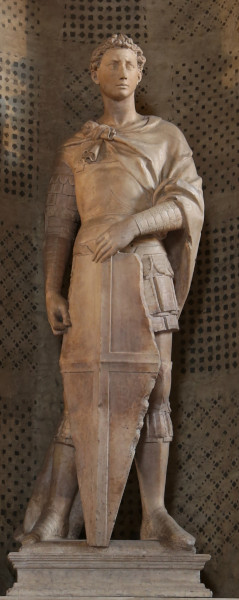
The glamourous Apollonianism of Italian Renaissance art begins with Donatello, who frees sculpture from its medieval subordination to architecture. From his St. George (1417), stepping from its niche, to David: stone knight to bronze kouros. Medieval armour is the pagan exoskeleton of western personality. Hard, shiny, absolutist, it is a product of that radiant Apollonian thing-making which passes from Egypt to Greece and Rome and resurfaces in the High Middle Ages as military design. The bronze David is St. George’s suit of armour turned inside out. David’s brazen nudity is the impermeability of western personality. His compact frame is supercondensed by the aggressive western eye. He is personality as sex and power.
The beautiful boy is homosexuality’s greatest contribution to western culture. Un-Christian and anti-Christian, he is an iconic formalization of the relation between the eye and reality. Repeated in a thousand forms in Italian painting and sculpture, he is the ultimate symbol of Renaissance art. He is St. Sebastian, the Christian Adonis pierced by arrows, or ephebic St. Michael, whom the Renaissance took out of his Byzantine tunic and clad in silver armour. The Northern European Renaissance has few beautiful boys and no Apollonian grandeur. Figures (portraits excepted) rarely fill the pictorial plane. They are modest, fluttery, and to my Mediterranean eye dry and insipid. They allow space to press upon them. Italian art makes personality and gesture florid and theatrical, in the fascist Apollonian manner. Donatello’s David stands on its own because it has rejected northern Gothicism for southern paganism. Its hardness and domination of space come from the artist’s rediscovery of the authentically western will, inflexible and amoral. Art has rearmed itself with the pagan glorification of matter.
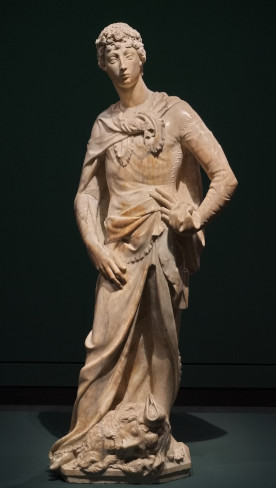
Donatello’s youths are always sexually ambiguous. His marble, clothed David (1409) has a graceful, feminine hand and girlishly delicate face with a small, pretty mouth. The statue was apparently based on an Etruscan goddess in the Medici collection.[8] The unfinished marble David in Washington has fleshy cheeks in classic Greek style. The bust of a youth in Florence has a sensitive face and sweet smile and a provocatively swelling throat and breast. With longer hair, he could pass as a woman. In his harrowing late period, Donatello abandons his ephebic dreams and banishes pagan eroticism from his art. The emaciated wooden John the Baptist and Mary Magdalene are withered by guilt and atonement. David’s glossy Apollonian surface is scored and slashed, the flesh already bored by worms. Such self-laceration is typical of Mediterranean Catholicism, with the ecstatic mortifications of its pagan heritage.
The morally and sexually ambiguous smile of Donatello’s David has a long subsequent history. It goes directly to Michelangelo’s Victory after passing through Verrocchio to Leonardo, where it ends up on the Mona Lisa. Finally, we see it on Bernini’s androgynous angel impishly piercing St. Teresa. David’s smile is dreamy and solipsistic. He is the beautiful boy as destroyer, triumphing over his admirers. He is western armoured ego as sex object, free-standing because separatist. Despite his beguiling insouciance, David’s Apollonian hardness, mental and material, is evident when we compare him to Caravaggio’s beautiful boys. Here, by the richness of oil paint, the Dionysian mouth intrudes on the Apollonian eye. Caravaggio’s cardinal metaphor of fruit is written all over his street urchins’ inviting nudity. Subtly, despite ourselves, we salivate. In high classic dignity, Donatello’s David, unlike Caravaggio’s bolder boys, does not meet our eyes. His sword keeps us at a distance. He has true Apollonian iconicism. While entranced by his eroticism, we look up to him and leave him in his temenos of sacred beauty. Like Nefertiti, he is a hierarch of the western eye.
Chapter 22 American Decadents: Poe, Hawthorne, Melville
After observing that Thomas Mann's Death in Venice (1911) "is deeply indebted to The Picture of Dorian Gray," Paglia writes:

Death in Venice is a late flower of the fin de siècle. Civilization is in decay: Venice, the city of art, is “diseased,” “filled with the smell of things rotting.” The writer Gustav von Aschenbach arrives in Venice to find, like Goethe in the Venetian Epigrams and Hofmannsthal in The Death of Titian (1892), that it harbors a fascinating adolescent androgyne. What Melville polarizes in the antithesis Billy Budd/Tartarus of Maids Mann condenses in one tale. Aschenbach has a vision of primeval nature, clearly inspired by Huysmans: “a tropical swampland under a heavy murky sky, damp, luxuriant and enormous, a kind of prehistoric wilderness … sluggish with mud,” “hairy shafts of palms rising out of a rank lecherous thicket,” “fat, swollen” plant life rooted in green “stagnant pools.”[9] This is the female swamp of generation, the chthonian miasma against which the beautiful boy dreamily protests, his dazzling formal perfection a rebuke to nature’s indiscriminateness and fluidity. The swampland of Death in Venice corresponds to Tartarus’ pulpy “albuminous” matrix.
Aschenbach, the man of words, is captivated by an image of the Apollonian visual arts. An “absolutely beautiful,” longhaired fourteen-year-old boy, straight out of “Greek sculpture,” appears in an epiphany of Apollonian stillness. Surrounded by women—a governess, imposing mother, and three “nunlike sisters”—Tadzio is a sequestered god doomed to die young. Arriving near May Day, Mann’s vernal androgyne is an Adonis, the privileged son-lover of a mother goddess. I suspect this cool, dignified woman wandering alone with her children was inspired by Hawthorne’s mother-of-Pearl, Hester Prynne. She wears a simple gray dress strangely ornamented with “priceless” jewelry and pearls, a “fantastically lavish” effect—reminiscent of Hester’s plain Puritan dress and sumptuous scarlet letter, embroidered in “Oriental” style.[10]

Tadzio has the Apollonian attributes of “aristocratic distinction” and vocal impediment. Because the boy is Polish, “Aschenbach did not understand a word he said”; the writer sees him “smiling, with something half muttered in his soft vague tongue.” Tadzio’s Delphic utterances, like Billy Budd’s stutter and Belphoebe’s broken sentences, are another Apollonian muteness. Tadzio has a radical visibility. Each of his appearances is literally spectacular, as in his theophanic emergence from the sea. He steps from the waves not because he is of the sea but because he renounces the fluid realm, the seraph transcending foam-born Venus. “Astonished, terrified” by Tadzio’s “godlike beauty,” Aschenbach is as hierarchically subordinated as Basil Hallward to Dorian Gray or Claggart to Billy Budd. Death in Venice explicitly incorporates the references to Plato’s Phaedrus I found implicit in Dorian Gray: Aschenbach experiences “the hot terror which the initiates suffer when their eyes light on an image of the eternal beauty.”[11]
Like Basil, Aschenbach is an artist destroyed by a beautiful boy, who dresses in an “English sailor suit,” a period style that may be an allusion to Wilde. Mythologically, Tadzio’s sailor suit belongs to Saxon Billy Budd. But Mann’s beautiful boy is more solipsistic than Melville’s, his fatality literalized by the epidemic claiming his admirer’s life. Though their eyes sometimes meet, the boy does not really see Aschenbach: “It was the smile of Narcissus bent over the reflecting water, that deep, fascinated, magnetic smile with which he stretches out his arms to the image of his own beauty.”[12] Aschenbach’s eyes are mirrors in which Tadzio sees nothing but himself. Obsessed, the writer imagines invitation where there is only autism. The beautiful boy, iconically isolated, is a mirage of the inflamed eye. As part of its Decadence, Death in Venice makes a Florentine beautiful boy a symbol of heterosexual Venice in its degenerate late phase.
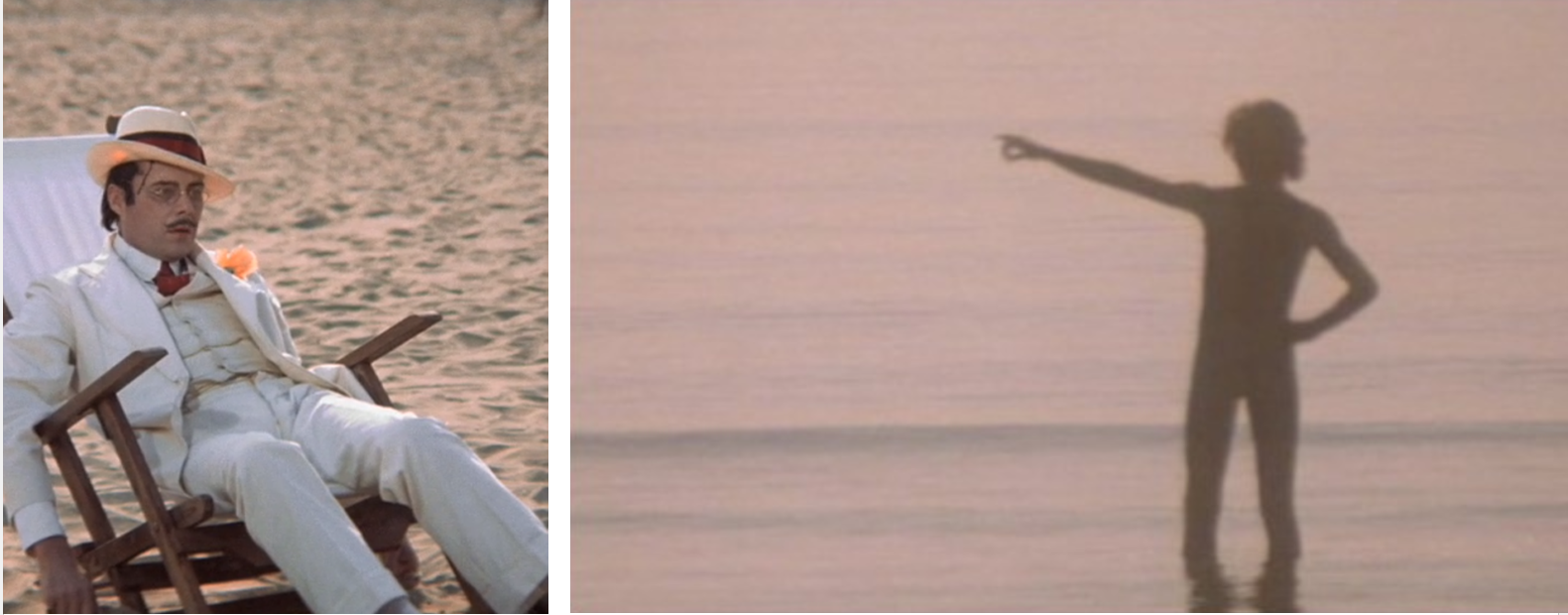
Even at the height of hallucination, Aschenbach does not desire sex. It trivializes Death in Venice to reduce it, as has been done, to a homosexual chronicle of coming out of the closet. The beautiful boy is never contaminated by touch, for the Apollonian recedes with every step taken toward it. Stalking Tadzio through the streets, Aschenbach carefully preserves the critical aesthetic distance. He has become the deranged fan of the star-god. The beautiful boy, always fatal to his admirers, leads Aschenbach from dynastic and professional dignity toward self-immolation in the pre-Hellenic past. Like Euripides’ Pentheus, Aschenbach is transvestized and Orientalized: decked with jewels, he uses perfume, dye, mascara, rouge. The western analytic mind is reabsorbed into its sultry Asiatic origins. Mann calls the Byzantine basilica of San Marco, into which Aschenbach pursues Tadzio, an “Oriental temple”; Aschenbach is felled by “Asiatic cholera,” “hatched in the warm swamps of the Ganges delta.”[13] If we step back from the naturalistic surface of Death in Venice and look at it mythologically, we will see that it contains, internalized, Melville’s female Tartarus. A jealous mother goddess envelops her son’s admirer in her chthonian miasma, for it is she who brings the pestilence into the city of art.

[1] The Changing Nature of Man, trans. H. F. Croes (New York, 1961), 71–72.
[2] Greek Love (London, 1971), 147, 255. John Addington Symonds says, “In the bloom of adolescence the elements of feminine grace … are combined with virility to produce a perfection which is lacking to the mature and adult excellence of either sex.” A Problem of Greek Ethics (London, 1901), 68–69.
[3] Three Contributions to the Theory of Sex, trans. A. A. Brill (New York, 1962), 10.
[4] Campbell, The Masks of God: Occidental Mythology (New York, 1964), 228–29. Zimmer, The Art of Indian Asia (1955), 1:131.
[5] The Gramophone, March 1968, 495.
[6] Phaedrus, trans. W. C. Helmbold and W. G. Rabinowitz (New York, 1956), 34.
[7] The Sculpture of Donatello (Princeton, 1957), 2:85.
[8] Marvin Trachtenberg, “An Antique Model for Donatello’s Marble David,” Art Bulletin 50 (1968): 268. I am grateful to Kristen Lippincott for bringing this to my attention.
[9] Death in Venice, trans. Kenneth Burke (New York, 1965), 91, 114, 5.
[10] Ibid., 39–42.
[11] Ibid., 41, 69, 45, 72.
[12] Ibid., 40, 82.
[13] Ibid., 88, 103.
Comments powered by CComment