
THE AUTOBIOGRAPHY OF A SCHOOLBOY
A MEMOIR BY THOMAS TOMKINS
Presented here with his kind permission is the hitherto unpublished memoir of his youth of a retired English publisher written under the pen name Thomas Tomkins and finished in 2026.
Foreword
In order to protect people still living from impertinent curiosity, I have altered most of the names and specific locations within this book, though those with experience of the school to which I have given the name of 'Flamborough' may possibly recognize it. As to some extent the narrative needs to be fitted into its historical context I have given years which were accurate but not more definite dates. Here and there I have invented small details to confuse the picture, but all of the main events are given as they happened.
I have written about two things. One is my own childhood and youth, up to the time of my marriage. This has included a good many other people. One or two, if they read this book, may recognize themselves. My other topic is relationships. My relationships with my parents, which were largely negative, and with other people I met along the way, which were largely positive.
My life since my late twenties has been conventional enough. I married and brought up children; I worked at my business and, if I did but little good, I trust I did less harm. But the time has come when this tale must be told.
For the relationship which forms the most important part of this book, I have no regrets whatever. It was a loving, mutually supportive relationship which brought nothing but good to both people concerned. I write about this because many such relationships have been exposed and vilified, with disastrous results to all concerned. I hope that by writing this I will set at least one part of the record straight.
My earliest memories are of afternoons confined to my bedroom and being forbidden to do anything which could make a noise, of being taken on long and tiring walks in the park and of reading, endlessly reading. I was encouraged to read as this was a more or less silent activity. Of toys such as other boys had there were few, and games in the garden were permitted only at weekends.
My father was a doctor; not, I suspect, a particularly efficient one, and such competence as he might once have had was gradually eroded by his heavy drinking. He had a practice in a private house in a large East Anglian town and, as was not uncommon in the 1950s, we lived in a flat above the practice. There were two large rooms on the ground floor, originally intended as a sitting room and dining room, which had been converted into a waiting room and consulting room. There was a kitchen which was used as an office and where Maureen, his nurse and receptionist (I never knew her surname) sat when not required to either attend in the surgery or answer the door. I believe this kitchen was also used for carrying out such diagnostic tests as were then in use, and occasionally for the dispensing of simple medications, probably consisting of little beyond coloured and flavoured water. Certainly, most of my father’s prescriptions were dispensed by the chemist whose shop was in the nearby High Street.
The bathroom was one of my favourite places as it was equipped with a Geyser, a remarkable piece of apparatus for producing hot water. The pilot light inside had to be lit with a match, and a few minutes allowed for the gas to “get through”. The main cock was then turned on, water flowed from the spout and if it lit straight away from the pilot light all was well and a copious supply of hot water was provided. If, on the other hand, it blew out the pilot light, a lighted match was applied to a hole in the base of the machine and as often as not a most satisfying explosion resulted, with flame issuing from every opening.
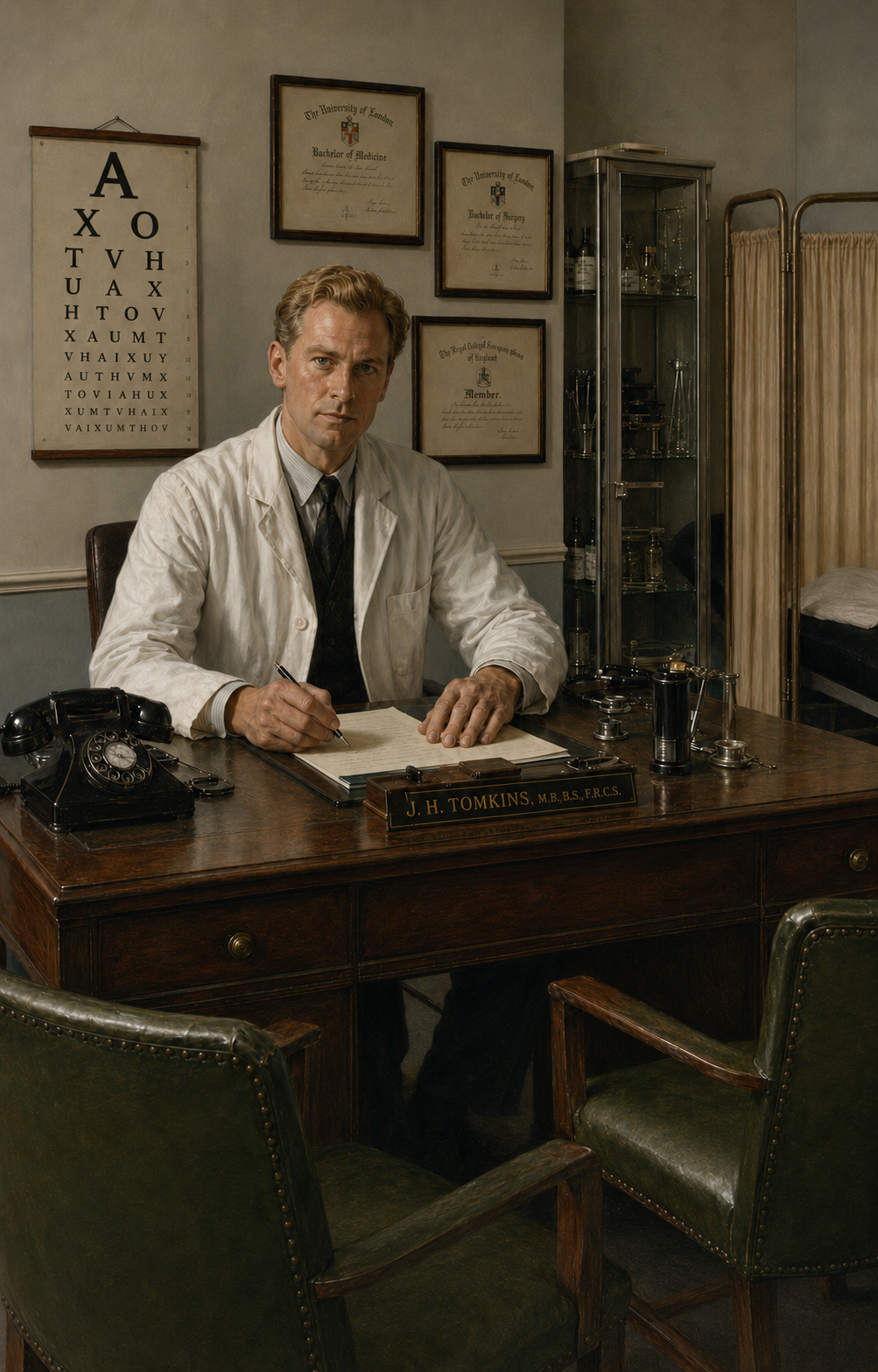
The consulting room was furnished with a large mahogany desk and chair, with two uncomfortable chairs, upholstered in green leather, for patients (who were not encouraged to linger), an examination couch behind a screen and a large metal and glass cupboard containing instruments. A chart of Snellen’s test types was on the wall, along with my father’s framed diplomas. He was a Bachelor of Medicine, a Bachelor of Surgery and a Member of the Royal College of Surgeons. He had studied medicine at University College, London, a fact which was to come in handy later on after his practice ceased.
Maureen was, I think, a kindly enough girl, though outwardly rather tart in manner. In her own way I think she was fond of me, or perhaps felt sorry for me. She used occasionally to slip sweets into my hand, and brought me books and toys from time to time, which I think had been outgrown by her younger brother.
My mother’s chief preoccupation was Keeping Up Appearances. She was distantly related to a minor member of the aristocracy, and never let anyone forget it. She had, in her own words, married beneath her. I think her acceptance of my father’s proposal, though even then he was not a particularly attractive prospect, was because there had been no other proposals and she was getting on in years.
The marriage was probably doomed from the beginning. I do not know how or when I was conceived, since my parents slept in separate rooms. Perhaps the crucial event took place when they were on holiday, or possibly she felt it her duty to give way to him on occasion, even if only to prevent his straying. This, as far as I know, never occurred. He did, after all, have the opportunity to see women naked on a regular basis in his consulting room, and I am certain that the appearance of female bodies under such circumstances, particularly those of the middle-aged and overweight women who formed the largest part of his patients, would have been an effective anti-aphrodisiac.
When he was at work in his consulting room, my father insisted upon silence in the house. As far as he was concerned, my mother’s domestic duties comprised providing flowers for the waiting room, a little genteel dusting (we had a ‘daily woman’ to clean the ground floor, and the chaos upstairs was nobody’s concern) and keeping me quiet. Any noise I made, however accidental, was met with a sibilant “shh!” from between my mother’s teeth and usually a slap upon whatever portion of my anatomy happened to be handy. If I cried when slapped, I received a second, harder slap and if that did not produce the desired result – silence – her bony hand would cover my mouth and I would be picked up and unceremoniously dumped on my bed, forbidden to come out without permission.
This had one very curious result. I don’t suppose my bladder was any weaker than other little boys’, but when confined to my room I frequently needed to urinate. When I was very small this was simple enough as a chamber pot was kept under the bed, but once I was considered to be “toilet trained” this necessary utensil was removed and I had to make whatever arrangements I could. I occasionally tried the effect of peeing into my water glass and drinking the contents, which as far as I remember never did me any particular harm, but if the glass had been removed for washing – though this was an infrequent occurrence - the only option remaining was cautiously to open the window a couple of inches and pee through the gap. Fortunately the window was on the blind side of the house; the only other window in that wall was the kitchen and if Maureen ever saw the stream passing outside, she said nothing about it.
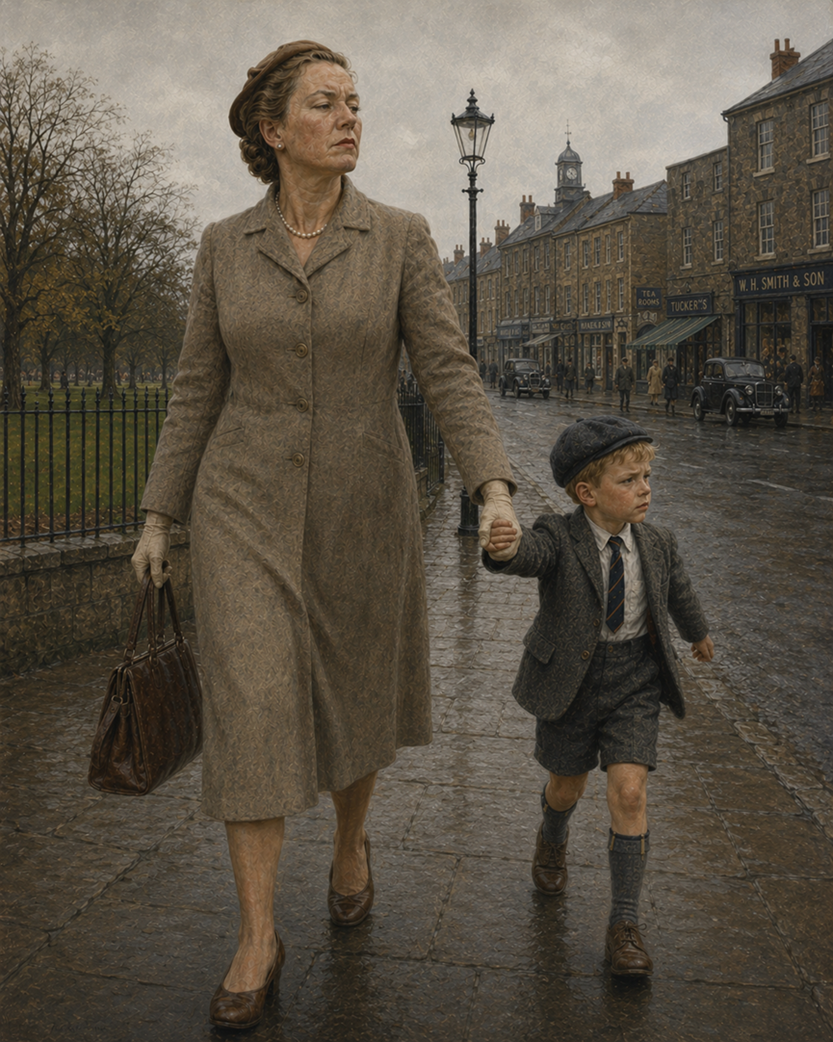
On most afternoons I was “taken for a walk”. This involved going out dressed in my best – horrible, itchy, hot garments - my hand firmly grasped by my mother’s to prevent my straying, and marching briskly though the streets until we reached the park, when, if my mother was in a good mood, I was allowed – if I wished to – to trot around at my own pace, as long as I didn’t soil or otherwise damage my clothes. If, on the other hand, my mother was feeling irritable, which was a not uncommon occurrence, I would be haled briskly around the park with her fingers in my collar until she considered that we had gone far enough, when we would return home.
Not infrequently my mother would meet one or another of her friends, and they would stop for a long and, to a small boy, inexpressively tedious conversation. These friends fell into one of two categories; the first was of women with exaggerated, braying ‘upper class’ voices; there were only two or three of these, one of whom had a title, though I suspect it was derived from a husband who had been successful in politics or business. The second category was of women whose husbands were ‘professional men’; parsons, doctors, solicitors and the like. After meeting one of these, when they were out of earshot my mother would usually remark, “She’s really very common, you know”.
“Common” was my mother’s most stringent term of derogation. I was not allowed to play with other boys in the neighbourhood because they were Common. When I went to school at the local ‘day prep’, I was never allowed to bring other children home because they would make a noise, and very seldom allowed to visit other children’s homes because they were Common and I should learn Bad Habits. What these Bad Habits were which Common Children had, I never did learn, because any attempt to find out was invariably met by my mother’s usual response, either a tart “that’s no concern of yours” or, more often, a slap.
The main result of this was that I learned, very early, to read fluently – my mother started teaching me my letters when I was about three, I think; one of the very few benefits I had from her, and I established the habit of losing myself in a book. There were books galore in the large bookcase on the landing, more on the bookcase in the sitting room (my mother always referred to it as the Drawing Room; I never understood why as no-one ever used it for drawing; it was many years later that I discovered it to be an abbreviation of ‘Withdrawing Room’) and even books - mostly selected classics for show - in the waiting room downstairs. Very few of these were children’s books, but as long as it resulted in my being curled up in a chair or on my bed, reading quietly, no book was ever forbidden to me.
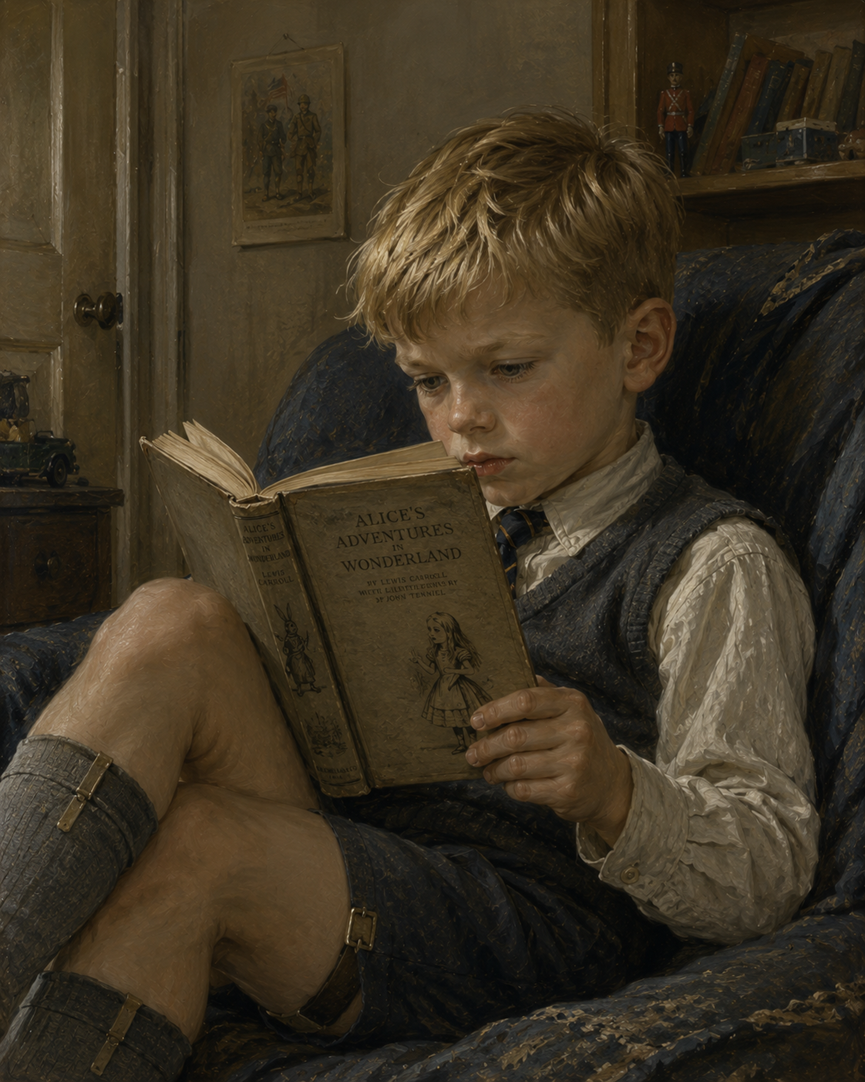
There were a few children’s favourites such as Alice in Wonderland and Grimm’s Fairy Tales (I think these were left-overs from my father’s childhood), but I devoured books avidly, so that by the time I went to boarding school I had already got through a lot of Dickens, Stevenson, Mark Twain and others. Factual books there were in plenty, including some scientific and medical books. These, too, I read, though the mathematical parts had to be skipped, resulting in my acquiring a good deal of miscellaneous information, not all of it necessarily accurate or clearly understood. The only limit placed on my reading was that imposed by the height of the shelves; the books on the upper shelves became accessible only as I grew taller.
How my mother occupied her time I really have very little idea. She cooked meals for herself, my father and me (though we were technically a family it was only when I grew up, married and had a family of my own that I realised what a joy family life can be); she held long and, to me, inexpressibly tedious telephone calls with one of her sisters (she had fallen out with her younger sister when she married) or one of her snobbish friends, did a small amount of desultory cleaning and tidying, though she clearly felt that my father should have earned enough to permit her to employ at least one full-time servant. I am very glad that this did not happen, as the unfortunate servant’s life would have been made entirely wretched.
She took one or two magazines: The Tatler was one and The Lady another. I occasionally saw copies of Country Life around as well. I never knew her to read a book. Washing up, which she called “doing the dishes” was done, very sketchily, when clean plates or knives were needed; the kitchen was generally a chaos of dirty crocks, saucepans, food in opened packets and general litter. Why we were not overrun with mice I have no idea, especially as we kept no cat. But she did spend a good deal of time each day putting on make-up and arranging her hair. I sometimes wonder whether I was not originally attracted to my wife because she never wore make-up; she had a naturally clear and beautiful complexion.
My mother’s other preoccupation was keeping me presentable. I was, and am to this day, naturally scruffy. How I was dressed while at home didn’t matter, but when going out I must wear a clean shirt, neatly pressed; shorts, socks with garters so that they did not slide down to my ankles, and of course a cap. I am sometimes surprised that I was not put into a miniature version of a man’s hat; in those days all men wore hats when out of doors. Working class men wore peaked caps, men of the middle and upper classes wore bowlers or trilbies, depending upon their age and professional status. The more old-fashioned professional men still wore top hats and striped trousers, though these were becoming more and more confined to senior men in City offices or political appointments.
Comments powered by CComment