
PLUTARCH’S LIFE OF NUMA
Numa Pompilius was the second King of Rome, generally considered legendary by moderns. According to traditional Roman chronology, he was born in 753 BC and reigned from 715 until his death in 672.
The Greek biographer and essayist Plutarch wrote a biography of him at the beginning of the second century AD as one of his Parallel Lives. Here follows the only passage in it relating to pederasty.
The translation is by Bernadotte Perrin in the Loeb Classical Library volume XLVI (Cambridge, Massachusetts, 1914). His romanisations of Greek names have been amended to more literal transliterations of the Greek.
4 v-vi
Plutarch says it is hard to believe “that an immortal god should take carnal pleasure in a mortal body and its beauty,” but fit and proper that he should have “a so-called love which is based upon affection.” …
|
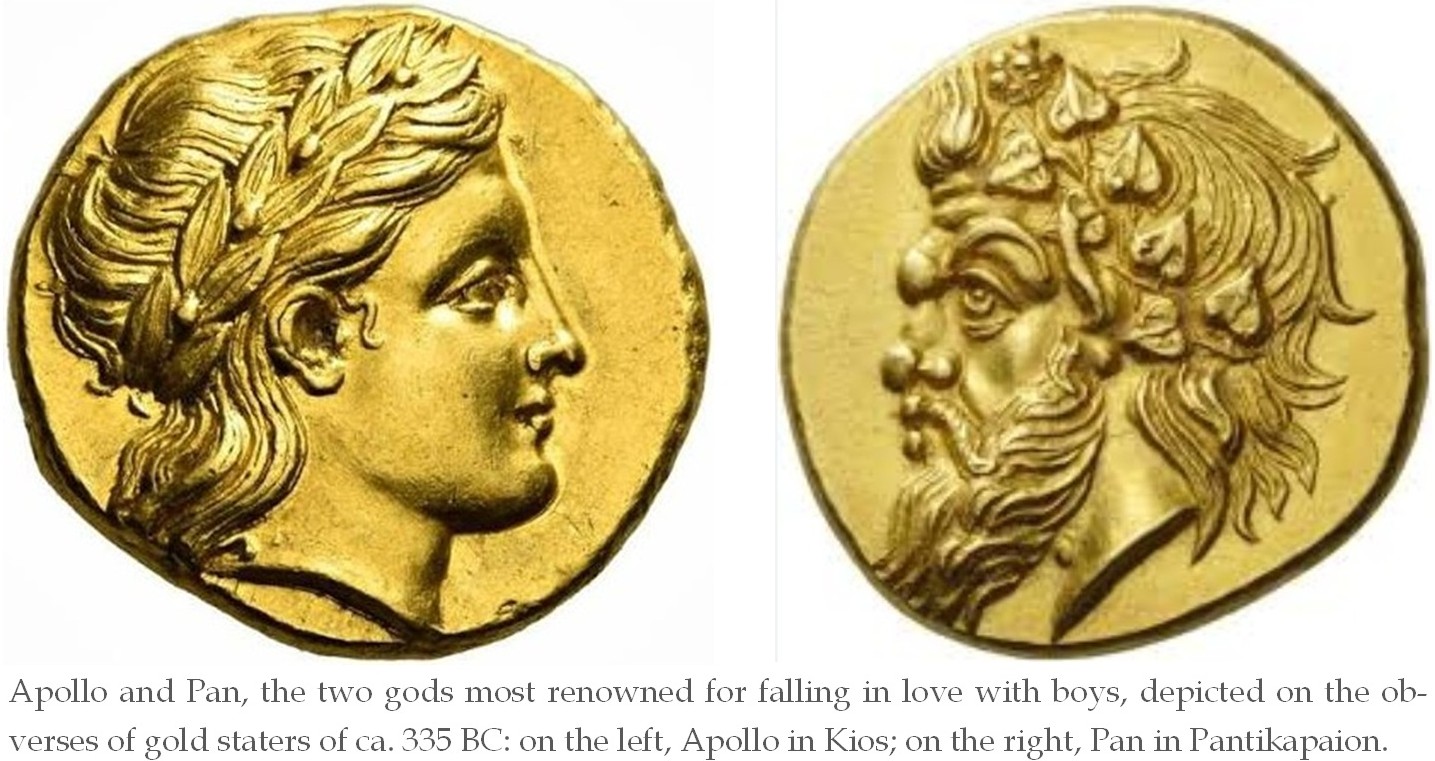
And therefore it is no mistake when the ancient poets tell their tales of the love Apollo bore Phorbas, Hyakinthos, and Admetos, as well as the Sikyonian Hippolytos also, of whom it is said, that, as often as he set out to sail from Sikyon to Kirrha, the Pythian priestess, as though the god knew of his coming and rejoiced thereat, chanted this prophetic verse:— “Lo, once more doth beloved Hippolytos hither make voyage.”[1] There is a legend, too, that Pan became enamoured of Pindar[2] and his verses. |
[v] καὶ οὐ πλημμελοῦσιν οἱ τὸν Φόρβαντα καὶ τὸν Ὑάκινθον καὶ τὸν Ἄδμητον ἐρωμένους Ἀπόλλωνος γεγονέναι μυθολογοῦντες, ὥσπερ αὖ καὶ τὸν Σικυώνιον Ἱππόλυτον, ᾧ δὴ καί φασιν, ὁσάκις τύχοι διαπλέων εἰς Κίρραν ἐκ Σικυῶνος, τὴν Πυθίαν, οἷον αἰσθανομένου τοῦ θεοῦ καὶ χαίροντος, ἀποθεσπίζειν τόδε τὸ ἡρῷον· Καὶ δ᾿ αὖθ᾿ Ἱππολύτοιο φίλον κάρα εἰς ἅλα βαίνει. [vi] Πινδάρου δὲ καὶ τῶν μελῶν ἐραστὴν γενέσθαι τὸν Πᾶνα μυθολογοῦσιν. |
[1] Despite doubting gods could love humans erotically, Plutarch uses ἐρωμένους (beloveds in an erotically inspired sense) to describe these four loved by Apollo. The Spartan Hyakinthos and the Pheraian Admetos were boys described by many other ancients as Apollo’s beloveds in this sense. For the love story of Apollo and the Hyakinthos, see The Metamorphosis of Hyakinthos. Plutarch is the only source for Apollo as the lover of a Phorbos (there were several mythological characters of this name) or of Hippolytos of Sikyon (otherwise unknown, unless the mythological King of Sikyon mentioned in Pausanias’s Description of Greece II 6 vii).
[2] Pindar (ca. 522-443 BC) was a much admired and entirely historical Theban poet. An affirmed lover of boys, he died while asleep with his head on the lap of one of them (Valerius Maximus, Memorable Doings and Saying IX ext. xii).
Comments powered by CComment