History

Open menu

Literature

Open menu

Other

Open menu
three pairs of lovers with space

EXPERIMENT 2


Briefe über die Galanterien von Berlin, auf einer Reise gesammlet von einem österreichischen Offizier (Letters on the Gallantries of Berlin, Collected on a Journey by an Austrian Officer) was published in Gotha in 1782. The author and publisher were not named, but bibliographical research has established that they were respectively the Austrian journalist, actor and soldier Johann Friedel (1755-1789) and Carl Wilhelm Ettinger. 

11 talking to father 2000 d1

The letters were twenty-nine, written to an unnamed and perhaps fictitious correspondent. They describe social, especially sexual, customs observed by Friedel in Berlin. Four of them, the fifteenth to eighteenth, were revealing about the social scene involving what he variously called the warm society, paederasts, lovers of boys and sodomites. Some parts of them describe what was clearly androphile behaviour rather than Greek love, but an assumption runs through them all that love of boys of a broad age range was central to the tastes of the men described, reflecting the general confusion that prevailed in the great cities of eighteenth century northern Europe, where androphiles challenging traditional gender roles had begun to displace pederasts in the popular imagination of sodomy. 

Presented here is the whole of the sixteenth letter, translated into English for the first time for this website. Unlike the others, which describe the practice of Greek love, this one is concerned only with if and how sodomy should be punished.


Sixteenth Letter.

My dearest friend!
     You certainly have the opinion of the more free-thinking philosophers on your side when you say that the secular arm of justice cannot and ought not to subject paederasts to any punishment.
     I too am of this opinion—but only so long as justice persecutes this vice with fire and sword.

Sechzehnter Brief.

Theuerster Freund!
     Sie haben allerdings die Meynung der freydenkenderen Philosophen vor sich, wenn Sie sagen: der weltliche Arm der Gerechtigkeit könne und dürfe die Knabenschänder keiner Ahndung unterziehen.
     Auch ich bin dieser Meynung; aber nur so lange, als die Gerechtigkeit mit Feuer und Schwerd dieses Laster verfolget.

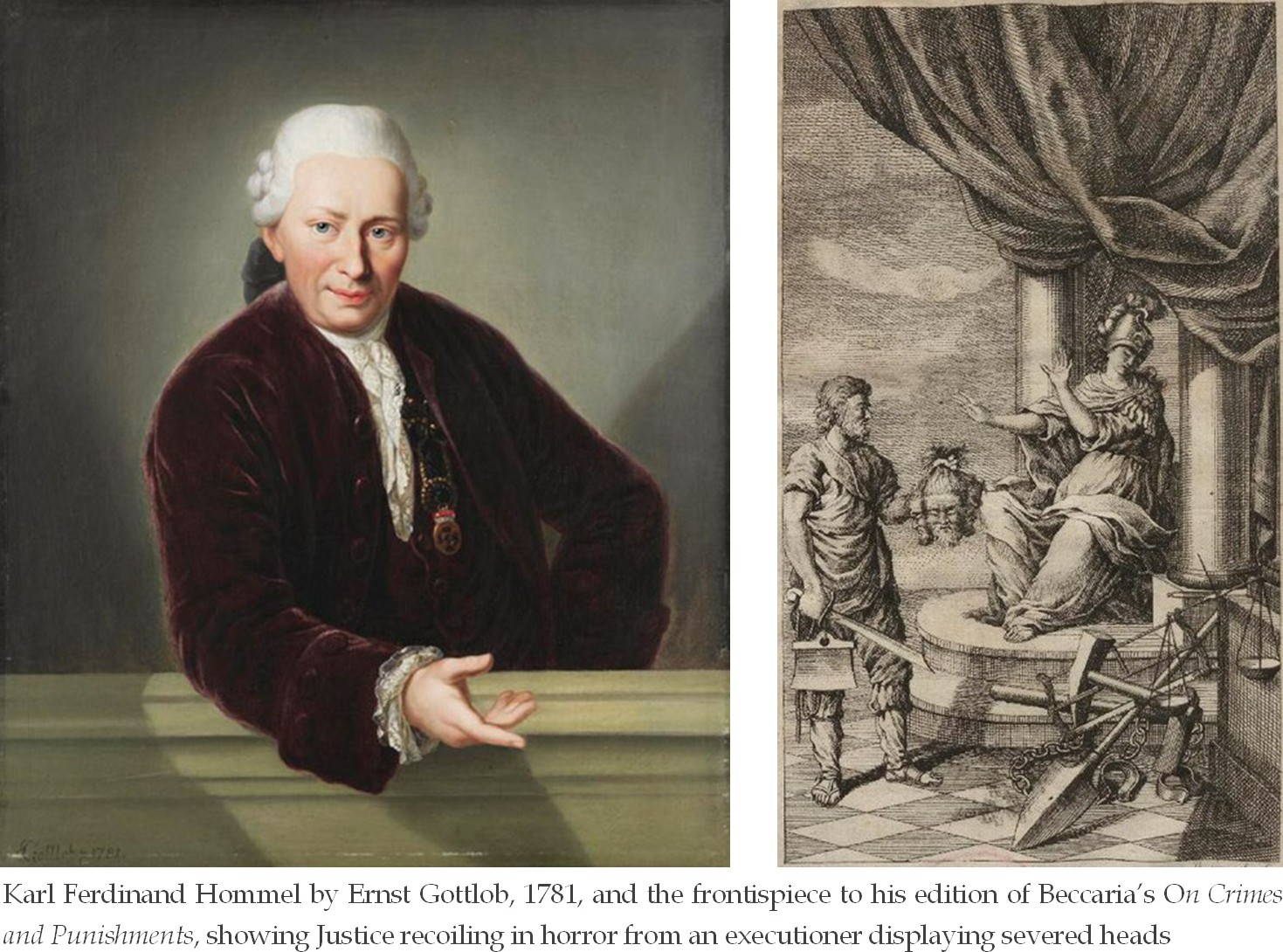
Hommel  Frontispiece

I am very much disposed today to add glosses even to weighty observations.
     First allow me, my most esteemed friend, to examine Beccaria’s opinion. Then Mr. Hommel may pass under review.
     Where does Beccaria, that exact anatomist of human vices, say that paederasty is not a crime, nor yet a vice?
     It is true that he condemns the severity of laws that sacrifice the filthy man to the flames. But one cannot therefore conclude that he ought to go entirely unpunished.
     The law that proposed to repay this voluptuary’s unfortunate appetite with so warm a death is certainly cruel. But must the law, in order not to be cruel, descend to the opposite extreme of complete impunity?
     I believe that no one who judges these excesses correctly can permit himself to make such a demand.
     I shall speak candidly upon this point.
     First, however, a small reminder, friend: your Laura must not be allowed to read a single syllable of this letter.
     Let her be angry with me! On another occasion I shall write all the more for her.
     What is boy-love? As for Socratic or Platonic love, I already gave you Lucian’s apology for it in my previous letter,[5] and in this one too I have given you the explanation.
     But now the animal—or, to speak more methodically, physical—love of boys, which, like the physical love of girls, revolves around its own centre: what is it? Is it not a vice at which humanity must blush?
     Are we not entitled to regard this vice as the highest degree of the complete corruption both of the human heart and of human feeling?
     Beccaria has indeed correctly observed that the yoking together of the young as though they were slaves constitutes the first source of this vice.
     A more recent writer offers the following further explanation:[6]
     
“The inclination of one sex towards the other may already be observed in earliest youth. Young males feel the strength that nature has placed within them; but because they have no object by which this instinct may be satisfied, they turn to things resembling its natural objects. For two or three years, a youth with fresh skin, a glowing complexion and gentle eyes often resembles a beautiful girl. When one loves him, this love is nothing other than an error of nature. One pays the female sex its proper respect by attaching oneself to something that has acquired a likeness to its beauties; and when this likeness has been extinguished by age, the error disappears.
               Citraque juuentam
   Aetatis breue ver et primos carpere flores.[7]
     
“It is well known that nature goes astray more frequently in southern countries than in cold ones; there the blood is more violently stirred and opportunities are more frequent. Thus, what one might perhaps forgive in Alcibiades as a weakness would in northern countries be called a perverse vice, towards which all inhabitants ought to feel abhorrence.
     “But this error of nature ceases to be an error when the ardent youth comes to his senses; indeed, this error becomes the most damnable of vices as soon as, in the arms of a Lais or a Phryne, he learns to recognize it as such.”[8]
     
I do not wish to confine myself here to first principles. What good would syllogisms in Barbara or Celarent do against the debauchee who has once acquired a taste for these filthy practices?[9]

Ich bin heute sehr aufgelegt, zu großen Anmerkungen noch Glossen zu machen.
     Zuerst erlauben Sie mir, schätzbarster Freund, Beccaria Meynung zu untersuchen. Dann mag Herr Hommel die Musterung passiren.
     Wo sagt Beccaria, dieser genaue Anatomiker der menschlichen Laster, — daß die Päderastie kein Verbrechen oder kein Laster sey? —
     Wahr ist es, er mißbilliget die Schärfe der Gesetze, die den Unflätigen den Flammen opfert. Aber daraus kann man noch nicht den Schluß machen, daß er dem ohngeachtet gar nicht bestrafet werden sollte.
     Grausam ist das Gesetz allerdings, das den unglücklichen Appetit dieses Wollüstlings mit einem so warmen Tode vergelten wollte. Soll aber das Gesetz, um nicht grausam zu seyn, zur entgegengesetzten Extremität der Nichtahndung herabsinken? —
     Ich glaube, niemand, der diese Ausschweifungen mit Richtigkeit beurtheilet, kann sich diese Forderung erlauben.
     Ich will offenherzig über diesen Punkt seyn. —
     Vorher aber die kleine Erinnerung, Freund, — Ihre Laura muß nicht eine Silbe auch von diesem Briefe zu lesen bekommen. —
     Sie mag böse auf mich seyn! — Ich werde ein andermal desto mehr für Sie schreiben.
     Was ist Knabenliebe? — Von der Sokratischen oder Platonischen habe ich Ihnen die Apologie des Lucians schon in meinem vorigen Briefe, — und in diesem auch die Erklärung gegeben. —
     Aber nun die thierische — oder methodischer zu sprechen, die phisikalische Knabenliebe, die sich wie die phisikalische Mädchenliebe um ihr eigenes Centrum herum beweget, — was ist die? Nicht ein Laster, über welches die Menschheit erröthen muß?
     Ist man nicht berechtiget, dieses Laster für die höchste Stufe der gänzlichen Verderblichkeit des menschlichen Herzens sowohl als des Gefühls anzusehen?
     Beccaria hat allerdings gründlich bemerket, daß die sklavische Zusammenjochung der Jugend die erste Quelle dieses Lasters wird.
     Und ein neuerer Schriftsteller giebt hierüber noch folgende Erklärung.
     „Der Hang eines Geschlechtes zu dem andern, läßt sich schon in der frühesten Jugend wahrnehmen. Die jungen Mannspersonen empfinden die Stärke, die die Natur in sie gelegt hat; da sie aber keinen Gegenstand haben, der diesen Instinkt befriedigt, so fallen sie auf Dinge, die den natürlichen ähnlich sehen. Oft gleicht ein Jüngling mit seiner frischen Haut, mit seiner glänzenden Farbe, seinen sanften Augen, zwei oder drei Jahre einem schönen Mädchen. Wenn man ihn liebt, so ist die Liebe nichts anders als ein Irrthum der Natur; man erweiset dem Frauenzimmer den gebührenden Respekt, indem man sich an das hängt, das die Aehnlichkeiten von ihren Schönheiten bekommen hat, und, wenn diese Aehnlichkeiten durch das Alter verloschen sind, so verschwindet der Irrthum.
               Citraque juuentam
   Aetatis breue ver et primos carpere flores.
     „Bekanntermaßen verirrt sich die Natur in den südlichen Ländern mehr als in den kalten; das Blut ist hier mehr in Wallung, und die Gelegenheit dazu öfter. Was man also dem Alcibiades vielleicht als eine Schwachheit vergeben könnte, würde man in nördlichen Ländern ein widersinniges Laster nennen, vor welchem alle Bewohner einen Abscheu haben sollten.
     Allein dieser Irthum der Natur hört auf, ein Irthum zu seyn, wenn der feurige Jüngling seinen Verstand bekommt; dieser Irthum wird sogar zum verdammlichsten Laster, sobald er ihn in den Armen der Lais oder der Phryne einsehen lernet.“
     Ich will mich hier nicht auf Grundsätze einschränken. Was hälfen Sillogismen in Barbara oder Cälarent wider den Wüstling, der nun einmal an diesen Unfläthereyen den Narren gefressen hat?

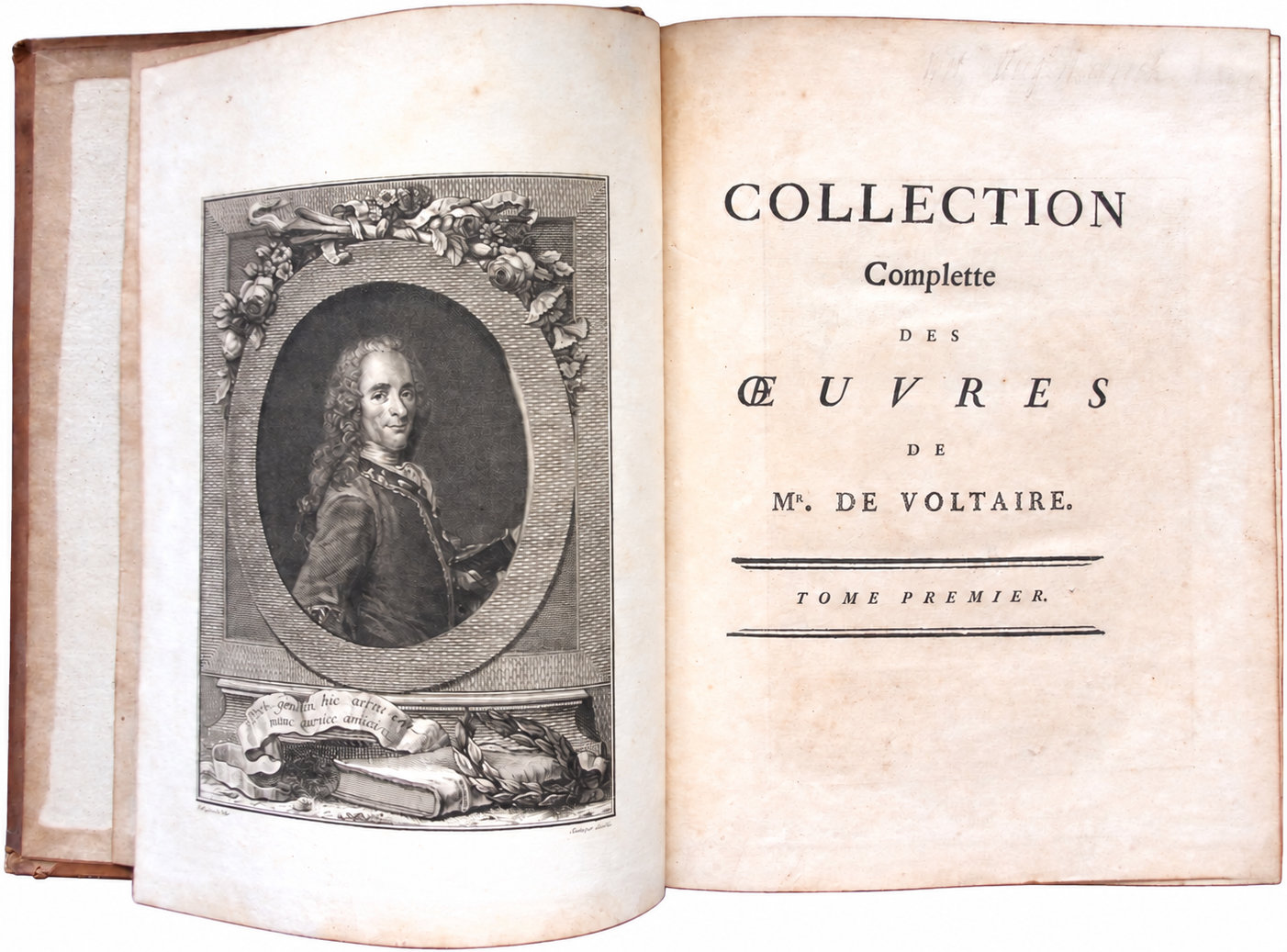
Voltaire. Complete Works
Voltaire at his writing desk, engraved frontispiece by Jean-Jacques Flipart to the Cramer edition of Voltaire's Œuvres, Geneva, 1768–77

Yet any thinking mind free from prejudice must always admit that a man not only neglects the primary purpose for which he was placed in the world but actually profanes it—even in the strictest sense—when he consecrates himself as a priest of Baal to pederasty.
     It is not enough, it seems to me, for a man to excuse himself by saying that his fantasies have led him astray. It is his duty to free himself from error.
     But why do I dwell upon this for so long, when Beccaria does not even pretend to excuse this vice?
     Hommel’s note, however, deserves a more exact dissection.
     Will you become angry, my best friend, if I undertake it?
     Sodomy is a sin but not a crime? How so, if I may ask?
     Hommel answers this paradox himself. It is not a crime because it deprives no one of what belongs to him, does not arise from a malicious heart and does not disrupt civil society.
     I cannot believe that the translator of the perceptive Beccaria is serious when he advances these proofs.
     Would you like to know why? Then listen.
     “Sodomy deprives no one of what belongs to him.” I think the first available girl—provided she is already endowed with the plums of Venus—will settle the question for Hommel and demonstrate to him, with arguments that all the schools of philosophy could not construct, how much sodomy deprives her of what belongs to her.
     “Sodomy does not arise from a deceitful and malicious heart?”
     
Yet it certainly arises from a corrupted one. And does a crime cease to be a crime merely because it does not arise from a malicious heart?
     I can see no reason why I should not treat the murderer of my beloved as a criminal if, from jealousy—in which a malicious heart may have little part—, he thrusts steel into her breast.
     The circumstances may indeed mitigate his crime; but abolish the crime itself? Never!
     The same applies to sodomy. It is true that the debauchee who soils himself with this vice need not necessarily possess a malicious heart.
     But ought the law not nevertheless to act severely in restraining this filth, which has its source in a corrupted heart? What would that be other than reforming the heart of the weakling who has sunk so far beyond the sphere of his nature and purpose?
     Burning at the stake will certainly not reform this voluptuary. But because no furnace ought to glow for him, it does not follow that the law should never wield its rod against him.
     Finally, sodomy is supposed not to disrupt civil society?
     
I do not know whether a politician or a jurist can say such a thing seriously.
     Despite the polymathic clamour of a Justi, it has long been generally agreed that the population of the state must be accepted as a standard of political legislation.
     This is not the place to cite the proofs for and against that proposition. It is enough that it has the judgement of the most perceptive political thinkers on its side.
     Nevertheless, the essential happiness, strength and durability of the state; the nation’s culture; the advancement of the arts—in short, everything that brings prosperity to the state—depends upon the multitude that, through the wise guidance of the laws, is bound together in order, activity and association for the common purpose of society.
     And is civil society not disrupted by vices that squander, in so wild and unnatural a fashion, the very raw material from which the population is formed?[10]
     
Without dwelling upon the thought that it constitutes a deliberate rebellion against the wisdom of the Creator to employ things contrary to their intended purpose, I ask only this: does the debauchee not actually disrupt civil society in the most literal sense when he squanders—in a manner that must draw a blush from every honest man—the powers that nature gave him solely so that he might employ them for the preservation of society?
     Hommel is, however, entirely correct when he expresses his displeasure that theft, arson with murderous intent and poisoning are placed in the same class as sodomy in respect of punishment.
     It is folly for a judge to draw his sword of vengeance against crimes arising from a corrupted but not malicious heart with the same fury that he displays against the crimes of villains.
     I, at least, can form no conception of the two being equally punishable. But just because one is more punishable than the other, who could possibly draw the conclusion that the latter is therefore no concern of punitive justice?
     The same reasons that I advanced against the sodomite certainly apply to the Onanist as well.
     And I admit that I wish the wisdom of the laws could prevent this evil too, and then punish the transgressor in an appropriate manner.
     I shall have an opportunity on another occasion to converse with you about the prevailing mania for Onanism.

Allein ein denkender, von Vorurtheilen freyer Kopf wird allemal gestehen müssen, daß er die erste Bestimmung, weswegen der Mensch in die Welt gesetzet worden, nicht nur dadurch vernachlässige, sondern sogar — auch im strengsten Verstande genommen — entheilige, wenn er sich zum Baalspriester der Päderastie einweihet.
     Es ist nicht genug, deucht mich, daß der Mensch sich damit entschuldige, seine Phantasien haben ihn irre geleitet. Seine Pflicht ist, sich vom Irrthume zu befreyen.
     Doch, was halte ich mich hier so lange auf, da Beccaria sich nicht einmal die Miene giebt, dies Laster zu entschuldigen?
     Aber Hommels Note verdient eine genauere Zergliederung.
     Werden Sie böse werden, bester Freund, wenn ich mich dieser Zergliederung unterziehe?
     Die Sodomiterey ist Sünde, aber kein Verbrechen? — Wie so, wenn ich fragen darf?
     Hommel beantwortet dieses Paradoxon selbst. Sie ist kein Verbrechen, weil sie niemanden das Seinige entzieht, nicht aus einem boshaften Herzen entspringt, und die bürgerliche Gesellschaft nicht zerrüttet.
     Ich glaube nicht, daß es dem Herrn Uebersetzer des einsichtsvollen Beccaria Ernst sey, wenn er diese Beweise führet.
     Wollen Sie wissen, warum? — So hören Sie.
     Die Sodomiterey entzieht Niemanden das Seinige. Ich denke, das erste, das beste Mädchen, wenn es anders schon mit den Venuspflaumen besiedert ist, wird Hommeln die Frage auflösen, und ihm, mit Gründen, die alle philosophische Schulen nicht zusammenketten können, beweisen, wie viel die Sodomiterey ihr das Ihrige entziehe.
     Die Sodomiterey entspringt nicht aus einem betrügerischen boshaften Herzen?
     
Doch gewiß aus einem verdorbenen. — Und hört das Verbrechen auf, Verbrechen zu seyn, wenn es eben nicht aus einem boshaften Herzen entspringet?—
     Ich sehe keinen Grund ein, warum ich den Mörder meiner Geliebten nicht als einen Verbrecher behandeln sollte, wenn er aus Eifersucht, woran das boshafte Herz wenig Theil hat, ihr den Stahl in die Brust stößt.
     Zwar mildern können die Umstände sein Verbrechen; aber das Verbrechen selbst aufheben? Nimmermehr!
     Eben so verhält es sich mit der Sodomiterey. Es ist wahr, der Wüstling, der sich mit diesem Laster besudelt, hat eben nicht nöthig, ein boshaftes Herz zu haben.
     Soll aber das Gesetz diesem ohngeachtet nicht mit Schärfe darauf dringen, diesem Unflathe, der seine Quelle in einem verdorbenen Herzen hat, zu steuern? Was hieße das anders, als dem Schwächling, der sich so weit außer dem Kreise seiner Natur und Bestimmung versenket, das Herz bessern?
     Freylich wird der Scheiterhaufen diesen Wollüstling nicht bessern; aber weil kein Feuerofen für ihn glühen soll, folget der Schluß noch nicht, daß das Gesetz seine Ruthe gar nicht wider ihn schwingen dürfe.
     Endlich soll die Sodomiterey die bürgerliche Gesellschaft nicht zerrütten?
     
Ich weiß nicht, ob ein Politiker oder Jurist im Ernste so sprechen kann. —
     Man ist lange schon einig, trotz dem Polyhistorgeschrey eines Justi, — Bevölkerung des Staats zum Maaßstabe der politischen Gesetzgebung anzunehmen.
     Es ist hier der Ort nicht, die Beweise für und wider diesen Satz anzuführen. Genug, daß er das Urtheil der einsichtsvollesten Politiker für sich hat.
     Indessen hängt doch das wesentliche Glück, die Stärke, Dauerhaftigkeit, die Kultur des Landes, die Aufnahme der Künste, — alles, was dem Staate den Flor verschaft — von der Menge ab, die durch weise Fingerzeige der Gesetze zum allgemeinen Zwecke der Gesellschaft in Ordnung, Thätigkeit und Verbindung gekettet ist. —
     Und wird nicht die bürgerliche Gesellschaft durch Laster zerrüttet, die gerade den Urstoff — zur Menge des Volkes — auf eine so wilde, und widernatürliche Weise versplittert?
     Ohne mich bey dem Gedanken aufzuhalten, daß es eine vorsetzliche Rebellion wider die Weisheit des Schöpfers sey, Dinge wider ihren Entzweck anzuwenden, so frage ich hier nur: Zerrüttet der Wüstling nicht wirklich im eigentlichsten Verstande die bürgerliche Gesellschaft, wenn er die Kräfte, die ihm die Natur bloß aus der Ursache gab, um sie zur Erhaltung der Gesellschaft anzuwenden, auf eine Art verschwendet, die jedem ehrlichen Manne Schamröthe ablocken muß? —
     Uebrigens hat Hommel vollkommen recht, wenn er sein Mißfallen äußert, daß man Diebstahl, Mordbrennerey und Vergiftung — mit der Sodomiterey von Seite der Strafe in eine Klasse setzt.
     Es ist Thorheit, wenn der Richter wider Verbrechen, die zwar aus einem verdorbenen, aber nicht boshaften Herzen entsprangen, sein Rachschwerdt mit der Wuth ziehen wollte, als er wider die Verbrechen der Bösewichter thut?
     Ich wenigstens kann mir keinen Begriff davon machen, daß beyde gleich strafbar wären. Weil aber der eine strafbarer ist als der andere, wem sollte die Folgerung in den Sinn kommen, ergo ist der letztere kein Gegenstand der strafenden Gerechtigkeit? —
     Zwar eben die Gründe, die ich wider den Sodomiten anführte, gelten auch wider den Onaniten.
     Und ich gestehe es, daß ich es wünsche, die Weisheit der Gesetze könnte auch diesem Uebel vorbeugen, und dann den Uebertreter zweckmäßig strafen.
     Ich werde Gelegenheit haben, über die herrschende Onaniesucht ein andermal mit Ihnen zu schwätzen.

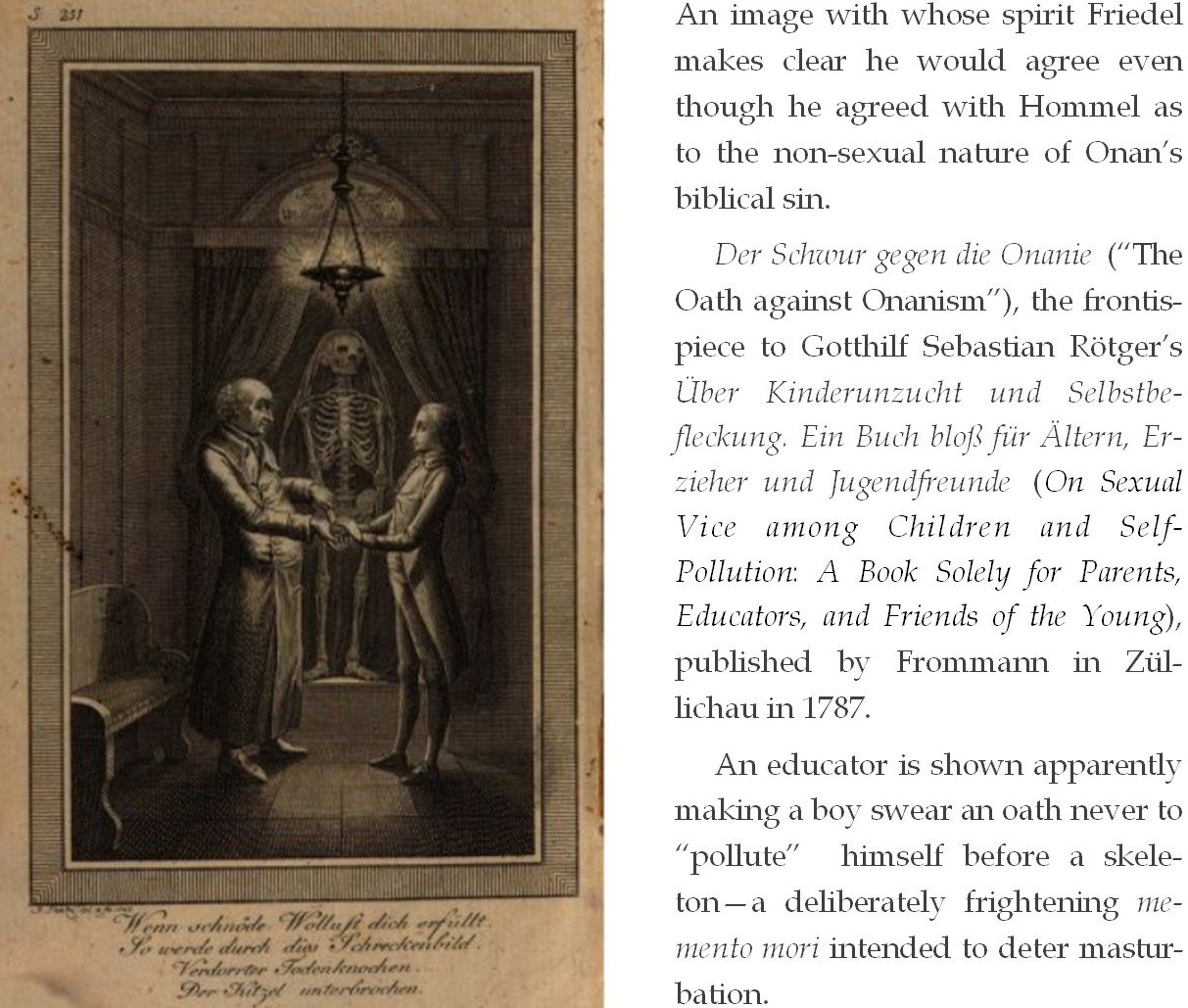
Rotger Uber Kinderunzucht 1787. Frontispiece

For now, I wish only to add the following to Councillor Hommel’s observation about Onan: although he discerned the true cause of Onan’s death with perfect acuity, I also wish that he had done justice to the historian’s subtlety.
     Moses, who shows in so many passages that he knew how to use the most natural events for the moral improvement of the people he had led out of servitude, also made use of this opportunity to achieve his purpose.
     Onan was punished with death. What did Moses do? In order to warn the people against Onan’s filth, he says: “And the Lord said: Cursed is he who allows his seed to fall upon the ground.”
     I think these few words made a greater impression upon the superstitious Israelites than a hundred laws would make today.
     This vice, which is committed in such secrecy, can certainly not be checked in its increasingly prevalent advance in any other way than by placing the Lord’s curse as vividly as possible before the eyes of the debauchee.
     For these reasons, it seems to me, the framers of canon law can always be excused when—to express myself in Hommel’s words—they confined themselves in this passage solely to the filth.
     Could they do otherwise than bring the Lord’s sword of vengeance into play?
     A just and holy zeal—not stupidity—against vices that destroy the human being and thereby also disrupt civil society led them, even contrary to their better conviction, to make Onan die in their commentaries upon this passage because he had polluted himself.
     This vice can be eradicated only through the idea that it is a great crime, a great offence against God, against which he thunders in the fullness of his wrath.
     The arms of the law can seize only the known criminal. But the debauchee who conceals his shameful acts from the eye of justice through secrecy escapes its punishment.
     It is therefore advantageous, in order to erect a barrier against vice even in secret, for the legislator to attempt through religious conceptions to restrain the evil where the secular arm cannot reach.
     One further observation, and I shall conclude for today. It is certainly also folly, in the case of Onanism, to rack one’s brains along with the old faculty jurists over whether the Onanist ought not to be burned for recreation. Thanks be to the discernment of our present-day jurists that they do not construct their wisdom solely upon gallows, wheels, swords and stakes!
     Nevertheless, it would certainly be desirable if this cancerous evil could be remedied through wise reforms of public educational institutions.
     That is not possible?
     O friend, nothing in the world is impossible when the improvement of mankind is concerned and wise men are resolved to carry it out with seriousness and prudence.
     In my eyes, it is one of the greatest mistakes to shut up young people of the same sex together like a flock of sheep.
     What would be lost if girls and youths became acquainted with one another several years earlier?
     I would even consider it advantageous if the two were brought into one another’s company as early as possible. First, the unnatural excesses of youth would disappear far sooner than through any other means; and then, when youths and girls entered the world, they would not be so easily swept away by seduction.
     The two would be more accustomed to one another. The overwhelming impression would diminish, and one would truly see fewer amorous adventurers than one sees now.

Indessen will ich hier nur zu der Bemerkung des Herrn Hofrath Hommels über den Onan noch diese hinzusetzen: daß er zwar vollkommen scharfsichtig die wahre Ursache von Onans Tod bemerkte, aber daß ich auch wünsche, er hätte der Finesse des Geschichtsschreibers Gerechtigkeit widerfahren lassen.
     Moses — der in so vielen Stellen zeiget, daß er die natürlichsten Ereignisse zur Verbesserung der Moralität seines aus der Dienstbarkeit geführten Volkes anzuwenden wisse, benuzte auch diese Gelegenheit, seinen Endzweck zu erreichen.
     Onan wurde mit dem Tode gestraft. Was that Moses? Um das Volk vor dem Unflathe Onans zu warnen, sagt er: Und der Herr sprach: verflucht ist der, der seinen Samen auf die Erde fallen läßt. —
     Ich denke, diese wenigen Worte machten auf die abergläubischen Israeliten mehr Eindruck, als hundert Gesetze heut zu Tage thun würden.
     Durchaus ist dieses Laster, das mit so vieler Verheimlichung begangen wird, nicht anders in seinen überhand nehmenden Fortschritten zu hemmen, als wenn der Fluch des Herrn dem Wüstling so lebhaft, als möglich vor Augen gestellet wird.
     Aus diesen Gründen, scheint mirs, lassen sich die Erfinder des kanonischen Rechts allemal entschuldigen, wenn sie, um mich mit Hommeln auszudrücken, in dieser Stelle lediglich bey dem Schmutze stehen blieben.
     Konnten sie anders, als das Rachschwerdt des Herrn mit in das Spiel ziehen?
     Nicht Unverstand, — gerechter heiliger Eifer wider Laster, die den Menschen zerstören und ebendaher auch die bürgerliche Gesellschaft zerrütten, verleitete sie selbst wider ihre bessere Ueberzeugung, in ihren Kommentaren über diese Stelle, Onan aus der Ursache sterben zu lassen, weil er sich selbst beflecket hatte.
     Dies Laster kann nur durch die Idee, daß es ein großes Verbrechen, eine große Beleidigung Gottes ist, wider die er in vollem Grimme donnert, getilget werden.
     Die gesetzlichen Arme können nur den bekannten Verbrecher ergreifen. Der Wüstling aber, der seine Schandthaten durch die Verborgenheit dem Auge der Gerechtigkeit entziehet, — entgeht seiner Ahndung.
     Es ist also, um auch im Verborgenen dem Laster einen Damm entgegen zu stämmen, vortheilhaft, wenn der Gesetzgeber durch Religionsbegriffe dem Uebel dort zu steuern suchet, wo er nicht mit dem weltlichen Arme hinlangen kann.
     Noch eine Anmerkung, und ich schließe für heute. Allerdings ist es auch bey der Onanie eine Thorheit, sich den Kopf mit den alten Fakultisten zu zerbrechen, ob man den Onaniten nicht zum Zeitvertreibe verbrennen sollte. Dank der Einsicht unserer heutigen Rechtsgelehrten, daß sie ihre Weisheit nicht lediglich auf Galgen, Rad, Schwerdter und Scheiterhaufen bauen! —
     Zu wünschen wäre es indessen allerdings, wenn durch weise Reformen der öffentlichen Erziehungsanstalten diesem krebsartigen Uebel abgeholfen würde.
     Das ist nicht möglich?
     O, Freund, nichts in der Welt ist ohnmöglich, so bald es die Besserung des Menschen betrifft, und weise Männer es mit Ernste und Vorsicht auszuführen entschlossen sind.
     Es ist in meinen Augen eins der größten Versehen, die Jugend von einerley Geschlecht wie eine Heerde Schafe zusammen zu sperren.
     Was verlöhre man, wenn sich die Mädchen und Jünglinge auch um einige Jahre eher kennen lernten?
     Ich würde es sogar für vortheilhaft halten, wenn man sie beyde so frühzeitig als möglich in Umgang brächte. Erstlich würde die widernatürliche Ausschweifung der Jugend weit eher verschwinden, als durch alle andere Mittel; und dann würde der Jüngling, das Mädchen, wenn sie in die Welt treten, von der Verführung nicht so leicht fortgerissen werden.
     Beyde sind einander mehr gewohnt. Der erschütternde Eindruck verlöhre sich; und man würde wirklich weniger verliebte Abentheuerer sehen, als man jetzt sieht.

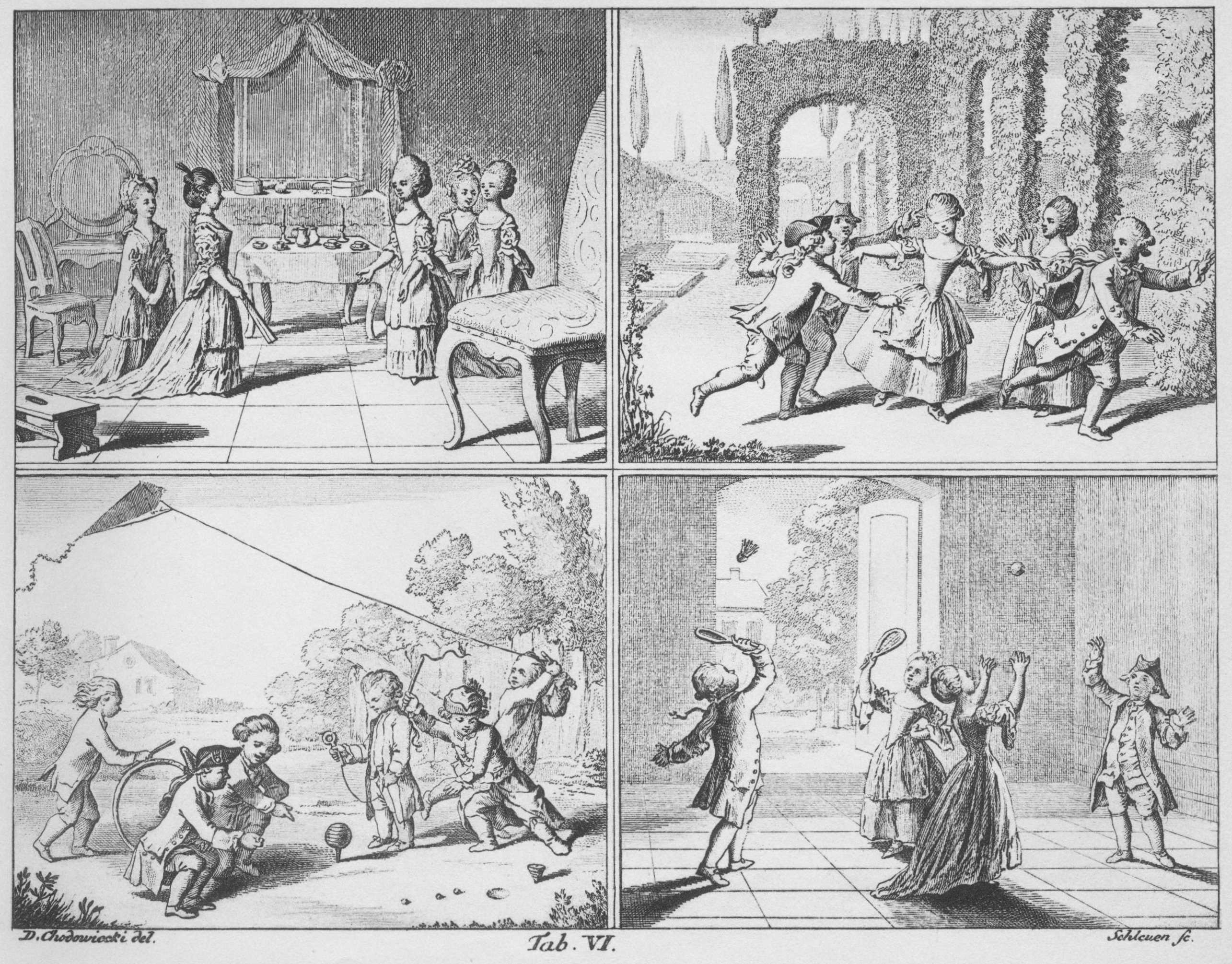
Chodowiecki Daniel. Children at Play 1774
Other Amusements of Children by Daniel Chodowiecki, an illustration to Basedow's Elementarwerk (1774). Boys and girls are shown mingling freely in play, as recommended by Friedel to discourage sex between boys

But away with “one would”, “it would” and the like! The subject now is—and ought to be nothing other than—the statu causae, the facts of the matter as they actually exist. Telescopes that show my eye objects only within the orbit of Sirius are telescopes; but my own eye, which depicts objects immediately before me, is of infinitely greater value to me.
     What use is it to know that Stax and Parfax would be thus and thus if a thousand other circumstances were thus and thus?[11]
     
Please excuse the length of this letter.
     How often must you have become impatient with me for keeping you, by means of it, away for so long from your beloved Laura—the dearest and best of girls, whom I esteem so highly and love as tenderly as I love you, and whom I kiss just as often as I kiss you?
     Well, yes—kisses upon paper! Very well! Surely I may kiss my male and female friends per posto, by post?
     A thousand farewells from
          Your
               sincere friend.


Doch weg mit dem man würde, es würde, und dergleichen! Jetzt ist — und soll auch nur seyn, — die Rede von dem statu causae, wie er wirklich ist. — Ferngläser, die nur in dem Cirkel des Sirius meinem Auge Gegenstände zeigen, sind — Ferngläser; und mein Auge, das mir die Gegenstände ganz in der Nähe vormalet, ist für mich unendlich mehr werth.
     Was nützt es zu wissen, Stax und Parfax würden dann so und so seyn, wenn tausend andre Umstände so und so wären?
     Nehmen Sie mir meinen langen Brief nicht übel.
     Wie oft werden Sie nicht dabey unwillig geworden seyn, daß ich Sie durch ihn von Ihrer lieben Laura so lange abhalte, — dem liebsten besten Mädchen, das ich so hochschätze, so zärtlich liebe, als ich Sie liebe, und eben so oft küsse, als ich Sie küsse?
     Nun, ja, Küsse auf dem Papiere! Gut so! — Ich kann ja doch wohl auch per Posto meine Freunde und Freundinnen küssen?
     Tausendmal Adieu von
          Ihrem
               aufrichtigen Freund.


Continue to the seventeenth letter.


[1] The German of which this is a translation is itself a translation of the Italian jurist Cesare Beccaria’s famous Enlightenment work Dei delitti e delle pene (On Crimes and Punishments), first published anonymously in 1764 and best known for its condemnation of torture and the death penalty. The translation into German is not Friedel’s own, but is taken from the next work he alludes to, Karl Ferdinand Hommel’s edited translation of Beccaria in 1778. [Website note]

[2] The passage which follows is quoted from the Leipzig jurist Karl Ferdinand Hommel (1722-81)’s influential German edition of Beccaria, Des Herrn Marquis von Beccaria unsterbliches Werk von Verbrechen und Strafen, published in Breslau in 1778. This included extensive commentary by Hommel, of which the quoted passage is an example. [Website note]

[3] “Self-pollution”, sometimes referred to as the sin of Onan (the name of a man killed by God for resorting to it in Genesis chapter 38), means masturbation, the subject of furious condemnation in 18th-century Europe (with interesting parallels to that of Greek love in the 21st). [Website note]

[4] Hommel’s sarcastic “Ergo!” is the punch-line to his demonstration through this example of how absurd traditional criminal-law reasoning could become when biblical terminology was treated as legal taxonomy. [Website note]

[5] The Fifteenth Letter. [Website note]

[6] Here Friedel begins to quote from Voltaire’s essay on “Socratic Love” in his Dictionnaire philosophique anonymously published in Geneva in June 1764. This continues down to “Alcibiades as a weakness.” Friedel then paraphrases Voltaire for the rest of the sentence in which that appears. His final supposedly quoted paragraph (mentioning Lais and Phryne) appears to be his own invention, as it is not in Voltaire’s essay. [Website note]

[7] This is a direct quotation by Voltaire of Ovid’s Metamorphoses X 84-5. Ovid was describing Orpheus’s introduction to the Thracians of the practise of loving boys. The quoted words mean, “and enjoying the springtime and first flower of their youth.” [Website note]

[8] This paragraph has been invented by Friedel or another, as it is not in Voltaire’s essay on “Socratic Love”. It may well, however, have been inspired by Voltaire’s mention of Phryne and Lais, in his preceding essay in the same Dictionnaire philosophique on “Love”. In any case, Friedel (or perhaps another he copied) is here expanding on Voltaire to make his own point that once a youth has reached maturity and has actually experienced women, the excuse of méprise de la nature (error of nature) disappears.
     Phryne and Lais were two famous ancient Greek courtesans and thus emblematic desirable women.  [Website note]

[9] Barbara and Celarent are traditional mnemonic names for forms of syllogism in Aristotelian logic. Friedel is thus mocking the idea that formal philosophical argument can reason someone out of a sexual inclination. [Website note]

[10] This is one of several 18th-century concerns Friedel raised against pederasty which Jeremy Bentham also addressed in his essay Offences Against One’s Self: Paederasty written around the same date (though not published until 1978). Bentham also quoted from Beccaria for his argument. [Website note]

[11] Stax and Parfax appear to be facetious invented names for hypothetical people, equivalent to talking of an invented Tomkins and Bumpkins in English. [Website note]


 I would even consider it advantageous if the two were brought into one another’s company as early as possible. First, the unnatural excesses of youth would disappear far sooner than through any other means; and then, when youths and girls entered the world, they would not be so easily swept away by seduction.  ndre Umstände so und so wären?
     Nehmen Sie mir meinen langen Brief nicht übel.
     Wie oft werden Sie nicht dabey unwillig geworden seyn, daß ich Sie durch ihn von Ihrer lieben Laura so lange abhalte, — dem liebsten besten Mädchen, das ich so hochschätze, so zärtlich liebe, als ich Sie liebe, und eben so oft küsse, als ich Sie küsse?


13 in street 1985 d1


Comments powered by CComment