
LETTERS ON THE GALLANTRIES OF BERLIN: XVI EXPERIMENT 1
Briefe über die Galanterien von Berlin, auf einer Reise gesammlet von einem österreichischen Offizier (Letters on the Gallantries of Berlin, Collected on a Journey by an Austrian Officer) was published in Gotha in 1782. The author and publisher were not named, but bibliographical research has established that they were respectively the Austrian journalist, actor and soldier Johann Friedel (1755-1789) and Carl Wilhelm Ettinger.
The letters were twenty-nine, written to an unnamed and perhaps fictitious correspondent. They describe social, especially sexual, customs observed by Friedel in Berlin. Four of them, the fifteenth to eighteenth, were revealing about the social scene involving what he variously called the warm society, paederasts, lovers of boys and sodomites. Some parts of them describe what was clearly androphile behaviour rather than Greek love, but an assumption runs through them all that love of boys of a broad age range was central to the tastes of the men described, reflecting the general confusion that prevailed in the great cities of eighteenth century northern Europe, where androphiles challenging traditional gender roles had begun to displace pederasts in the popular imagination of sodomy.
Presented here is the whole of the sixteenth letter, translated into English for the first time for this website. Unlike the others, which describe the practice of Greek love, this one is concerned only with if and how sodomy should be punished.
|
Sixteenth Letter. My dearest friend! |
Sechzehnter Brief. Theuerster Freund! |
|
Beccaria says: “The love of boys and other irregular commingling of the flesh, for which the laws—and who would have thought it?—have ordained the flames, and on account of which the judge hastens joyfully to torture, has its origin in the passions of people who are brought together in close confinement, as though they were slaves. It arises not so much from a disgusting satiety with ordinary pleasures as from that defective education which, in order to make men useful to others, renders them useless to themselves. In institutions where ardent young people are shut up together and an insurmountable barrier is erected against their intercourse with the opposite sex, nature, just as it is beginning to unfold, squanders its powers to no purpose and brings old age down prematurely upon their necks.”[1] |
Beccaria sagt: „Die Knabenliebe und andre unordentliche Vermischung des Fleisches, worauf die Gesetze (und wer sollte es denken?) das Feuer gesetzet, und um derentwillen der Richter mit Freuden zur Marter eilet, nimmt ihren Ursprung aus den Leidenschaften der sklavischen und in enge Gesellschaft vereinigten Menschen. Nicht sowohl aus der ekelhaften Sättigung an gewöhnlichen Ergötzlichkeiten, als vielmehr aus derjenigen fehlerhaften Erziehung, welche die Menschen, um sie andern nützlich zu machen, sich selbst unnütze macht. In solchen Häusern, wo man eine feurige Jugend zusammen sperret, und ihr einen unübersteiglichen Damm wider den Umgang mit dem andern Geschlechte vorbauet, dergestalt, daß die Natur, die sich eben entwickelt, ihre Kräfte auf eine unnütze Weise verschleudert, und das Alter sich über den Hals ziehet.“ |
|
First allow me, my most esteemed friend, to examine Beccaria’s opinion. Then Mr. Hommel may pass under review. Where does Beccaria, that exact anatomist of human vices, say that paederasty is not a crime, nor yet a vice? It is true that he condemns the severity of laws that sacrifice the filthy man to the flames. But one cannot therefore conclude that he ought to go entirely unpunished. The law that proposed to repay this voluptuary’s unfortunate appetite with so warm a death is certainly cruel. But must the law, in order not to be cruel, descend to the opposite extreme of complete impunity? I believe that no one who judges these excesses correctly can permit himself to make such a demand. I shall speak candidly upon this point. First, however, a small reminder, friend: your Laura must not be allowed to read a single syllable of this letter. Let her be angry with me! On another occasion I shall write all the more for her. What is boy-love? As for Socratic or Platonic love, I already gave you Lucian’s apology for it in my previous letter,[5] and in this one too I have given you the explanation. But now the animal—or, to speak more methodically, physical—love of boys, which, like the physical love of girls, revolves around its own centre: what is it? Is it not a vice at which humanity must blush? Are we not entitled to regard this vice as the highest degree of the complete corruption both of the human heart and of human feeling? Beccaria has indeed correctly observed that the yoking together of the young as though they were slaves constitutes the first source of this vice. A more recent writer offers the following further explanation:[6] “The inclination of one sex towards the other may already be observed in earliest youth. Young males feel the strength that nature has placed within them; but because they have no object by which this instinct may be satisfied, they turn to things resembling its natural objects. For two or three years, a youth with fresh skin, a glowing complexion and gentle eyes often resembles a beautiful girl. When one loves him, this love is nothing other than an error of nature. One pays the female sex its proper respect by attaching oneself to something that has acquired a likeness to its beauties; and when this likeness has been extinguished by age, the error disappears. Citraque juuentam Aetatis breue ver et primos carpere flores.[7] “It is well known that nature goes astray more frequently in southern countries than in cold ones; there the blood is more violently stirred and opportunities are more frequent. Thus, what one might perhaps forgive in Alcibiades as a weakness would in northern countries be called a perverse vice, towards which all inhabitants ought to feel abhorrence. “But this error of nature ceases to be an error when the ardent youth comes to his senses; indeed, this error becomes the most damnable of vices as soon as, in the arms of a Lais or a Phryne, he learns to recognize it as such.”[8] I do not wish to confine myself here to first principles. What good would syllogisms in Barbara or Celarent do against the debauchee who has once acquired a taste for these filthy practices?[9] |
Ich bin heute sehr aufgelegt, zu großen Anmerkungen noch Glossen zu machen. |
|
Yet any thinking mind free from prejudice must always admit that a man not only neglects the primary purpose for which he was placed in the world but actually profanes it—even in the strictest sense—when he consecrates himself as a priest of Baal to pederasty. |
Allein ein denkender, von Vorurtheilen freyer Kopf wird allemal gestehen müssen, daß er die erste Bestimmung, weswegen der Mensch in die Welt gesetzet worden, nicht nur dadurch vernachlässige, sondern sogar — auch im strengsten Verstande genommen — entheilige, wenn er sich zum Baalspriester der Päderastie einweihet. |
|
folly for a judge to draw his sword of vengeance against crimes arising from a corrupted but not malicious heart with the same fury that he displays against the crimes of villains. |
Anerstandenen Richter, der sein Rächerschwert wider Verbrechen, die aus einem verdorbenen, aber nicht boshaften Herzen entspringen, mit eben der Wut zückt, die er wider die Verbrechen der Bösewichter blicken lässt. |
|
For now, I wish only to add the following to Councillor Hommel’s observation about Onan: although he discerned the true cause of Onan’s death with perfect acuity, I also wish that he had done justice to the historian’s subtlety. |
Indessen will ich hier nur zu der Bemerkung des Herrn Hofrath Hommels über den Onan noch diese hinzusetzen: daß er zwar vollkommen scharfsichtig die wahre Ursache von Onans Tod bemerkte, aber daß ich auch wünsche, er hätte der Finesse des Geschichtsschreibers Gerechtigkeit widerfahren lassen. |
|
But away with “one would”, “it would” and the like! The subject now is—and ought to be nothing other than—the statu causae, the facts of the matter as they actually exist. Telescopes that show my eye objects only within the orbit of Sirius are telescopes; but my own eye, which depicts objects immediately before me, is of infinitely greater value to me. |
Doch weg mit dem man würde, es würde, und dergleichen! Jetzt ist — und soll auch nur seyn, — die Rede von dem statu causae, wie er wirklich ist. — Ferngläser, die nur in dem Cirkel des Sirius meinem Auge Gegenstände zeigen, sind — Ferngläser; und mein Auge, das mir die Gegenstände ganz in der Nähe vormalet, ist für mich unendlich mehr werth. |
Continue to the seventeenth letter.
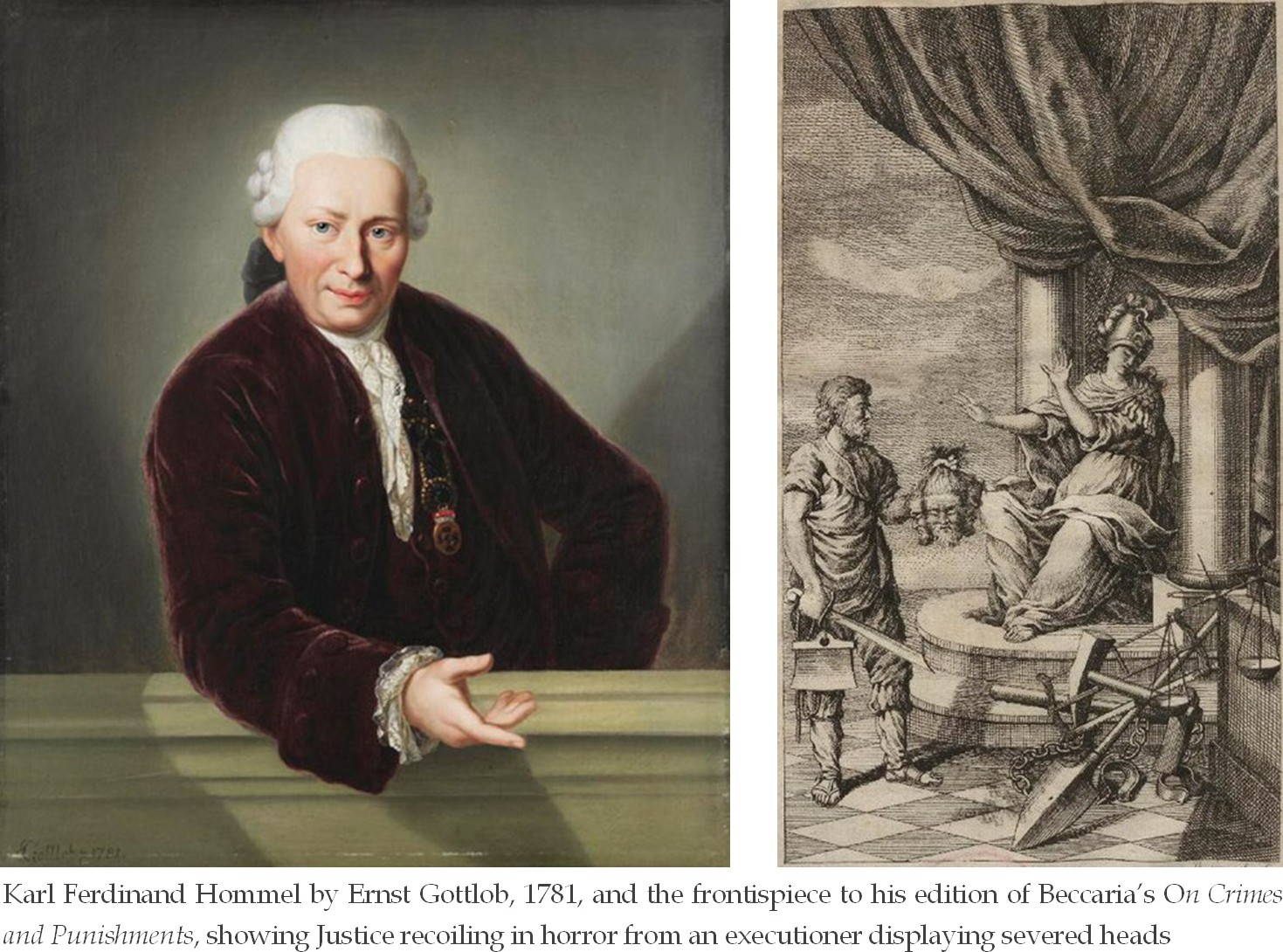
[1] The German of which this is a translation is itself a translation of the Italian jurist Cesare Beccaria’s famous Enlightenment work Dei delitti e delle pene (On Crimes and Punishments), first published anonymously in 1764 and best known for its condemnation of torture and the death penalty. The translation into German is not Friedel’s own, but is taken from the next work he alludes to, Karl Ferdinand Hommel’s edited translation of Beccaria in 1778. [Website note]
[2] The passage which follows is quoted from the Leipzig jurist Karl Ferdinand Hommel (1722-81)’s influential German edition of Beccaria, Des Herrn Marquis von Beccaria unsterbliches Werk von Verbrechen und Strafen, published in Breslau in 1778. This included extensive commentary by Hommel, of which the quoted passage is an example. [Website note]
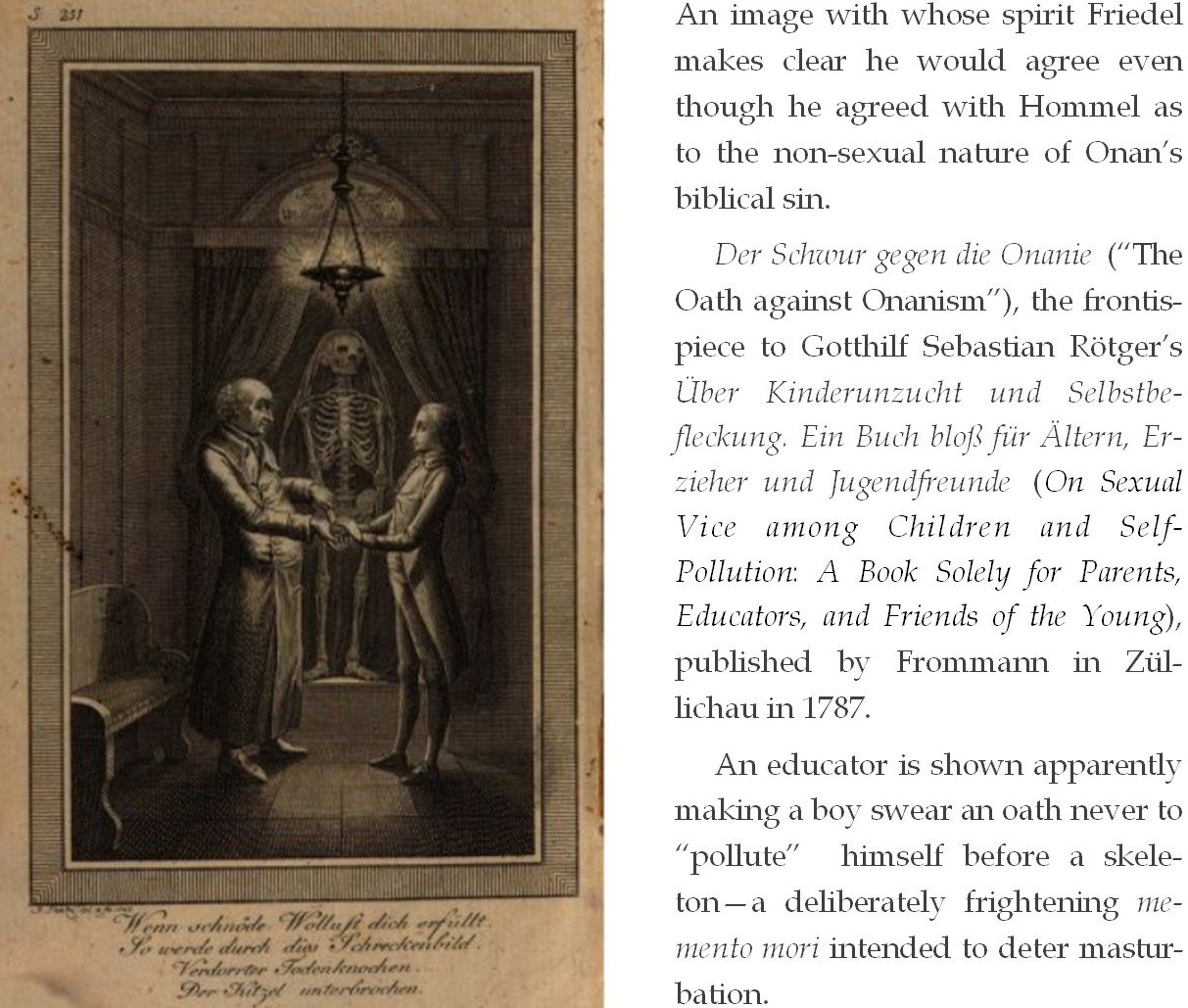
[3] “Self-pollution”, sometimes referred to as the sin of Onan (the name of a man killed by God for resorting to it in Genesis chapter 38), means masturbation, the subject of furious condemnation in 18th-century Europe (with interesting parallels to that of Greek love in the 21st). [Website note]
[4] Hommel’s sarcastic “Ergo!” is the punch-line to his demonstration through this example of how absurd traditional criminal-law reasoning could become when biblical terminology was treated as legal taxonomy. [Website note]
[5] The Fifteenth Letter. [Website note]
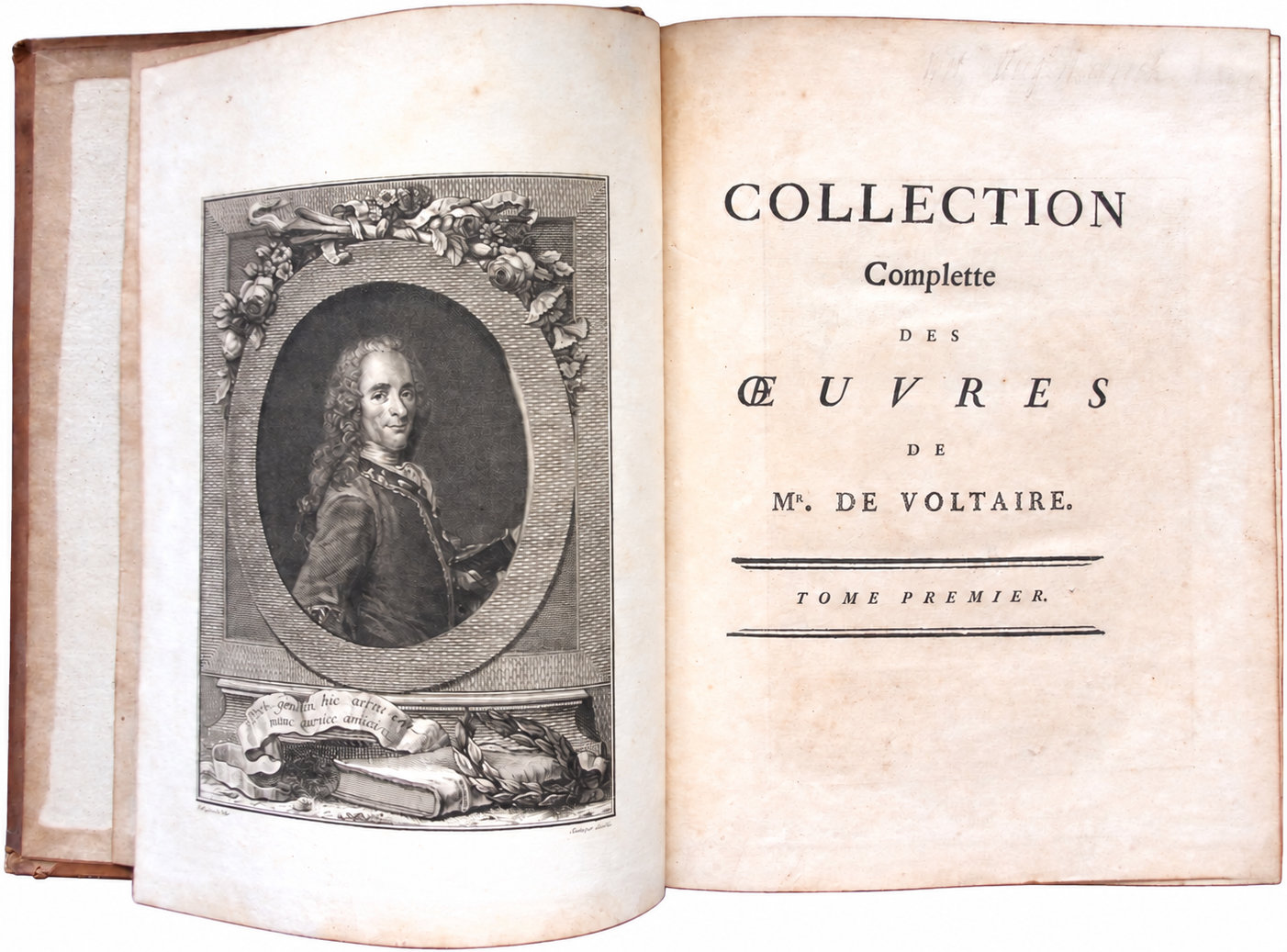
[6] Here Friedel begins to quote from Voltaire’s essay on “Socratic Love” in his Dictionnaire philosophique anonymously published in Geneva in June 1764. This continues down to “Alcibiades as a weakness.” Friedel then paraphrases Voltaire for the rest of the sentence in which that appears. His final supposedly quoted paragraph (mentioning Lais and Phryne) appears to be his own invention, as it is not in Voltaire’s essay. [Website note]
[7] This is a direct quotation by Voltaire of Ovid’s Metamorphoses X 84-5. Ovid was describing Orpheus’s introduction to the Thracians of the practise of loving boys. The quoted words mean, “and enjoying the springtime and first flower of their youth.” [Website note]
[8] This paragraph has been invented by Friedel or another, as it is not in Voltaire’s essay on “Socratic Love”. It may well, however, have been inspired by Voltaire’s mention of Phryne and Lais, in his preceding essay in the same Dictionnaire philosophique on “Love”. In any case, Friedel (or perhaps another he copied) is here expanding on Voltaire to make his own point that once a youth has reached maturity and has actually experienced women, the excuse of méprise de la nature (error of nature) disappears.
Phryne and Lais were two famous ancient Greek courtesans and thus emblematic desirable women. [Website note]
[9] Barbara and Celarent are traditional mnemonic names for forms of syllogism in Aristotelian logic. Friedel is thus mocking the idea that formal philosophical argument can reason someone out of a sexual inclination. [Website note]
[10] This is one of several 18th-century concerns Friedel raised against pederasty which Jeremy Bentham also addressed in his essay Offences Against One’s Self: Paederasty written around the same date (though not published until 1978). Bentham also quoted from Beccaria for his argument. [Website note]
[11] Stax and Parfax appear to be facetious invented names for hypothetical people, equivalent to talking of an invented Tomkins and Bumpkins in English. [Website note]
Comments powered by CComment