
THE MOVING PICTURE BOY ARCHIVE
THE BALLAD OF SALOMON PAVEY

Title: The Ballad of Salomon Pavey
Production type: TV Play
Year of transmission: 1977
Director: Richard Bramall
Country of Production: Britain
Genre: musical play, historical drama, ballad opera
Length: 53 minutes
Language: English
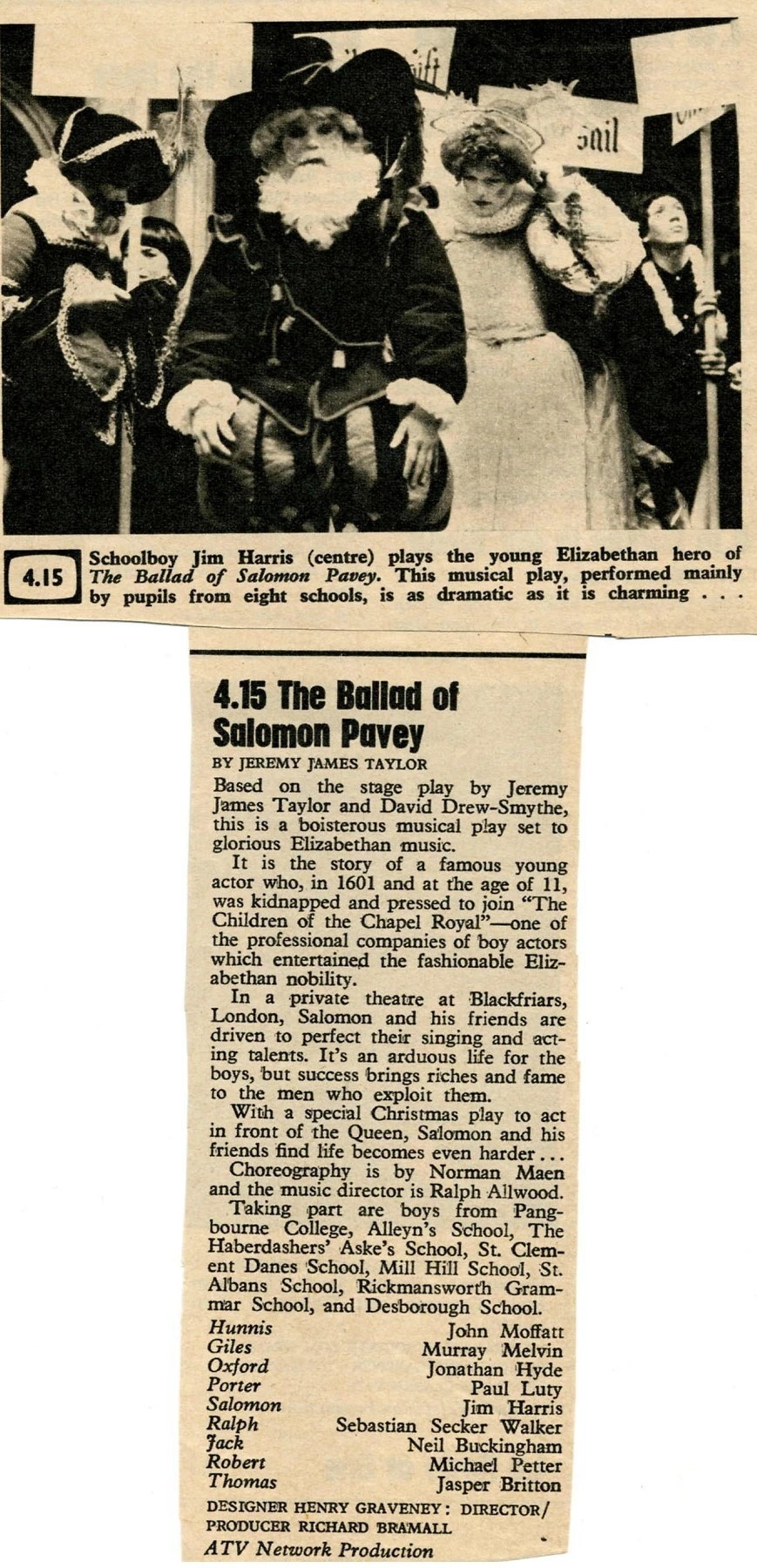
Principal boys: Jim Harris plays the title role. His only other screen credit was as Harris in the miniseries The Strange Affair of Adelaide Harris, two years later, in which he was excellent. Neil Buckingham plays Jack Fletcher, and Jasper Britton plays Thomas Rich. Michael Petter plays Robert, the boy who gets the woman's role in the piece the group are rehearsing near the start of this play, and Sebastian Secker Walker, whose voice has broken, plays Ralph. The boys in this production were actual choristers chosen from eight different schools.
Availability: No official release of this production has ever been issued. At time of writing, a poor quality video of the programme can be viewed on Vimeo here.
Synopsis
Salomon Pavey, the most outstanding and celebrated member of the Chapel Royal troupe of boy actors and singers, must rehearse, along with his peers, for a special performance before the Queen, to be performed together with the boys of the St. Paul's Singing School. The entire action of the play takes place in the theatre of the Children of the Chapel Royal at Blackfriars.
Source material
This production was written for television by Jeremy James Taylor, based on the stage play written by Jeremy James Taylor and David Drew-Smythe which was first performed at Belmont, The Mill Hill Junior School, in 1976.
Salomon Pavey was a real Elizabethan boy actor, who died at the age of 13, prompting Ben Jonson to write an epitaph to him which began:
Weepe with me all you that read
This little storie:
And know, for whom a teare you shed,
Death’s self is sorry.
Twas a child that so did thrive
In grace and feature,
As heaven and nature seem’d to strive
Which owned the creature.
Yeares he numbered scarce thirteene
When fates turn’d cruell,
Yet three fill’d Zodiackes had he beene
The stage’s jewell [...]
As the authors explain in their foreword to the published play:
"No one knows why Salomon died – possibly of the plague – but in this we have conjectured. We have also telescoped the events of some twenty-five years into a period of months. For the purposes of the piece, this seemed to us a reasonable liberty. The story is a fiction based on fact. Hunnis, Giles, Oxford, and Lyly did exist and involved themselves with the theatre at Blackfriars. There was a door-keeper at the theatre and, in 1582, the boys of The Chapel Royal and of St Paul’s did combine to perform jointly at Court. It is also certain that Salomon (some sources quote Salathiel) died in 1602 when he was only thirteen and already famed for his playing the parts of old men. [...] The music has been drawn from compositions of the period, and the range of the songs has been chosen with a boy’s very strong chest register in mind." (The Ballad of Salomon Pavey: An Elizabethan Ballad Opera based on the Children of the Chapel Royal, Jeremy James Taylor and David Drew-Smythe, Oxford University Press, 1979)
The Chapel Children, along with the St. Paul's Boys, were immensely popular in the last quarter century of the Elizabethan period, exciting the jealousies of the Common Players. Shakespeare even refers to them in Hamlet as "an aery of children, little eyases, that cry out on the top of question, and are most tyrannically clapped for't" (Act II, Scene 2).
Below: cuttings of article and listing in TV Times (24 December 1977 to 6 January 1978 edition)

________

Comments powered by CComment