
A REVIEW OF RESEDA BY ALFRED GRÜNEWALD
The manuscript of the novella Reseda by Austrian writer Alfred Grünewald was discovered long after the author's murder. Along with a selection of his stories, it was published as Reseda. Novelle und andere Prosa by Männerschwarm in Hamburg in 2013, and reviewed here. The reviewer, C. Caunter went on to translate the novel into English as Reseda: A Novella. This was published by Arcadian Dreams in London in 2025, and is the subject of the present review.
The Beautiful Boy as Destroyer: An Addition to the Canon
by Sam Hall, March 2026
The Beautiful Boy as Destroyer is an artistic subgenre defined in Camille Paglia's Sexual Personae and further popularised in Karl Andersson's boy-celebrating magazine Destroyer. Donatello's David heads up a visual canon stretching back to the genre's origins in ancient Greece, while literature is presided over by heavyweights such as Oscar Wilde's The Picture of Dorian Gray and Thomas Mann's Death in Venice. Mann's novella gave the trope important intellectual gravitas, linking modern boy-worship to Plato's Phaedrus. The beautiful boy offers the devotee inspired glimpses of divinity, which, for mere mortals, often turns out indistinguishable from ecstasy, insanity and death. If nothing else, it's catnip for artists.
Thanks to the investigative and translation work of C. Caunter, the genre now has a worthy new addition in the form of the novella Reseda. Alfred Grünewald (1884-1942), a German-speaking Austrian, wrote this highly entertaining 75-page story sometime in the early 1930s but it remained buried in an archive until 2013. With the Arcadian Dreams 2025 translation, Grünewald has achieved a long overdue introduction to English-speaking readers.
The first thing to strike a modern reader is the novella's very fresh, darkly comic edge. Our hero and diarist, Gustav Reseda, is a middling man with very modest life ambitions, but backed by a restive ego. At one level he gives us an office-worker satire that stands comparison with contemporary cringe-comedy classics like The Office. The character of Gustav Reseda, in fact, might have provided Ricky Gervais with the answer to his never quite successful post-Office search for a worthy comic project. Gervais could mine the grotesque in a grain of social sand and in this rich vien Reseda contains multitudes.
For this reviewer, the bulk of Alfred Grünewald's oeuvre remains untranslated and out of reach, so it added greatly to the reading experience to have, in this edition, a biographical essay and discussion of the novella. Caunter tells us that "In his life as in his work, Grünewald was open about his attraction to males of adolescent age and into early adulthood. Teenage boys crop up everywhere in his poems, plays and short prose." Of the boy-love poems we learn that "They often express an acceptance—an embrace, even—of melancholy solitude as part and parcel of loving an unattainable youth." For this man not to have contributed an entry to The Beautiful Boy as Destroyer category would have been criminal negligence.
One gets the impression Grünewald might have been attracted to Reseda as a deliberate escape from his melancholic devotional poetry. All that mystical boy-prompted sighing and suffering needs an occasional satirical drubbing to maintain one's psychic health. In the very first paragraph of Reseda's very first diary entry, the office accountant announces, "I am no friend of poetry." And "this kind of doggerel" gets several similar swipes along the way: "Kindly don't talk to me of poetry."
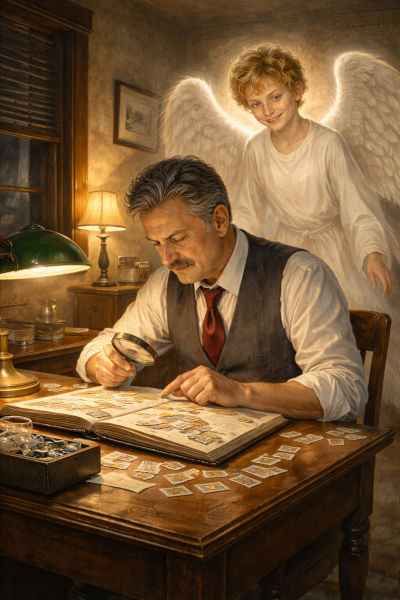
It leaves Grünewald with an enticingly dark and playful proposition: what if I didn't have poetry in which to express, contain, and understand my passion for boys? What if I was a middling bookkeeper and stamp-collector, well-wadded with received wisdom and safely ensconced in the small pond of convention? As Reseda tracks his inexorable path to madness and death, including some truly excruciating scenes, the writing never loses its zippy pace and comic bite. Sentimental pathos is for the clowns of mediocrity. Gustav Reseda's love of a beautiful boy might have been appallingly ignorant, horribly embarrassing, but it still leads him to a singular fate worthy of art.
* * *
An anonymous editor introduces Gustav Reseda's diary entries by telling us the grotesque conclusion. Reseda has "bitten through a young person's throat" and dies eight years later in "a state of utter derangement." Cue Reseda's introducing himself: "I am a middling person and in no way do I rise above the average. My achievements are satisfactory but they are unremarkable and, anyway, I receive a commensurate salary for them." We're obviously in for quite a trip from A to B! WTF, as the kids might say. But our first clue quickly arrives: "It so happens that I detest cross-eyed people to the core of my being." Despite some surface Kafkaesque echoes, fifty-year-old Reseda's peculiarly hard-beating heart—it frightens him at night—takes us far beyond any demure pretensions to existential despair.
While Reseda contains significant elements from both Wilde's Dorian Gray and Mann's Death in Venice, the novella involves a psychological exploration that is entirely original. Importantly, Reseda's journey to self-destruction begins well before the arrival of the beautiful boy. It seems to be triggered by the recent arrival at his workplace of Lazarus, "someone who's barely out of school." So we start not with love of a beautiful boy but revulsion of a cross-eyed youth who "gets under my skin more every day." Lazarus is in fact a cloying presence who dominates Reseda's every tortured attempt to negotiate the effect that Walter, the beautiful boy, will come to have on him.
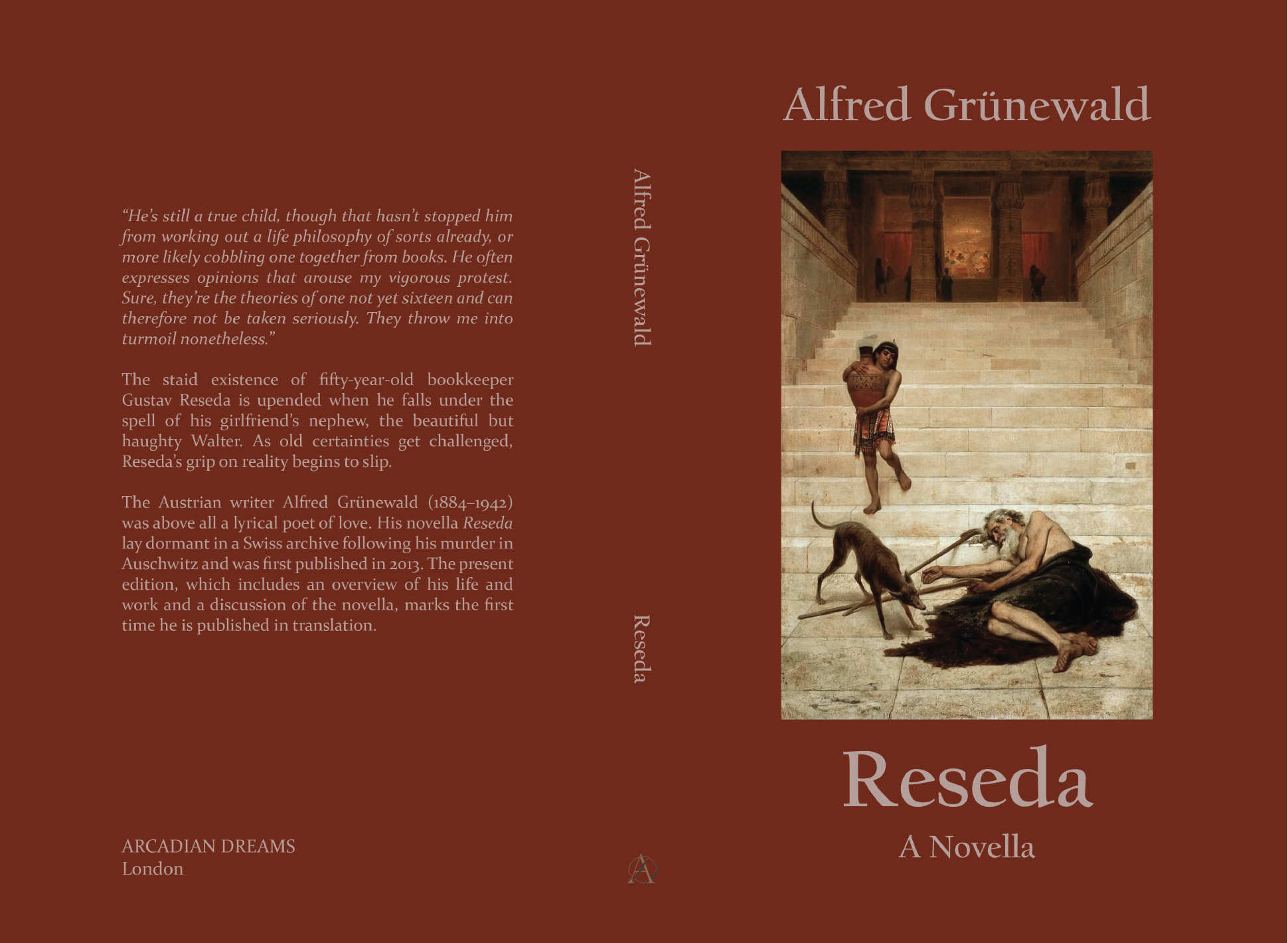
The Arcadian Dreams' cover design shows Andreyevich Bronnikov's 1886 oil painting, Parable of Lazarus, and it's a fitting choice. The biblical beggar from Luke 16, covered with sores, planting himself at the gates of a rich man, expresses well Reseda's disgust of him and Lazarus's pressing insinuation. Reseda recognises the young man's right to join the office—he isn't without talent—but finds him too personally repellent to abide. His inability to deal justly and humanely with Lazarus will see Reseda consigned to hell.

From the start, Lazarus represents a sexual problem besetting our diarist. As a character, Lazarus is never fully individuated, seems to exist primarily as an externalised aspect of Reseda. The only time Lazarus interacts with other office workers is when they're making jokes about his indistinguishability from Reseda. It seems clear that, initially, Lazarus disturbs Reseda as a spectre of masturbation. Everything about the youth has a disgusting masturbatory sensuality: "his squinting eyes", his "sweet mouth" always seeming to be sucking sugar, his constant cloying attempts at intimacy, his sneaky ability to get inside an exact copy of Reseda's clothing—parading in the office like an unseemly stain on the older man's respectability. During one conversation Lazarus deployed "a soft, prolonged chuckle" while "his arms and legs were in continuous flux." Reseda further reflected:
my feelings of unease about this person that I can rarely truly shake were at times noticeable. In his close presence – and he’s in the habit of sometimes suddenly coming right up to you, so you’re actually forced to back away – his squinting is still more appalling. I wonder whether an operation could remedy this.
But an operation on whom? The "squinting" is not eradicable since Reseda dreams he can see Lazarus squinting through his closed eyelids. A biblical authority might have advised Reseda to first attend to the squint in his own eye.
The relationship between Reseda and Lazarus is rooted in Reseda's boyhood. Reseda has hated cross-eyed squinters since he was eight or nine when he "spat a playmate in the face for no other reason than that he squinted horrendously." This foreshadows Reseda's biting out the throat of Lazarus, another squinter, forty-odd years later. Reseda's beloved pastime of stamp collecting, "started when still a boy," is the shared pursuit by which Lazarus quickly attaches himself to the older man. Something that represents pure innocent pleasure suddenly becomes compromised and sordid.
The first major scene between the two seals the deal. Lazarus produces his stamp album to show Reseda. Work has finished for the day so they can enjoy their shared boyhood passion in private. Reseda, despite himself, can't help but be drawn in by the fine collection. Lazarus tells Reseda he's welcome to take any stamps that appeal, in fact is very keen he should do so. Reseda demurs, tries to distance himself from the offer. Lazarus is "up in arms," rather urgently insisting he must take what he wants. Reseda yields to temptation and takes a few stamps. It's a hilariously overcharged scene, and after Reseda yields: "As if a clockwork mechanism had wound down inside him, Lazarus suddenly calmed down." Time for a cigarette, perhaps.
In the latter stages of the story the sexual element between the pair becomes explicit, but during the formative early stages Lazarus is pungent with a shameful interpretation of male adolescent sexuality. He's redolent of airless bedrooms and compulsive contortions and furtive gulps and grimaces. For a fifty-year-old man, aspiring to middling respectability, this is unacceptably revolting and needs to be eradicated. But sex, whether sordid or sublime, is the ultimate tar-baby and Reseda's struggles only drag him deeper into the mire.
Alongside this disturbing eruption of seedy adolescent sexuality, Reseda proudly tells us of his fifteen-year relationship with Maria, a good sensible woman of similar age:
they have been years of perfect harmony. We have nothing to regret. We've never allowed ourselves to be led by the opinions of zealous simpletons. We've created our own world order, and not one of fantasy and poetry. We tread on solid ground. We find histrionics repugnant.
Avoiding poetry is an important strategy in Reseda's maintaining a grip on the middling life. Elsewhere, he forbids Maria to "leave this world before me." But the more we learn of this relationship the more unconventional it seems. Maria is married to another man who has moved away but still provides for his wife financially, "pays her a pension." Maria's husband is "practically always absent." Practically? Reseda lives in his own apartment and his constant visits to Maria's house never seem to involve him staying overnight. Reseda talks of enjoying kisses and embraces with Maria, so it's surely a sexual relationship, and yet an ambiguous niggle remains. Reseda refers to Maria's "practically" absent husband as "noble" and seems quite happy to cede him the conventional manly role. There's a sizeable hint of "son" in our "lover".
Dreams loom large in this tale, one that has more than a little of the living nightmare about it. Reseda's first reported dream involves his mother, which is significant in itself. He knows she's dead but can't let her know that. Reseda is aware of the need to leave his mother, attend an appointment in the outside world, but he's afraid. He has "the notion that a hideous-looking person could come out of the lavatory." One has to suspect the toilet-monster has a squint. His mother sits down at a table to play solitaire with a deck of cards and Reseda, our flimsy joker, realises he cannot ever leave. The dream upsets him greatly the next day, contributing to the unseating of his state of mind.
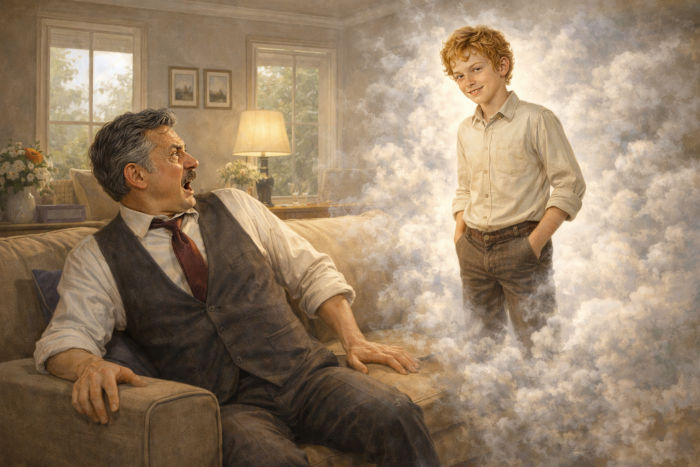
All this gives an inevitability to the much heralded arrival of Walter. The agitating intrusion of Lazarus, working within the safe shell of Maria's home, produces the pearl of a beautiful boy. Reseda's recording of his first meeting with the "rather lanky" Walter is superbly succinct: "His face—I've forgotten it." Soon after this, discussing Walter's arrival with Maria, Reseda corrects her on the boy's eye colour. Reseda aspires to be a clever and unreliable narrator but only ever succeeds in setting up his own pratfalls. This layered delivery of information is masterfully handled by Grünewald, and it's key to the novella's irresistible humour. The very next sentence after the forgetting of Walter's face, Reseda lets slip the truth: "I also have this notion that during our brief, hurried greeting the room was full of smoke." The appearance of the boy is indeed a startling magician's trick. For what immortal hand or eye would dare frame such fearful symmetry? But in order to enjoy a magic show one must allow oneself to be mystified, go with the dazzling flow. Nothing worse than the insecure cynic who must debunk and pooh-pooh. Unfortunately for the Lazarus-spooked Reseda, his life depends on such an approach.
Reseda's initial reaction to Walter's presence is one of fear. Not only is the boy beautiful but he has a lively and provocative personality. We are not in Venice where boys float on high as objets d'art. To admire Walter he must be engaged, he demands it. Their first conversation occurs when Walter walks into the room where Reseda is sitting, and Reseda "got up, though there was no need to." Every tug the boy exerts on the man is met by an equal and opposite frisson of resentment. Reseda describes Walter's greeting as being delivered "a bit mockingly." The boy's fifteen and in a strange new environment after the recent death of his mother. Reseda is not remotely acting his fifty years of age. He likely senses this and it only angers him more. He says he feels "something like hate well up" at Walter's showy adolescent views on life. Walter declares most of his new schoolmates "are middling to rubbish," and he happens "to find it boring always to be the same person," and while we're at it, "Thrift is an unhealthy vice." Perfectly normal, healthy adolescent views which ought to be charming and engaging. There's no better age than fifteen for discussing the meaning of life, the gaudier the better, and Reseda's supercilious derision pushes the reader's sympathy to the limit.

Sadly, the fact is that Walter is out of Reseda's league. Walter proves himself to be very capable and personable, quickly creating a busy social life. Reseda's growing infatuation flounders in the boy's wake, and although his initial tetchiness deepens and complicates it is always the essential, unchanging impediment. He remains stuck, hopelessly conflicted by the opposing poles of Walter and Lazarus, the divine beauty of Tadzio and the sinful ugliness of Dorian Gray's portrait. Walter and Lazarus operate like Plato's good and bad horse and eventually tear Reseda's reason in two.
The pivotal midpoint scene bears the tale's most sublime tragi-comic fruit. Practical Maria, who dotes on her nephew, has grown tired of Reseda's antics and strongarms him into inviting the boy to his place for dinner. Clearly, both she and Walter are aware of Reseda's fractious interest in the boy, so Maria gives her son-lover a shove out the door into the wider world. Walter, obviously intrigued by Reseda's peculiar attentions, is reported to be "eager" for such a date.
Interposed between the settling of the dinner date and its occurrence is a short scene describing the death of Schmittlein, a co-worker at the office. Schmittlein is a version of Reseda, a similarly aged middling man, but one who has successfully married and had a child. Upon this man's death, we're told that Lazarus was "crying his eyes out" and at the funeral was "so crushed, seized up with sobbing time and again." Why is this so, when Lazarus is still a relatively new employee? My reading: Lazarus represents the uncomfortable stirring of Reseda's repressed sexuality, specifically its homoerotic aspect. He represents both Reseda's boyhood sexuality, repressed under the aegis of his solitaire-playing mother, and also Reseda's stunted manly capacity for attraction to boys, now fiercely if unconsciously stimulated by Walter. The classical model of male sexuality involves a young man's pursuing sexual love with boys before going on to marry a woman and start a family. Reseda has failed to achieve a mature sexual union with a woman and he's unable to accept or recognise his sexual attraction to a beautiful boy. Lazarus as personified sex-instinct is mourning the symbolic death of Reseda's last chance to resurrect a path to rude health, to life. "Crushed, seized up" will instead be Reseda's epitaph. And that's exactly how the dinner date plays out.
Everything changes when Walter arrives at Reseda's apartment. We start with the usual banter between imperious boy and annoyed man, but Reseda makes an unusual misstep. He starts lamenting his ageing state: "I have thinning hair. Have a look at my features: you won't fail to notice a measure of devastation. My complexion—" But Walter brusquely tells him to quit it. From there the boy enters a more dreamy and conciliatory mood, and the banter turns decidedly good-humoured, flirtatious even. Compliments come from Walter—"Everything is beautiful here"—and Reseda observes the boy's "bewitching expression" and enjoys his jokes. Reseda's apartment is a male-only space—Maria seems never to go there—and relations between man and boy relax, become playful.
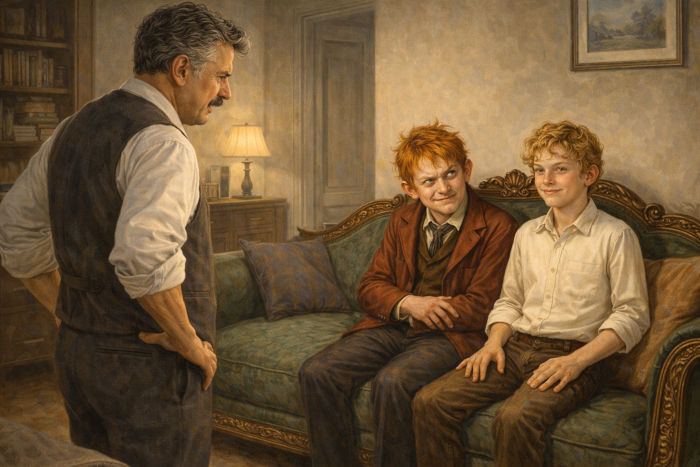
Walter takes an interest in Reseda's decorative divan, mocking but intrigued. He declares "anyone who sits on it is instantly some fifty years older." And he wants to lie down on it, because a boy will become a man. Walter stretches out on the divan "with a dreamy look on his face." He announces that "One lies here as in Abraham's bosom." This invocation of Lazarus is to have disastrous consequences. As Walter closes his eyes, Reseda moves closer, bends over him to study "a strange being"; he wants to "observe him better; perhaps also to shake this off." Can the opposing poles of Lazarus and Walter successfully fuse here on the mystical divan?
Walter dreamily leads the two into a fantasy involving a lord of the manor and a servant dwarf named Largolasso. He's first confused who is lord, but decides he is and Reseda is the dwarf. Reseda eagerly goes along, sings his lord a song... But the fantasy doesn't work for Walter and he soon breaks it off. Getting up from the divan he's drained, pale, and wants to go home. Reseda, in his sexual approach to Walter, needed to master Lazarus and direct his sexual energy in a mature manner. Instead, he became Lazarus, a stunted adolescent trying to ingratiate and insinuate his way into the boy's personal space. The scene is curiously vampiric—Lazarus, called up from the dead, takes control of the encounter; the boy then rises from the divan in a pale, depleted state. It's a bust.
Straight after this Lazarus at work undergoes "a sudden change" and "quite contrary to his usual behaviour," avoids Reseda. Reseda having briefly become Lazarus has weakened the avatar's projected presence, but it's not long before he comes storming back with a vengeance. Reseda's obsessive musings on Lazarus become increasingly fevered: "deep down I hate and despise him, this squinting goblin with his sugar mouth, his bird sounds and his grimaces."
Does Grünewald believe a healthy man-boy sexual relationship is desirable or even possible? From Caunter's biographical essay, this seems a moot point. Grünewald had close relationships with adolescent boys and young men, but we don't know their full nature. On the basis of this novella, the jury remains out, although the ruinous effects of sexual repression and its concomitant ignorance are certainly things to be despised. The history of boy-love is replete with the chaste ideal, particularly in Arabic Islam, and it can be pursued maturely and meaningfully. Ignorance, rather than sex, is the real villain of Reseda.
Similarities with Death in Venice become more overt in the tale's second half. Reseda writes a letter to Maria informing her Walter must be sent away before he destroys everything they have. This mirrors Aschenbach's attempt to flee Venice and his fixation on Tadzio. In both cases this last feeble cry of reason and self-preservation is rejected. Aschenbach panics and returns. Reseda puts his letter away and never sends it. Soon, Reseda is obsessively following Walter around town and conducting imaginary conversations with him that are very Aschenbachian, although with an extra comic tweak.
But Grünewald's preference for the grotesque gives us some fine scenes that would give Thomas Mann the vapours. With shades of Poprishchin in Gogol's Diary of a Madman, Reseda starts receiving communications from objects associated with his beloved. But going one better than overhearing a couple of gossiping dogs, Reseda hears "the decorative divan raise its silken voice." The Freudian monster is off the leash! Reseda has been closely studying this divan since his near mystical union with the reclining Walter, and now the divan, "a master in feigning harmlessness, is starting to declare itself." It demands a sacrifice, "no other way to appease wrathful fate." Reseda smashes three nearby vases. Cries of pain or ecstasy ring out as Walter appears in the middle of the room, naked and laughing. This is the madman's inspired moment of creation through self-mutilation. Not a creation that communicates anything to anyone—he's no poet—but still an insanely successful repeat of the magic trick when the boy first appeared in a puff of smoke. Maybe they could start over? Ha! Well might Walter laugh. The Beautiful Boy as Destroyer is crueller than any god. Further sacrifices, up to and including the ultimate, are a given.
As we advance, Reseda's stunted adolescent approach to Walter becomes more explicit. He sneaks into the boy's room to spy on his personal possessions. He's closely inspecting a shoe when Walter walks in. The boy is angry: "At your age one should not be doing such things." Reseda tries to make a joke about dwarves deserving some licence. Cringe! Reseda has never properly emerged from the divan fantasy. But he has wit enough left to reflect, "I knew that he hated me now," and the scene ends with, "I stood in emptiness." But madness isn't so easily defeated and Reseda makes another sortie into Walter's room, this time successfully stealing one of the boy's handkerchiefs. It's directly after the capture of this symbolic item that Lazarus makes direct sexual contact with Reseda.
It's possible Reseda is wearing Walter's handkerchief when Lazarus seduces him in the cloakroom at work. After this seduction scene Reseda dreams "I was wearing [the handkerchief] on my bare body," and we've already reached the stage where the boundary between dreaming and waking is decidedly porous. Either way, Othello's famous symbol of the green-eyed monster gains a sordid new lease on life.
The seduction begins in the office when, with supressed giggles, Reseda "unintentionally" sprays Lazarus's face with ink droplets. "Lazarus covered with moles!" Reseda laughs inwardly, now mocking the beggar at his gates. The beggar's sores have been sexualised. The following seduction at the washbasin is so much part of Reseda's withdrawal into insulated phantasmagoria, and Lazarus's approach involves such strange spasmodic bodily contortions, it remains an unseemly masturbatory enterprise. Reseda's dwarfish failure with Walter on the divan is brought squalidly into the light of day. It only operates as more fuel on the insanity bonfire. Mental patients masturbating in the day room are not on a road to anywhere useful.

From here we move to the climactic final supper and it's suitably gruesome. Reseda has a surprise in store—he shaves off his moustache! Early on, in days of sunshine and sanity, Walter had cheekily said the conservative fuddy-duddy should shave it off, so, like Aschenbach on a roll, Reseda beautifies himself for his beloved. Upon seeing it, Maria is beyond appalled; Walter mumbles a compliment but turns away. In fact, over the course of the evening, what little filters through from our mad diarist's report shows Walter avoiding Reseda as much as possible. There doesn't appear to be hostility on Walter's part, only confusion and embarrassment for a man he cannot understand.
Reseda is to be spared nothing at this excruciating supper, the novella's longest scene, and Walter has brought an older friend, Baron Krümel. "Intimate friends, one learns." Reseda thinks Krümel's face looks like a death-skull, but its Reseda's own death now staring balefully at him. Krümel confers closely with Walter and Reseda soon sees that a lot of Walter's expressions come from this young man: "the Baron addresses his friend in an almost fatherly tone, which the latter doesn't seem to mind in the least." Plainly and simply, Reseda is presented with a close mentoring friendship that would have been his heart's desire—if he'd understood his own heart.
Krümel grills Reseda, rather aggressively trying to score points. It becomes apparent Walter must have spoken often about Reseda, and Krümel is seeing off a potential threat or competitor. Another dagger, anyone? They are in fact plentiful. Krümel raises Reseda's stamp collecting: "It's no pastime for people your age." Behind Reseda's back, Walter laughs—was it at something Maria said or at Krümel's comment? Walter had made the same age remark about Reseda sneaking into his room. Was this an in-joke between Walter and Krümel? Fortunately, Reseda's grip on reality isn't strong enough to pursue such lines of reasoning very far.
Sinking, but bravely battling on, Reseda tries asking Walter questions and gets only mumbling non-answers. Reseda regularly slips into dangerously intense introspection, from which Maria tries to rescue him. During one tortured reverie, Reseda watches the boy "on the far shore of the table, a thousand miles away." He fantasises growing arms a thousand miles long and bending "forward to touch him. His hair perhaps." Reseda mouths the song he sang to Walter on the divan—and it's the one moment when Walter looks directly at him. Reseda's response is to flinch. The exact same dynamic that has existed from the first moment they met. It's been a gruelling journey to get precisely nowhere.
We reach the supper's longed-for end when Reseda drops a teaspoon which lands beside Walter's foot. Bending down to pick it up, he finds Krümel also bending below the table to put an arm protectively around Walter's leg, "as though to protect it, secure the spoils." This action below the waist exposes Reseda's secret Lazarus-nature and he concludes, "my disgrace was beyond redemption." To finish him off, Walter and Krümel, "a short time later...went into Walter's room." Krümel doesn't sneak in to the holy of holies like a sex pest, he is invited in. Reseda has been publicly unmanned in the most humiliating way, and he leaves Maria's place for the last time.
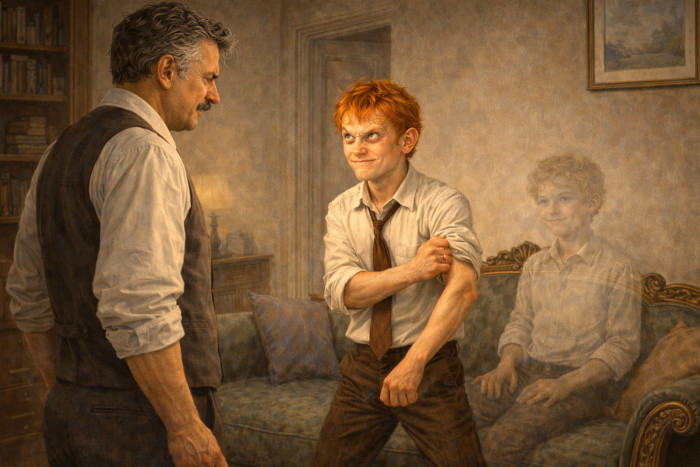
Upon arriving home, Lazarus is of course waiting for him. The mood is different. Lazarus is now familiar and coolly directs proceedings. He taunts Reseda with the fact he knows everything about him and his obsession with Walter. In other words, he confronts Reseda with the fact that Lazarus is Reseda, or at least his guardian homunculus. The arrival of Walter has turned Lazarus into a monster who can no longer be controlled. One of the youth's cuff links comes undone. Reseda asks him to leave. Lazarus says Reseda is lying: "you want something quite different." The now dominant Lazarus laughs, rolls up his sleeve, and moves toward Reseda.
Reseda doesn't say what happened after this. He only records his thoughts: "I hate him like I hate no one else in the world," and after praying for forgiveness for any ill will toward other people's foibles, he writes,
This one, however, is my scourge. From day one he has singled me out as his victim. He won't let go of me. He's always there.
I can no longer picture Walter's face.
Lazarus wins. Sordidness devours beauty like Asiatic cholera does Aschenbach. I don't believe Lazarus left Reseda's apartment that night. After the horror of the supper, Reseda was defeated and Lazarus, the self-generated parasitical demon, took possession of him. Lazarus foreshadowed this ability when, through trickery and harassment, he got inside an exact replica of Reseda's clothes. A co-worker's jokes that he couldn't tell Reseda and Lazarus apart was funny because true.
After Walter's beauty has been erased, six brief sentences is all we get to conclude the story, and the last two of those are by the anonymous editor. It's not explicitly stated who had his throat bitten out by Reseda, which is crucial. We learn that Lazarus is expected "in an hour," and that Reseda made sure "everything has been seen to." He has put out plenty of sweets—apparently this will attract Lazarus and his "sweet mouth." The last sentence of Reseda's diary is, "How does Maria put it?—'After all, we need something sweet in the house.'" Which provides a final plaintive link to Walter—they boy's sweet face can no longer be pictured and that is untenable, that is the end.
The murder is left entirely to the reader's imagination, so I think we need to consider the novella's basic structure. It is a fusion of the two primary Beautiful Boy as Destroyer works, The Picture of Dorian Gray and Death in Venice. Walter is Tadzio brought down to the quotidian and Lazarus is Reseda's secret demonic self-portrait. In Dorian Gray, the hero's sin-soaked soul is diverted onto the portrait. In Reseda's case—more prosaic, without poetry—the unacceptable homoerotic component of his sexuality is cast onto his projected avatar. Walter's arrival infused Lazarus with tremendous energy: Reseda's bound and suppressed homo-function, a furtive masturbatory thing, now tormented a man unable to maturely express an attraction to a beautiful boy. This may be a comment on modern society where the manly pederasty of old has been reduced, through centuries of suppression, to sordid tales of molestation. In the nineties, for example, Michael "Whacko Jacko" Jackson became our collective Lazarus. It's instructive that Reseda's cruelling of his homo-function also impaired his ability to form a mature relationship with the woman he genuinely loved. A man with one withered leg doesn't walk normally with the other.
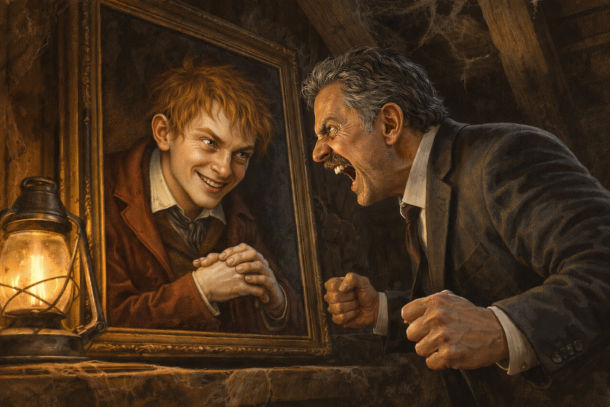
In the final hinted-at scene, Reseda's placement of sweets and his comment that "everything has been seen to" suggest he was set up to perform some sort of ritual. In a previous time of high stress, he performed an inspired sacrifice of three vases to successfully make a gloriously nude Walter appear. Now he does the same for the reprehensible Lazarus. It's a self-exorcism. When the demon duly appears, Reseda unleashes all his life's repressed energy to launch a savagely murderous "love bite" at Lazarus's throat. A fitting way to avenge his Lazarus-spooked failure on the divan. But, as in Dorian Gray's attic, the original's attack on the monstrous creation suffers a magical reverse. When the smoke clears, I say it is Reseda who lies dead on the floor. He is a "young man" because Lazarus's youth was transferred to him, in the same way Dorian Gray's portrait transferred his hideous old age to the original. Adolescent homoerotic sexuality, repressed for thirty-five years, was the quality Reseda had projected onto his demonic creation—and he received it back at the moment of death. Death gave him back the youth he'd rejected as a boy and as a man. The thing that lingered in the asylum for eight years before dying was the parasite Lazarus, now a dead-ringer for the older man. Severed from his host, the malignant parasite quickly declined into "a state of utter derangement" before dying.
So, unlike Dorian Gray, Reseda won a final victory of sorts. Theodore Faithful says, "Dreams of self-destruction, and probably many cases of suicide, are desires or attempts on the part of narcissistic individuals to give themselves a new birth by sexually attacking themselves and thus bringing about self fertilization."[1] And Reseda, in death, was successful. Received into the bosom of Abraham, youth restored, he was looking pretty sweet, while the lordly demon of damage was left to rot in the corner of a hellish asylum. There was, though, probably a better, more suitably prosaic, way to achieve such bliss.
Reseda's journey was one of self-mutilation through stasis. For the poet, such self-mutilation can be a motherlode; for the hapless middling accountant, it's a spectacle too awful and blackly comic to look away from. Fortunately, Alfred Grünewald was on hand to perform an artistic rescue with this fine addition to the genre of The Beautiful Boy as Destroyer.
[1] Quoted in Camille Paglia's Sexual Personae, Yale University Press, New Haven, 1990, p. 248-9
Comments powered by CComment