THE BOOK OF BEAUTIFUL BOYS
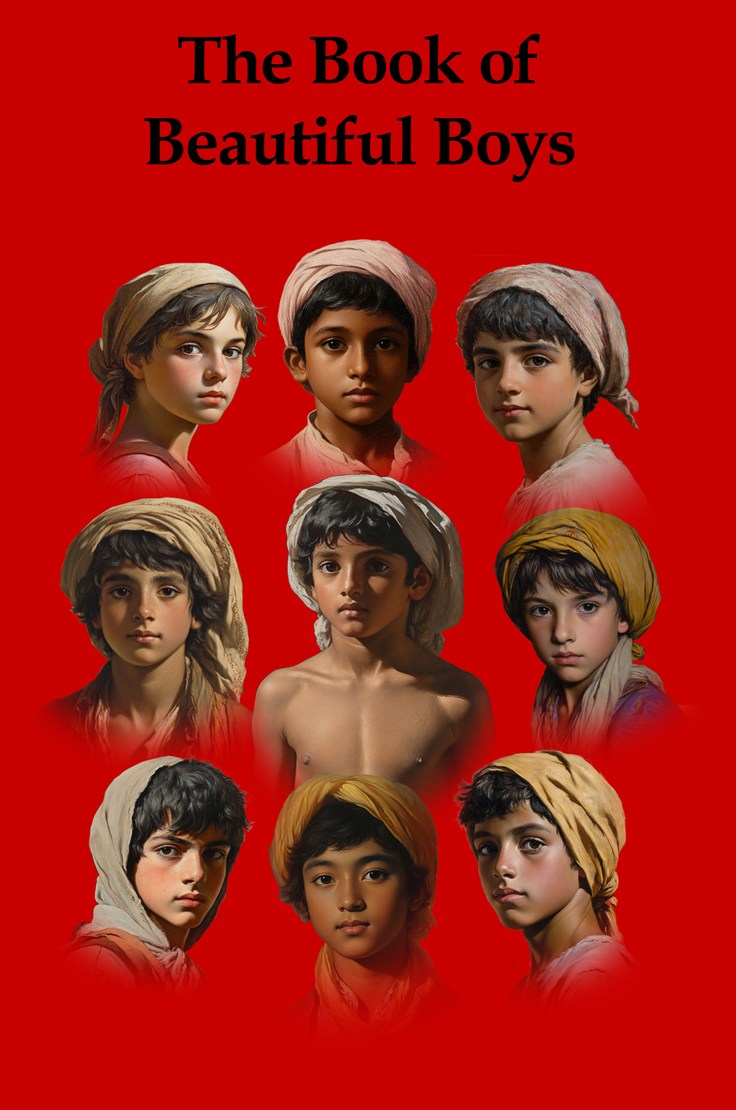
Enderunlu Fazil Bey was an Ottoman courtier of Palestinian birth who had been selected as a beautiful teenager for education in the Sultan’s seraglio in Constantinople. He became an innovative poet of love not satisfied with stale conventional imitation of Persian precedents. Typically of a cultured man of his age and adopted land, he expressed erotic interest in both women and boys, but showed a more serious interest in the latter as a worthier subject. In his long poem The Book of Beautiful Boys, written in 1792/3, he answers from rich experience a beloved boy’s question as to which nations have the most beautiful boys.
A little over a century later, an anonymous Frenchman commissioned someone jokingly called the Pasha with Three Tails, allegedly at least a sophisticated and cosmopolitan Turk familiar with Fazil’s work and sharing his taste, to adapt his poem to French ideas of the time as to what was scintillatingly and exotically erotic. The resulting Livre des Beaux, published in 1909 in a Paris that was then Europe’s centre for the production of semi-illicit erotica, and now at last translated into English over another century later, is thus a charming blend of the erotic spirit of two lost ages.
With its unabashed and often unflattering appraisal of the varying attributes of boys of different nationalities, this is definitely not a book for the politically correct, but offers fascinating entertainment for those not thus afflicted.
The paperback version of The Book of Beautiful Boys can be bought from amazon.co.uk for £7.99, from amazon.com for $16.49, and from every other Amazon branch for a roughly equivalent sum. The Kindle version can be bought from amazon.co.uk for £5.99, from amazon.com for $7.99, and from every other Amazon branch for a roughly equivalent sum.
Excerpt
Presented here is Chapter X (of forty-three chapters), which should give an idea of the book's style and content.
THE BEAUTY FROM BAGHDAD
The boy from Baghdad is the Khan of affectation and love-bites.
His cheek surpasses the fresh rose, and his lips new wine. His curls are of hyacinth and his eyebrows of black ermine.
He knows by heart the divine Thousand Nights and One Night, which the Turks have the stupidity to scorn[1].
Alas! Where are the Abbasids and my exhilarating precursor Abu Nuwas[2]? In their time, Baghdad was a true paradise for poets, jewellers, youths and lovers. Now, it’s only a heap of ruins.
But choice adolescents blossom amongst those ruins, and mine, for example, a carpet merchant in the bazaar, having the art of putting things off until the next day, gains more money with his idle bum than the flour produced by an ever-turning mill.
We got to know one another in a very narrow alley: there was, in front of our bedroom, an old windowless wall with peeling plaster; and as we were having a siesta, we seemed to see figures drawn in the protruding stone: there, “the beautiful Zumurrud,” and there, “the young jaundiced man,” and there “the sympathetic adulterer”, and “Princess Nur al-Nihar”; and our reverie followed in their nocturnal wanderings across the capital the Caliph Al-Rashid (the wild one), his grand vizier, Jafar (worried for his head) and the eunuch Masrur with the white rolling eyes.
[1] This reprimand is an interpolation of the Pasha with Three Tails. Fazil Bey shared his nation’s popular prejudice against the wonderful Arabo-Persian tales. [1909]
[2] The wittiest of Arab poets. He lived at the court of the Caliph Harun al-Rashid. Cf. Diwan des Abu Nuwâs. Aus dem Arabischen von A. v. Kremer (I vol., Wien, Braumüller, 1855); Kremer, Kulturgeschichte des Orients unter den Chalifen, II, 369 ff; Noldeke, Orient und Occident, I, 367-375; Brockelmann, Geschichte der arabischen Litteratur (2 vol., Weimar, 1898-1902). [1909]
Every person named in this chapter features in The Thousand Nights and One Night. Harun al-Rashid, Caliph 786-809, his vizier Jafar and his boon companion, the poet Abu Nuwas, were also historical characters. [2024]