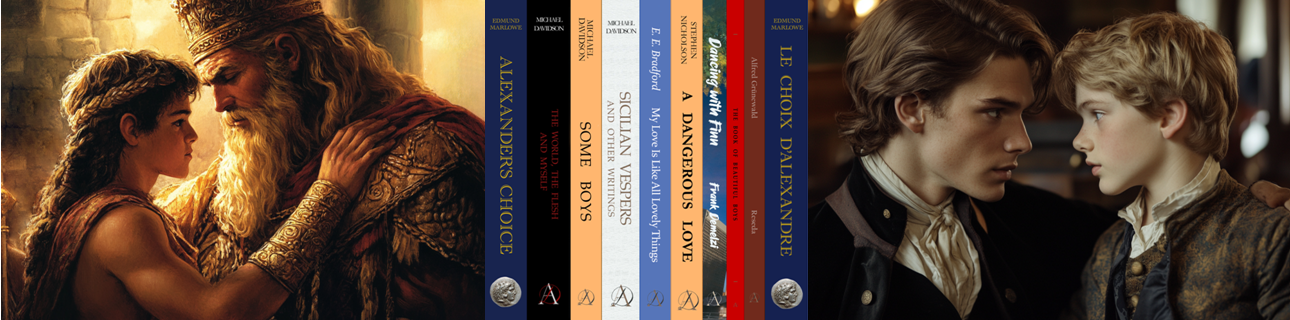
EDMUND MARLOWE
by himself
Edmund Marlowe was brought up in Buckinghamshire and educated between the ages of thirteen and eighteen at Eton, the well-known English public school, which he made the setting of his only book so far, Alexander’s Choice. He had a troubled adolescence there, marred by family tragedy and romantic agonies. As a result, he deeply disappointed himself by not excelling or taking better advantage of the fantastic opportunities offered by Eton, which, in most respects, he loved.
Passionately interested in history from the age of seven and always regretting he hadn’t been born in a much earlier era, he studied it at university, where he at last flourished academically. Soon afterwards, he fell in love with a girl and married her, thus finding happiness after a decade with little. After several years working in London, they settled in the French countryside to bring up their children, and they have lived there ever since.
Edmund told the story of how he came to write Alexander’s Choice and then began to get involved in other Greek love literary projects in an introductory note to Stephen Nicholson’s memoir, A Dangerous Love:
One sleepless night when I was in my forties, I lay awake remembering my days as a schoolboy at Eton, some happy memories and some terrible regrets, all of them involving powerful emotions that had shaped my life in the special way that perhaps only adolescent experience can. I thought of all that had happened and all that might have happened, and suddenly I realised, “I can write a book about this!” Like millions of others, I had always thought of that as a fine thing to do without believing I could. Now, however, I knew I could. By dawn, the title, Alexander’s Choice, and the outline of the plot had all come to me, and, bursting with enthusiasm to get on with it, I ran downstairs to begin.
What I wrote, and finally published in 2012, was the love story, ending in tragedy, of a boy of thirteen to fourteen and a young English master at Eton. I poured my soul into it, sometimes weeping as I recalled the memories that lay behind what I was writing. Evidently, with at least some very interesting people, it struck a deep chord, as it led to a multitude of correspondences, some of which have continued to this day.
These correspondents were of various types and the reasons my novel resonated with them varied accordingly. There was, for example, a particularly sympathetic and likeable woman my age who had been the daughter of a housemaster at a boys’ boarding school and wrote a fine memoir she sadly never published, recounting how her own love affair with a boy at the school had ended with him being expelled for it. But most of my new correspondents were boy-lovers, who all believed their feelings were badly misunderstood by society, which, grossly unfair and often cruel, shied away from trying seriously to learn the truth. They felt I had spoken up for that truth in Alexander’s Choice, and I, proud of this, struck up some serious friendships with a few whom I found particularly interesting and agreeable. The result was that I soon knew far more about boy-love than I had when I wrote my novel.
One of those he got to know was Colin Spencer, Michael Davidson’s close friend and literary executor who, aged eighty-five and in poor health, was anxious about what to do with Davidson’s unpublished writings. With his increased understanding of Greek love and its history, Edmund was now fascinated in its literature. He and Colin agreed that Edmund would not only edit Davidson’s unpublished manuscript, Sicilian Vespers, and his correspondence, but also find a publisher for this and his two old books (which had long been out-of-print despite having gone through several editions in freer days).